How to Properly Close Your BIR Registration in the Philippines: What RMC 47-2026 Changes for Business Owners
Published Date: May 27, 2026
Published By: Jac Cantos, Upcloud Accounting
If you have stopped business operations but never formally closed your BIR registration, you are still legally liable, for every unfiled return, every unpaid tax, and every penalty that has been accumulating since the day you stopped. The BIR does not automatically close your registration just because your business is no longer active.
The good news: Revenue Memorandum Circular (RMC) No. 47-2026, issued on May 19, 2026, has completely overhauled the rules for cancelling a BIR business registration. The process is now simpler, requirements are standardized nationwide, and processing timelines are significantly faster, especially for micro and small taxpayers.
This guide covers everything you need to know about closing your BIR registration under the new rules.
What is BIR Registration Cancellation, and Why Does It Matter?
BIR registration cancellation is the formal process of deregistering your business with the Bureau of Internal Revenue upon permanent cessation of operations. It is governed by Section 236(F) of the National Internal Revenue Code (NIRC), as amended, and is now further streamlined under RMC No. 47-2026, issued pursuant to the Ease of Paying Taxes (EOPT) Act (Republic Act No. 11976).
A critical rule that many business owners overlook:
Ceasing operations is NOT the same as closing your BIR registration.
If you stop operating without filing for cancellation, your registration remains active. This means the BIR will continue to expect your monthly, quarterly, and annual filings, and penalize you for every return you fail to file. Many businesses that closed years ago have discovered massive accumulated liabilities precisely because they skipped this step.
Who Does RMC 47-2026 Apply To?
The circular applies to all business taxpayers registered with the BIR who have permanently ceased operations, regardless of size or business structure. This includes:
Sole proprietors and self-employed individuals
Corporations, partnerships, and joint ventures
Cooperatives, estates, trusts, and government entities
Whether you are a micro-retailer, a freelancer, or a large corporate subsidiary, if your BIR registration is still active but your business is no longer operating, these new rules apply to you.
What Changed Under RMC 47-2026?
1. Standardized Requirements Across All RDOs
One of the most significant problems with the old process was inconsistency. Requirements and procedures often varied depending on which Revenue District Office (RDO) processed your application, creating confusion and delays.
RMC 47-2026 fixes this. Documentary requirements are now mandatory and uniform across all RDOs nationwide.
2. Faster Processing Timelines
The circular introduces clear, enforceable processing timelines — including a 3-business-day fast-track for micro taxpayers with no outstanding liabilities or pending investigations.
3. No More Automatic Audits for Micro Taxpayers
Previously, closing a business often triggered a mandatory audit regardless of the taxpayer's size or compliance record. Under RMC 47-2026, micro taxpayers are no longer subject to mandatory audit simply for filing a closure application. For larger taxpayers, an audit is only triggered if there is an existing open investigation or pending Letter of Authority (LOA) at the time of application.
Required Documents: What You Need to Prepare
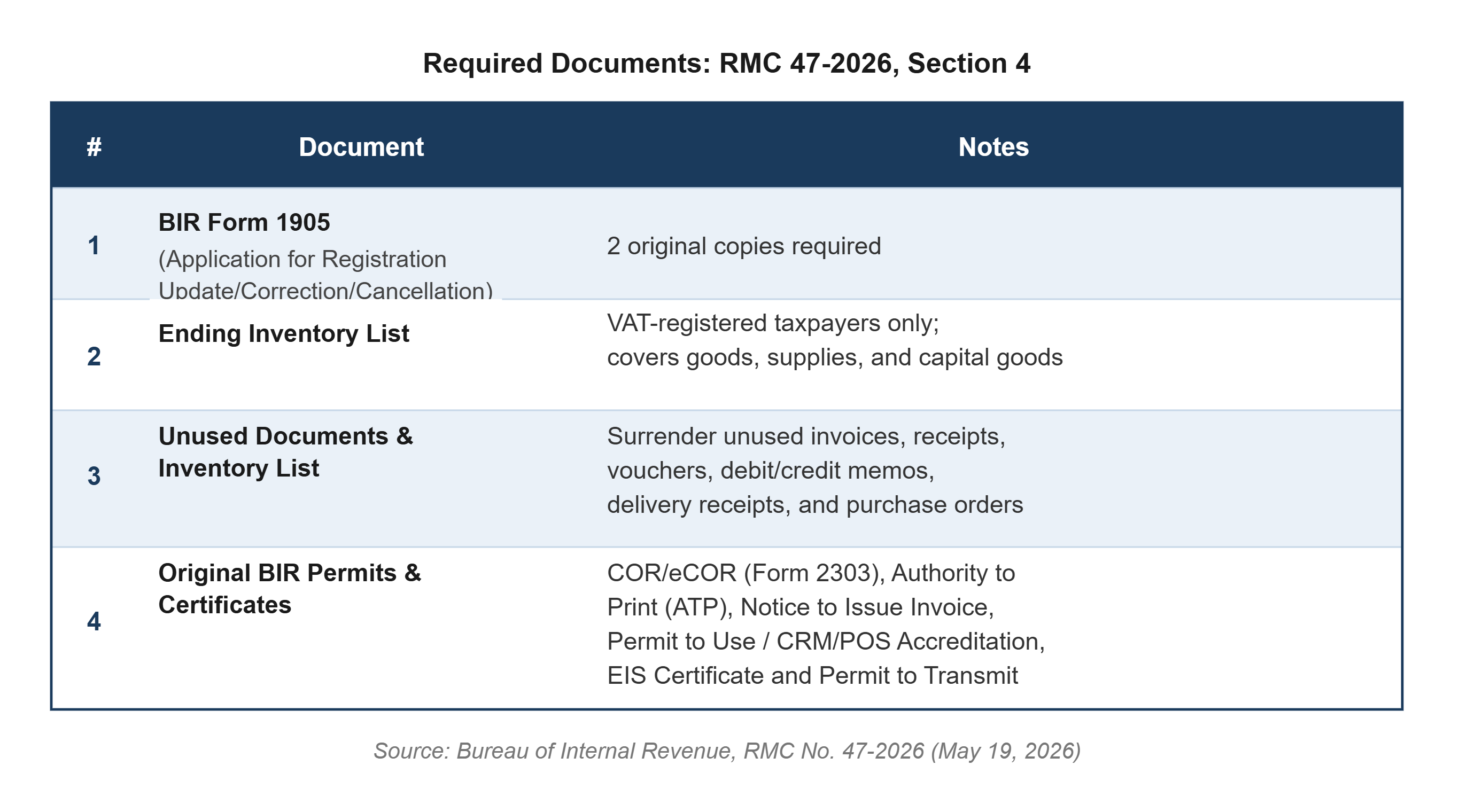
The following documents are now mandatory and standardized for all closure applications under Section 4 of RMC 47-2026:
If filing through a representative:
Individuals: Notarized Special Power of Attorney (SPA)
Corporations/Partnerships: Board Resolution or Secretary's Certificate
Valid government-issued IDs for both the taxpayer and the representative
How and Where to File
You may file your closure application either electronically or manually at the RDO where your Head Office or Branch is registered.
Electronic Filing
Submit your documents via your registered email to the RDO's official email address, or through the TRRA Portal or ORUS (Online Registration and Update System).
⚠️ Important: Even when filing electronically, the physical surrender of unused documents and original BIR permits (Items 3 and 4 in the requirements table) is still required. These must be brought in person to your RDO.
Manual Filing
Submit the complete dossier directly at the counter of your registered RDO.
Processing Timelines
RMC 47-2026 introduces clear timelines tied to taxpayer classification:
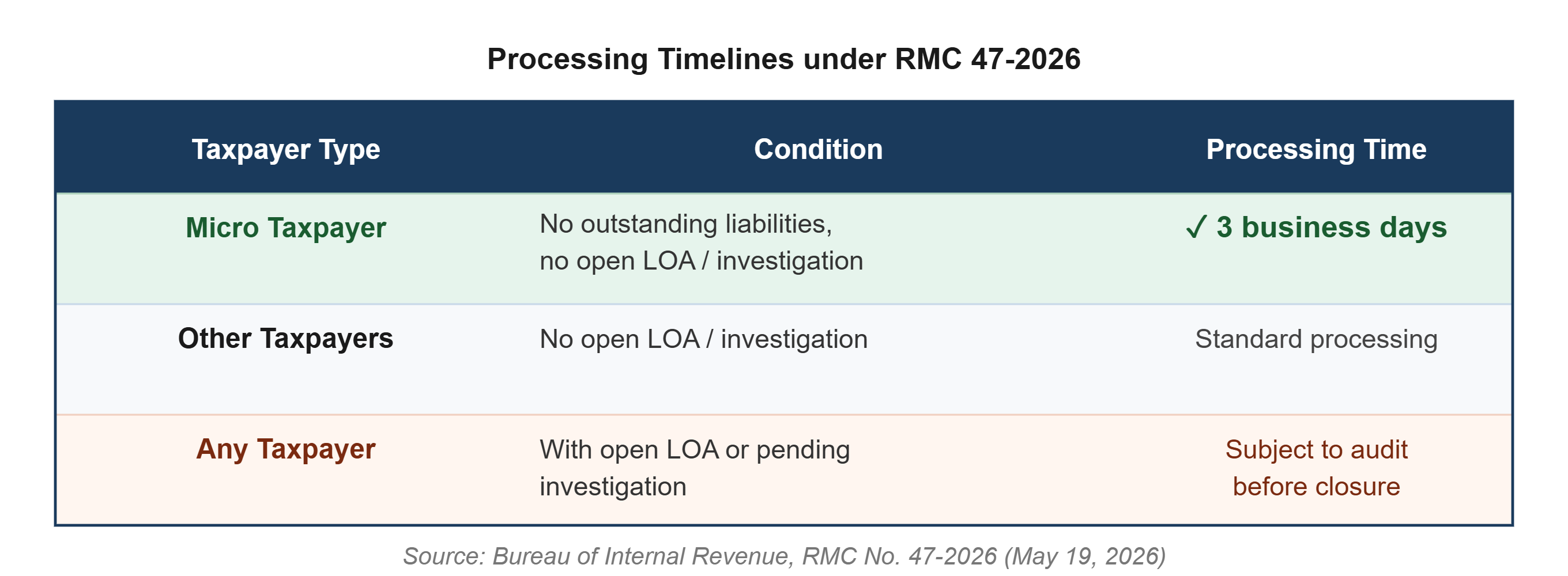
✅ Key rule: Once you submit complete requirements under Section 4 of RMC 47-2026, penalties for non-filing stop accruing. Your registered tax types are marked as "deregistered," and no new assessment cases will be generated from that point forward.
What Happens After Your Application is Approved?
The outcome differs slightly depending on your business structure:
Individuals (Sole Proprietors): Registration status is updated to "Closed"
Non-Individuals (Corporations, Partnerships, etc.): Registration status is updated to "Closed", followed by cancellation of the TIN
Pre-Filing Checklist: Do This Before You Submit
To ensure a smooth process and hit the 3-business-day turnaround, prepare the following in advance:
1. Confirm your RDO. File only at the RDO where you are registered — not where you currently reside or operate. If you have branches, each branch has its own registered RDO.
2. Finalize and file all outstanding tax returns. File all returns from the start of the taxable year up to your date of closure. If there was no activity during a period, file zero returns. The BIR requires a clean filing history before approving closure.
3. Settle all outstanding tax liabilities. Pay any unpaid taxes, penalties, and surcharges before submitting your application. The 3-business-day timeline only begins once you have zero outstanding liabilities and complete documentary requirements.
4. Prepare your inventory of unused documents. List and bundle all unused invoices, receipts, and other accountable forms for surrender. For VAT-registered taxpayers, prepare your ending inventory of goods, supplies, and capital goods.
5. Locate all original BIR permits and certificates. Gather your original Certificate of Registration (Form 2303), Authority to Print, and any other applicable accreditations for physical surrender.
Common Mistakes to Avoid
1. Assuming inactivity equals closure. This is the most common — and most costly — misconception. The BIR has no automatic closure mechanism. You must proactively file for cancellation.
2. Filing at the wrong RDO. Your application must be filed at the RDO where your business is registered, not your current address. Check your BIR Form 2303 to confirm your RDO.
3. Submitting incomplete documentary requirements. The 3-business-day clock starts only upon submission of complete documents. Missing a single requirement resets the timeline.
4. Failing to file zero returns for inactive periods. Even if your business had no transactions after ceasing operations, you are still required to file zero returns for each tax type registered in your name until your registration is formally cancelled.
5. Not settling liabilities before applying. Outstanding balances — including interest and surcharges — must be cleared before your closure application can be processed.
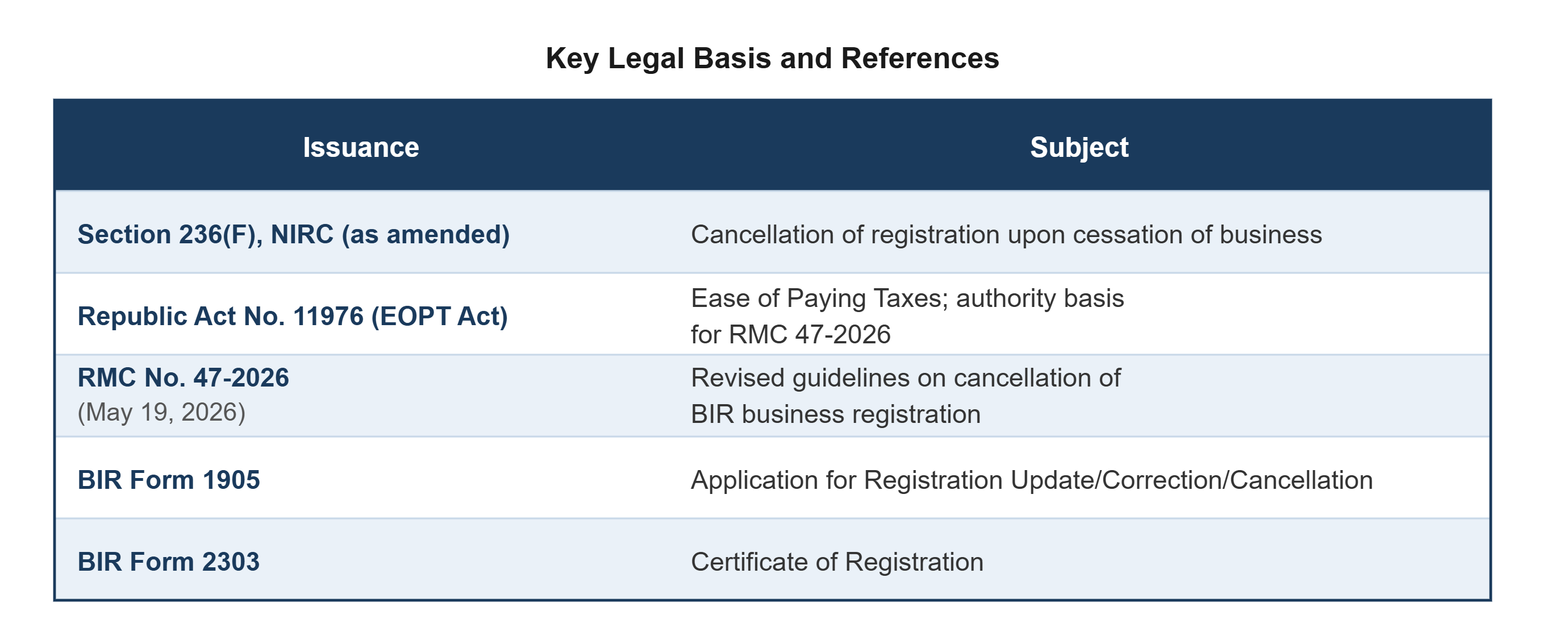
Key Legal Basis and References
Conclusion
For years, closing a business was one of the most frustrating compliance tasks in the Philippines — plagued by unclear rules, varying requirements across RDOs, and seemingly endless delays. RMC No. 47-2026 changes that, making the process faster, more predictable, and considerably fairer for small and micro businesses.
If you are planning to close your business, or if you ceased operations years ago but never formally notified the BIR, now is the time to act. The cost of doing nothing only compounds over time — in the form of penalties, surcharges, and interest that will not stop accruing until your registration is formally closed.
A licensed accountant or tax compliance professional can guide you through the entire process, from filing outstanding returns and clearing liabilities to preparing and submitting your closure documents at the right RDO.
References
Bureau of Internal Revenue. Revenue Memorandum Circular No. 47-2026: Revised Guidelines on the Cancellation of Business Registration. BIR, May 19, 2026. https://www.bir.gov.ph
Republic of the Philippines. Republic Act No. 11976 — Ease of Paying Taxes (EOPT) Act. Congress of the Philippines, 2024.
Bureau of Internal Revenue. National Internal Revenue Code of the Philippines (NIRC), Section 236(F) — Cancellation of Registration. As amended. https://www.bir.gov.ph
Bureau of Internal Revenue. BIR Form 1905 — Application for Registration Update/Correction/Cancellation. https://www.bir.gov.ph/index.php/bir-forms/registration-forms
Bureau of Internal Revenue. BIR Form 2303 — Certificate of Registration. https://www.bir.gov.ph
Upcloud Accounting: Virtual Outsourced Accounting and Bookkeeping Services in the Philippines
Upcloud Accounting offers accounting, bookkeeping, tax compliance, and business licensing services specializing with startups and SMEs in the Philippines.
Our goal is to increase efficiency, automation, and transparency across the accounting and finance functions of our clients with our cutting-edge technology. If you want to move your company’s finance function online, contact our Team of Expert Accountants and Bookkeepers directly via [email protected] or visit www.upcloudaccounting.comto learn more about how Upcloud Accounting accounting services can support your PH business!
Disclaimer: This article or blog is only for general knowledge and guidance and is not a substitute for an expert opinion. For technical advice, please consult your tax / legal advisor for your specific business concerns. For comments, suggestions, and feedback, feel free to email us at [email protected].