
Bookkeeping Basics Every Filipino Entrepreneur Must Understand Before Tax Season
Published Date: September 20, 2026
Published By: Jac Cantos, Upcloud Accounting
Every year, as April approaches, thousands of Filipino entrepreneurs scramble, pulling together receipts from the bottom of bags, hunting for bank statements in email threads, and calling their accountants in a panic trying to reconstruct what happened to their money over the past twelve months.
It is one of the most predictable problems in Philippine small business, and one of the most preventable. The root cause is almost never a lack of good intentions. It is a lack of a working bookkeeping system, or any system at all.
Bookkeeping is not an accounting concept that only applies to large businesses with finance departments. It is the foundational discipline that makes your business legible, to you, to your accountant, to the BIR, and to anyone who might one day want to lend you money, invest in your company, or buy it. For a Filipino entrepreneur, understanding bookkeeping basics is not optional. It is the difference between running your business and being run by it.
What Is Bookkeeping, and How Is It Different from Accounting?
These two terms are frequently used interchangeably in everyday conversation, but they refer to distinct activities.
Bookkeeping is the systematic recording of every financial transaction a business makes, every sale, every purchase, every payment received, every expense paid. It is the ongoing, day-to-day discipline of capturing what actually happened to your money.
Accounting is the interpretation, analysis, and reporting of the financial data that bookkeeping produces. Your accountant uses your bookkeeping records to prepare financial statements, compute your tax liability, and advise on your financial position.
A useful analogy: bookkeeping is the raw ingredient; accounting is the dish. A chef cannot cook without ingredients, and your accountant cannot prepare accurate tax returns without complete, organized bookkeeping records.
For most Filipino entrepreneurs, particularly sole proprietors and small business owners, bookkeeping is something they must either do themselves or delegate to someone they trust. Either way, they need to understand how it works.
Why Bookkeeping Is a Legal Requirement in the Philippines
Before getting into the mechanics, it is important to understand that bookkeeping is not a best practice that you choose to adopt. It is a legal obligation under Philippine law.
Section 232 of the National Internal Revenue Code (NIRC), as amended, requires every person subject to internal revenue taxes to keep a set of books of accounts that sufficiently reflects all business transactions. This obligation applies regardless of the size of the business, a freelancer, a sari-sari store, a sole proprietor, and a large corporation are all required to maintain books.
The books must be:
Registered with the BIR through the Online Registration and Update System (ORUS), as required by BIR RMC No. 004-2026
Available for inspection by BIR examiners at any time
Retained for ten (10) years from the date of the last entry, under Section 235 of the NIRC
Non-registration of books, failure to maintain them, or inability to produce them during a BIR examination are violations that carry administrative penalties and strengthen the BIR's basis for issuing a deficiency assessment.
Reference: Sections 232–235, NIRC as amended; BIR RMC No. 004-2026 (ORUS Registration)
The Three Types of Books of Accounts in the Philippines
Philippine businesses may maintain one of three types of books, depending on their size, volume of transactions, and BIR registration:
1. Manual Books of Accounts
The traditional option, physical bound journals and ledgers, registered and stamped by the BIR. Under the ORUS system, manual books are now registered online, after which a QR code is generated and affixed to the physical book.
Best for: Micro businesses and sole proprietors with a relatively low volume of transactions who prefer a simple, low-cost bookkeeping method.
Minimum required manual books:
General Journal: records all transactions in chronological order
General Ledger: classifies transactions by account (cash, accounts receivable, sales, expenses, etc.)
Cash Receipts Book: records all money received by the business
Cash Disbursements Book: records all money paid out by the business
Sales Journal: records all sales transactions
Purchases Journal: records all purchase transactions
2. Loose-Leaf Books of Accounts
A hybrid system, transactions are recorded in a computerized or typewritten format and printed on loose pages, which are then bound and submitted to the BIR. This requires a Permit to Use Loose-Leaf Books from the BIR.
Best for: Businesses with moderate transaction volumes that use basic accounting software but are not yet ready for a full Computerized Accounting System (CAS) permit.
3. Computerized Books of Accounts (CAS)
A fully digital system using accounting software, QuickBooks, Xero, Zoho Books, or locally-developed platforms like JUAN, that records and stores all transactions electronically. A CAS Permit from the BIR is required before the system can be used as the official set of books.
Best for: Growing businesses, corporations, and any taxpayer with a high volume of transactions where manual recording is no longer practical or reliable.
Reference: BIR Revenue Regulations No. 9-2009 (CAS); Section 232, NIRC; RMC No. 004-2026
The Five Core Bookkeeping Concepts Every Entrepreneur Must Know
You do not need to be an accountant to manage your bookkeeping. But you do need to understand the five concepts that underpin every bookkeeping entry, because if you understand these, you will understand every report your accountant produces and every question the BIR will ask.
1. The Accounting Equation
Everything in bookkeeping is built on one equation:
Assets = Liabilities + Owner's Equity
Assets are everything your business owns or is owed, cash, inventory, equipment, accounts receivable
Liabilities are everything your business owes, loans, unpaid bills, taxes payable
Owner's Equity is the residual, what belongs to you after all obligations are settled
Every transaction affects this equation. When you collect payment from a client, cash (asset) increases. When you take out a loan, cash (asset) increases and a loan payable (liability) increases by the same amount. The equation always stays balanced, that is what makes it a system rather than a list.
2. The Double-Entry System
Philippine bookkeeping, like bookkeeping everywhere, uses the double-entry system, which means every transaction is recorded in at least two accounts: one account is debited (increased or decreased, depending on the account type) and at least one other is credited by the same amount.
The reason for this is mathematical: it is what keeps the accounting equation balanced. If every debit has a corresponding credit, the books will always balance. If they do not balance, there is an error somewhere.
You do not need to master every debit-credit rule, but you need to understand that your accountant is not doing double the work, they are maintaining the integrity of the system.
3. Cash vs. Accrual Accounting
This is one of the most important decisions in setting up your bookkeeping system.
Cash basis accounting records income when cash is actually received and expenses when cash is actually paid. It is simpler and gives you a real-time picture of your actual cash position.
Accrual basis accounting records income when it is earned (regardless of when cash is received) and expenses when they are incurred (regardless of when cash is paid). It gives a more accurate picture of your financial performance during a period.
Under Philippine tax law, the accrual method is the default and is generally required for corporations and businesses above a certain scale. However, smaller taxpayers, particularly sole proprietors, may use the cash method for their books, subject to consistency and BIR acceptance.
The practical implication: if you bill a client in December 2025 but receive payment in January 2026, when is that income? Under accrual, it is 2025. Under cash, it is 2026. This distinction directly affects which tax year you report the income in.
4. The Chart of Accounts
A Chart of Accounts (COA) is the master list of all the categories your business uses to classify financial transactions, the filing system for your bookkeeping records.
A basic Chart of Accounts for a Philippine SME typically includes:
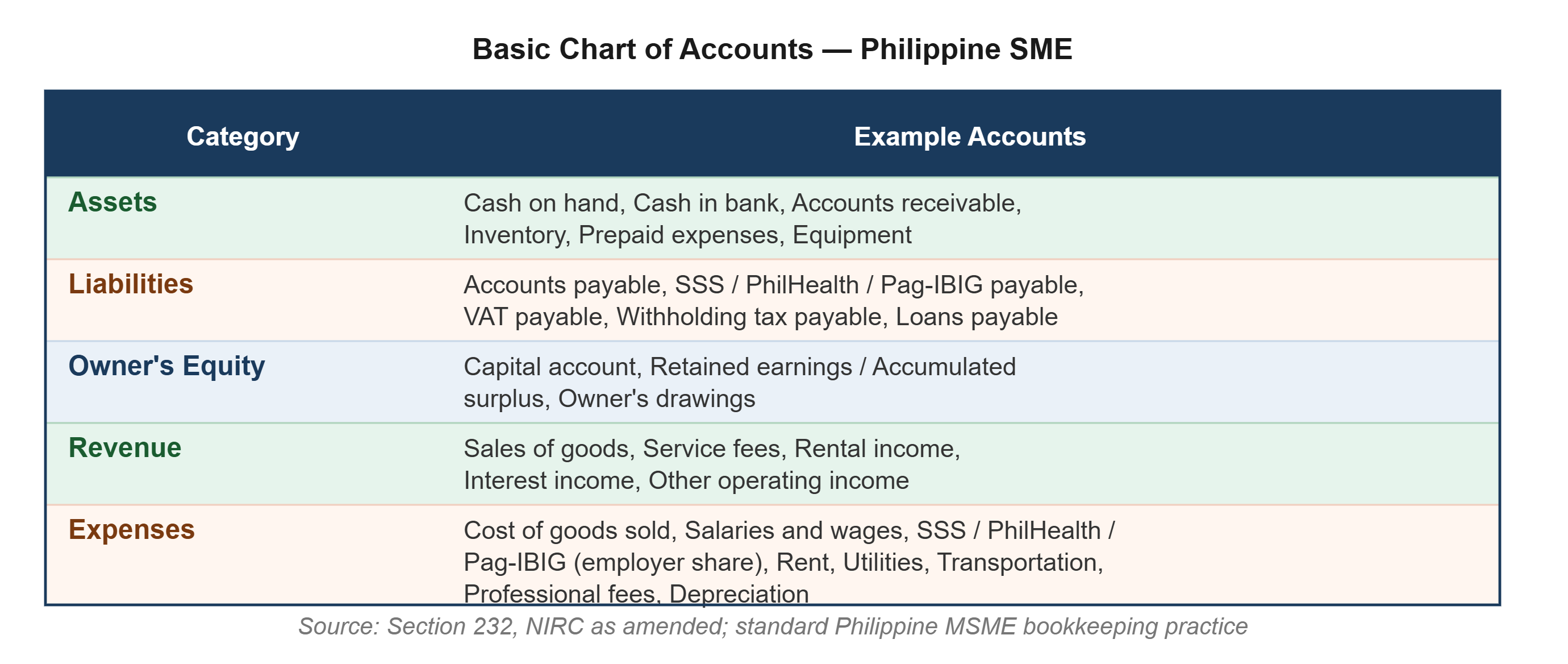
A well-designed COA is the difference between books that tell you something useful about your business and books that are a compliance requirement you tolerate. Every BIR return you file draws from one or more accounts in your COA, a misclassified transaction in the COA produces a misclassified entry on your tax return.
5. The Matching Principle
The matching principle requires that expenses be recorded in the same period as the revenue they helped generate. If you incurred costs in December 2025 to fulfill a project delivered in December 2025, those costs belong in 2025, even if you paid the invoice in January 2026.
This principle ensures that your income statement for any given period reflects the true economic activity of that period, rather than being distorted by the timing of cash movements. It is the foundation of accrual accounting and directly determines the accuracy of your annual income tax return.
The Key Financial Records You Must Maintain
Beyond the books of accounts themselves, Philippine entrepreneurs must maintain a set of supporting records that substantiate every entry in the books. These are the documents a BIR examiner will ask for, and their absence is what turns a routine examination into an extended, painful one.
Sales and Revenue Records
BIR-registered Invoices issued to all customers Under RR 7-2024 (EOPT Act), the Invoice is now the only valid principal document for all sales of goods and services. Every sale, whether cash, credit, online, or informal, must be covered by a BIR-registered Invoice. Unissued invoices are not just a compliance gap; they are unrecorded income, which is the most common basis for a BIR deficiency assessment.
Sales register or sales journal A chronological record of all invoices issued, showing date, invoice number, customer name, amount, and VAT breakdown (if VAT-registered).
Collection receipts or deposit slips Records confirming that payment was actually received, and the corresponding bank deposit.
Purchases and Expense Records
BIR-registered Invoices received from suppliers Under RR 7-2024, only a properly issued Invoice, not an Official Receipt, qualifies as a valid document for expense deduction and input VAT claims. Retain every Invoice received from suppliers, no matter how small the amount.
Purchase journal A record of all purchases, organized by date, supplier, amount, and account classification.
Proof of payment Bank transfer confirmations, cheque copies, or payment receipts that confirm expenses were actually paid. This is your second layer of documentation alongside the Invoice.
Payroll Records
Payroll register A complete record of all compensation paid to each employee each pay period, including gross pay, itemized deductions (SSS, PhilHealth, Pag-IBIG, withholding tax), and net pay.
BIR Form 2316 The annual certificate of compensation and withholding tax for each employee. This must reconcile with the BIR Form 1604-C filed with the BIR.
Government remittance records SSS, PhilHealth, and Pag-IBIG payment confirmations for each month of the year.
Bank and Cash Records
Monthly bank reconciliation statements A reconciliation comparing your bank statement balance to your book cash balance, identifying and explaining any differences. This is one of the most important monthly controls for a small business, it catches unrecorded transactions, errors, and unauthorized withdrawals.
Petty cash records A petty cash fund log showing disbursements, supported by receipts for each disbursement.
Tax-Related Records
BIR Form 2307 certificates received All certificates of creditable withholding tax received from clients and customers who withheld expanded withholding tax on payments to you. These are tax credits against your annual income tax liability, losing even one means overpaying.
Filed tax returns Copies of all monthly, quarterly, and annual BIR returns filed during the year, along with proof of payment.
Government assessment notices (if any) Any BIR or LGU notices received must be retained and responded to within the prescribed period.
Setting Up a Basic Bookkeeping System: A Practical Framework
You do not need expensive software to start bookkeeping correctly. What you need is a consistent process that captures every transaction as it happens. Here is a practical framework for Filipino entrepreneurs just getting started:
Week 1: Set Up Your Foundation
Open a separate business bank account. This is the single most important step a new entrepreneur can take. Commingling personal and business funds is the root cause of most bookkeeping disasters. A separate business account makes it possible to track business transactions accurately and makes bank reconciliation straightforward.
Register your books with the BIR via ORUS. Whether manual, loose-leaf, or CAS, your books must be registered before you make your first entry. Log in to the BIR ORUS portal, complete the book registration process, and print or save the QR confirmation.
Design your Chart of Accounts. List every type of income your business earns and every category of expense it incurs. This does not need to be elaborate, a basic list of 15–25 accounts is sufficient for most micro and small businesses.
Choose your bookkeeping method. Manual books, a spreadsheet, or accounting software, pick one and commit to it. Inconsistency (switching methods mid-year, maintaining parallel records, or recording transactions in one format and filing in another) is more damaging than using a simple method consistently.
Every Day (or at Least Every Week)
Record every sale. Issue your BIR-registered Invoice at the time of the sale and record it in your sales journal the same day or week. Do not let invoices accumulate unrecorded.
Record every expense. File every Invoice or receipt received from a supplier in a designated folder, physical or digital. Record the expense in your purchases journal on the day you receive the document.
Log all cash movements. Every cash receipt and cash disbursement should be logged the day it occurs. Cash transactions are the most frequently unrecorded, and the most frequently questioned by the BIR.
Every Month
Reconcile your bank account. Compare your book cash balance to your bank statement. Identify and investigate every difference. A bank reconciliation should not take more than 30–60 minutes if your records are current.
Review your income and expense totals. Add up your sales and expenses for the month and compare against the prior month and your expectations. Monthly review catches problems before they compound into year-end surprises.
File your monthly BIR returns. Withholding tax on compensation (BIR Form 1601-C), expanded withholding tax (0619-E), and VAT declarations (2550M for VAT-registered) are monthly obligations. Use the month-end reconciliation to feed these filings accurately.
Remit government contributions. SSS, PhilHealth, and Pag-IBIG contributions for the prior month must be remitted through the respective agency portals before the applicable deadline.
Every Quarter
File your quarterly income tax return. BIR Form 1701Q (individuals) or 1702Q (corporations) is due within 60 days after the close of each quarter. Your quarterly books must be complete and reconciled before you can file this accurately.
File your quarterly VAT return. BIR Form 2550Q, along with the Summary List of Sales and Purchases (SLSP), is due within 25 days after the close of each quarter.
Review your tax position. Compare total taxes paid year-to-date against your projected annual liability. If you are significantly under or overpaying, adjust your quarterly estimates now rather than at year-end.
Every Year-End
Close your books. Complete all entries for the year, reconcile all accounts to their supporting documents, and produce your year-end trial balance.
Prepare financial statements. Income statement, balance sheet, and cash flow statement, these are required for your annual ITR and, for corporations, for the SEC AFS filing.
File your annual ITR by April 15. Your annual income tax return must reflect the full year's books accurately. Discrepancies between your quarterly returns and the annual return are a common BIR audit trigger.
The Bookkeeping Mistakes That Make Tax Season a Nightmare
Recording income only when cash is received. If you issue an Invoice in December but are paid in January, accrual-basis books must show the income in December. Missing this timing creates a discrepancy between your books and your Invoices that is difficult to explain during an audit.
Mixing personal and business expenses. Every peso of personal spending that passes through your business account creates a bookkeeping problem. Personal expenses are not deductible under Section 34 of the NIRC, but when they are mixed in the books, they must be identified, separated, and removed before your tax return is filed.
Losing or discarding Invoices. Under RR 7-2024, only a valid BIR-registered Invoice supports a deductible expense or an input VAT claim. An expense without an Invoice is not deductible, regardless of whether you actually paid for it. Establish a filing habit for every Invoice received, physical or digital, from the first day of business.
Not recording small cash transactions. Many Filipino entrepreneurs record their larger transactions diligently but skip small cash purchases, fuel, supplies, printing, courier fees. These accumulate over a year into a material gap between your bank balance and your book balance, and they represent lost deductions.
Confusing gross sales with taxable income. Gross sales is your total revenue. Taxable income is gross sales minus allowable deductions. Many first-time entrepreneurs are surprised by their tax bill because they did not maintain the expense records needed to support their deductions, effectively paying tax on gross revenue instead of net income.
Not maintaining records for closed periods. Many entrepreneurs dispose of records once a tax return is filed. Under Section 235 of the NIRC, records must be kept for ten years. A BIR audit can cover any year within the three-year prescriptive period, and ten years in fraud cases. Disposing of records before the retention period expires is a violation.
Treating bookkeeping as an April activity. Bookkeeping done once a year in preparation for tax filing is not bookkeeping, it is reconstruction. Reconstruction is slow, error-prone, and expensive. And it produces books that a BIR examiner can dismantle because they lack the contemporaneous documentation that genuine, day-to-day bookkeeping creates.
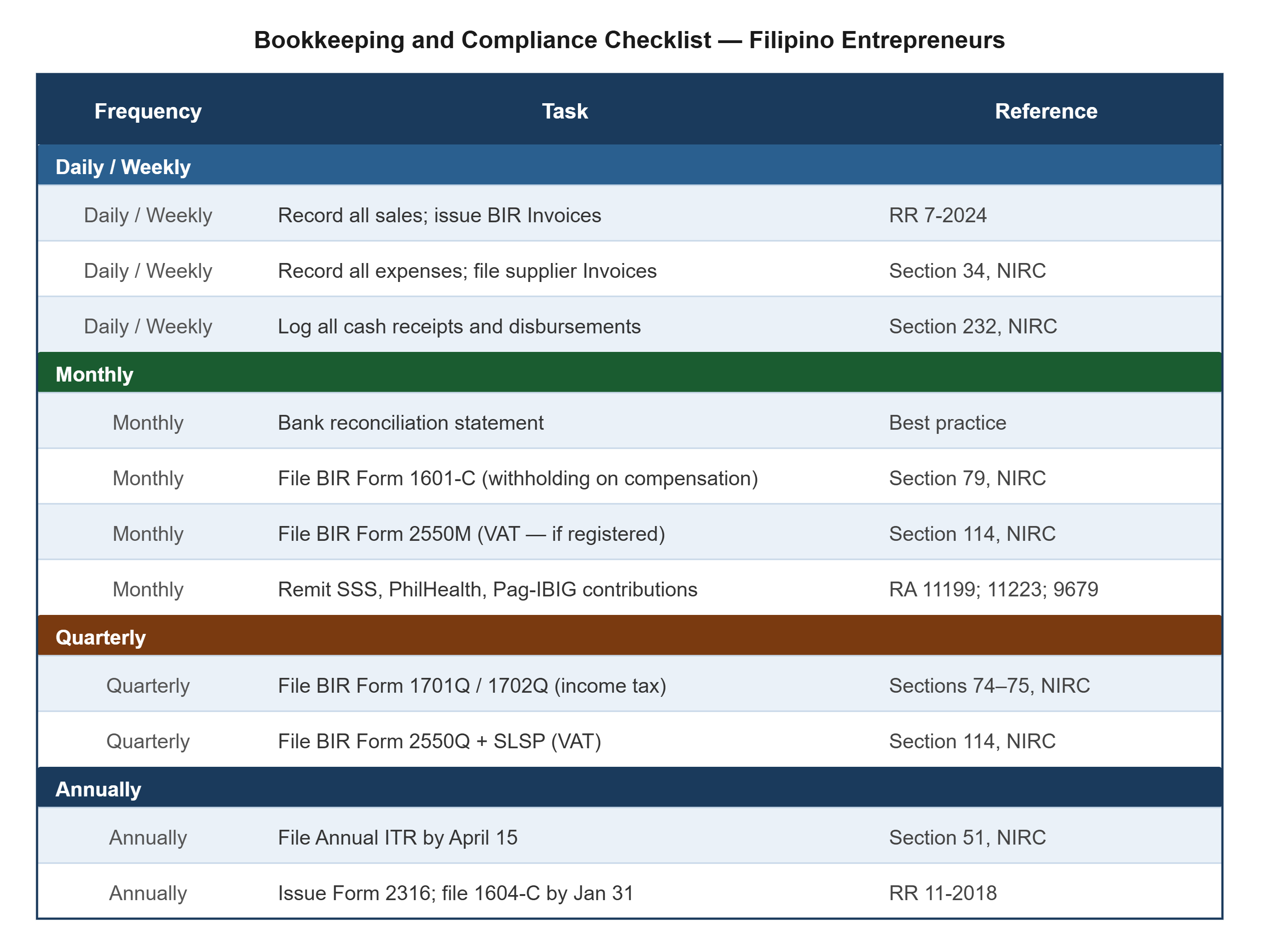
Summary: Monthly Bookkeeping Checklist for Filipino Entrepreneurs
Conclusion
Tax season does not have to be a crisis. For Filipino entrepreneurs who maintain clean, complete, and timely books throughout the year, April is simply the month they file, not the month they scramble.
The mechanics of bookkeeping are not complicated. What is difficult, and what separates entrepreneurs who stay compliant from those who face BIR assessments, is the discipline of doing it consistently, every week of every month, from the first day of the business year to the last.
If your current bookkeeping system is a folder of receipts or a bank statement you hope tells the whole story, this tax season is the right time to build something better. Start with a separate business bank account, register your books with the BIR, and commit to recording every transaction the week it happens. Your accountant, and your April self, will thank you for it.
References
Bureau of Internal Revenue. National Internal Revenue Code (NIRC), Sections 34, 51, 74–75, 114, 232–235, as amended by RA 10963 (TRAIN Law). https://www.bir.gov.ph
Bureau of Internal Revenue. Revenue Regulations No. 7-2024: Invoicing Requirements under the EOPT Act. BIR, 2024. https://www.bir.gov.ph
Bureau of Internal Revenue. Revenue Regulations No. 9-2009: Regulations on the Use of Computerized Accounting Systems (CAS). BIR, 2009.
Bureau of Internal Revenue. Revenue Regulations No. 11-2018: Revised Withholding Tax Regulations. BIR, 2018.
Bureau of Internal Revenue. Revenue Memorandum Circular No. 004-2026: Mandatory Online Registration of Books of Accounts via ORUS. BIR, 2026. https://www.bir.gov.ph
Republic of the Philippines. Republic Act No. 10963 — Tax Reform for Acceleration and Inclusion (TRAIN Law). Congress of the Philippines, 2017.
Republic of the Philippines. Republic Act No. 11976 — Ease of Paying Taxes (EOPT) Act. Congress of the Philippines, 2024.
Upcloud Accounting: Virtual Outsourced Accounting and Bookkeeping Services in the Philippines
Upcloud Accounting offers accounting, bookkeeping, tax compliance, and business licensing services specializing with startups and SMEs in the Philippines.
Our goal is to increase efficiency, automation, and transparency across the accounting and finance functions of our clients with our cutting-edge technology. If you want to move your company’s finance function online, contact our Team of Expert Accountants and Bookkeepers directly via [email protected] or visit www.upcloudaccounting.comto learn more about how Upcloud Accounting accounting services can support your PH business!
Disclaimer: This article or blog is only for general knowledge and guidance and is not a substitute for an expert opinion. For technical advice, please consult your tax / legal advisor for your specific business concerns. For comments, suggestions, and feedback, feel free to email us at [email protected].