
Common BIR Audit Red Flags and How Philippine Businesses Can Avoid Them
Published Date: July 12, 2026
Published By: Jac Cantos, Upcloud Accounting
A BIR audit, formally called a tax examination, is one of the most disruptive events a Philippine business can face. It demands management time, professional fees, document retrieval across multiple years, and the constant uncertainty of not knowing what the final assessment will be until it arrives. For many small and medium enterprises, a single deficiency assessment can represent months of net income, erased in a single BIR letter.
What most business owners do not realize is that BIR audits are rarely random. The Bureau uses a combination of data analytics, third-party information returns, industry benchmarks, and inter-agency data matching to identify taxpayers whose returns present anomalies worth investigating. Understanding what those anomalies look like, what the BIR's systems flag as suspicious, is the most practical form of audit prevention available.
The BIR's Authority to Audit: What the Law Says
Before diving into red flags, it is important to understand the legal framework that governs BIR audits.
Under Section 6 of the National Internal Revenue Code (NIRC), the Commissioner of Internal Revenue has the authority to examine any book, paper, record, or other data that may be relevant or material to a tax inquiry. This authority is exercised through a Letter of Authority (LOA), the official document that authorizes a specific BIR examiner to examine a taxpayer's books and records for a specific taxable year.
Key rules governing the LOA:
An examination can only be conducted if a valid LOA has been issued by the Regional Director, Assistant Commissioner, or Commissioner, depending on the taxpayer's classification
The LOA must specify the taxable year(s) covered and the type of tax being examined
A taxpayer cannot be subjected to a second examination for the same taxable period and tax type once a case has been closed, this is the one-assessment-per-taxable-year rule under Section 235 of the NIRC
The BIR's right to assess deficiency taxes prescribes after three (3) years from the date of filing of the return, or from the last day prescribed for filing (whichever is later), extended to ten (10) years in cases of fraudulent returns or failure to file
How the BIR Selects Taxpayers for Audit
The BIR does not audit every taxpayer, it prioritizes based on risk signals. The primary selection mechanisms include:
Run After Tax Evaders (RATE) Program High-profile cases of suspected large-scale tax evasion are filed under the RATE program, typically involving celebrities, politicians, and large corporations.
Industry Benchmarking The BIR maintains industry benchmarks, ratios of gross income, cost of goods sold, and net income as a percentage of gross revenues, for different business sectors. Taxpayers whose declared ratios fall significantly outside the industry norm are flagged for potential examination.
Tax Gap Analysis The BIR cross-matches data from multiple sources: alphalist submissions, BIR Form 2307 (creditable withholding tax) filings from payers, VAT invoices, and import/export declarations. Unexplained gaps between income declared by the taxpayer and income reported by third parties are a primary trigger.
Information from Third Parties The BIR receives information from other government agencies, Bureau of Customs (BOC) import declarations, Land Registration Authority (LRA) property transactions, Land Transportation Office (LTO) vehicle registrations, and Securities and Exchange Commission (SEC) filings, that can reveal undisclosed income or assets.
Taxpayer's Own Patterns Significant year-over-year changes in declared income, gross margins, or tax liability, particularly sudden drops, are flagged by BIR data systems for review.
The Most Common BIR Audit Red Flags
Red Flag 1: Gross Income Ratio Falls Significantly Below Industry Benchmark
The BIR's industry benchmarking program compares your declared gross income as a percentage of gross revenues against the average for your industry and region. If your gross margin is materially lower than the benchmark, suggesting either unusually high costs or understated revenues, the discrepancy becomes a selection trigger.
Why it happens: Businesses sometimes over-declare cost of goods sold, claim personal expenses as business deductions, or underreport cash sales, all of which suppress the gross income ratio below what the BIR expects for that type of business.
How to avoid it:
Know your industry's BIR benchmark ratio, ask your accountant to identify it
Ensure your cost of goods sold (COGS) is accurately computed and reconciles to your inventory records and supplier invoices
Review expense classifications annually, personal expenses, non-business costs, and capital expenditures improperly charged to operating expenses are the most common sources of artificially suppressed margins
If your margins genuinely differ from the benchmark due to specific business circumstances (long-term contracts, startup phase, unusual input costs), document the explanation in writing
Reference: RMC No. 40-2003; BIR Industry Benchmarking guidelines
Red Flag 2: Declared Sales Do Not Match Third-Party Data
This is the BIR's most powerful matching tool and the most common source of deficiency VAT and income tax assessments. The BIR cross-matches data from multiple sources against your declared gross revenues:
BIR Form 2307 certificates filed by your clients (each Form 2307 records a payment made to you, on which withholding tax was deducted, if the total of all 2307s filed against your TIN exceeds your declared gross receipts, the BIR will notice)
VAT alphalist (SLSP) data submitted by your VAT-registered customers, showing purchases from your TIN
SEC audited financial statements (for corporations), which are cross-matched against BIR filings
Bureau of Customs import declarations, for businesses that import goods
Credit card and online payment platform data (the BIR has been expanding its data access to include payment processors)
Why it happens: Unrecorded cash sales, revenue from informal transactions not passed through the books, and timing differences between actual collections and recorded income are the most common causes.
How to avoid it:
Reconcile all BIR Form 2307 certificates received against your declared gross receipts before filing your annual ITR, the total should match or be explainable
Ensure all sales, including cash transactions, online orders, and informal arrangements, are recorded through your books and reflected in your monthly and quarterly VAT returns
Reconcile your SLSP (alphalist of sales) against your issued invoices and your declared output VAT every quarter, discrepancies identified internally are far less costly than those discovered by the BIR
Reference: Section 5, NIRC (Power to Obtain Information); RR No. 1-2014 (Third-Party Information)
Red Flag 3: Significant Year-Over-Year Drop in Declared Income
A sudden and unexplained decline in declared taxable income, particularly when industry-wide economic conditions do not support such a decline, is a strong audit trigger. The BIR's data systems compare each year's filing against the prior year and flag material deteriorations that are inconsistent with available economic data.
Why it happens: Some businesses legitimately experience income drops due to lost clients, market disruption, or economic downturns. The problem arises when the decline is not supported by documentation, or when it is accompanied by a corresponding increase in deductible expenses that lacks substantiation.
How to avoid it:
Maintain contemporaneous documentation for any significant business changes, lost contracts, major client attrition, extraordinary expenses, that explain a year-over-year income decline
If your business experienced a genuine downturn, ensure your books reflect the specific reason clearly and that supporting documents (client termination letters, cancelled contracts, expense receipts) are retained
Do not use paper losses or inflated deductions to reduce income artificially, these are exactly what the BIR looks for when it investigates an anomalous income drop
Red Flag 4: Claiming Unusually Large or Unsupported Deductions
Deductions are the most audited area of income tax returns. The BIR examines whether declared deductions are:
Ordinary and necessary for the business under Section 34(A) of the NIRC
Supported by valid BIR-registered Invoices (under RR 7-2024, Official Receipts are no longer valid for expense substantiation)
Not personal in nature, expenses for personal travel, family meals, personal vehicle maintenance, and similar items are not deductible business expenses
Not capital in nature, expenditures for the acquisition of assets, major renovations, or other capital items must be capitalized and depreciated, not expensed in full
Common deduction red flags specifically watched by the BIR:
Representation and entertainment expenses exceeding the 0.5% of net sales (for sellers of goods) or 1% of net revenues (for sellers of services) ceiling under Section 34(A)(1)(a)(iv) of the NIRC
Interest expenses where the corresponding interest income is not declared, or where the 33% interest arbitrage adjustment under Section 34(B)(1) of the NIRC has not been applied
Depreciation claimed on fully depreciated assets, or on assets not owned by the business
Professional fees paid to related parties without adequate substance, documentation, or arm's-length pricing
Bad debt write-offs claimed without meeting the strict requirements of Section 34(E) of the NIRC, specifically, that the debt has been proven worthless during the taxable year, was previously included in gross income, and is within the prescribed period
How to avoid it:
Maintain a complete file of BIR-registered Invoices for every claimed deduction, after the EOPT Act changes under RR 7-2024, Official Receipts are no longer acceptable
Apply the representation and entertainment expense ceiling and document the calculation in your tax return workpapers
Compute and apply the interest expense adjustment if you earn interest income in the same year you claim interest expense deductions
Establish a formal bad debt write-off policy with documented evidence of collection efforts before claiming any write-off
Reference: Section 34(A)(B)(E), NIRC as amended; RR 7-2024; Revenue Memorandum Order (RMO) No. 19-2007 (Examination Procedures)
Red Flag 5: VAT Input Credits Significantly Higher Than Output VAT
A VAT-registered business that consistently declares input VAT significantly higher than output VAT, creating either a perpetual VAT refund position or a minimal net VAT liability, will attract BIR scrutiny. While legitimate excess input VAT credits exist (particularly for exporters or businesses with large capital expenditure programs), an unexplained pattern of excess credits is a red flag.
Why it happens: Claiming input VAT on non-qualifying purchases, using invalid or fictitious VAT invoices, claiming input VAT from non-VAT-registered suppliers, or claiming input VAT on transactions where VAT was not actually paid.
How to avoid it:
Only claim input VAT supported by a valid, BIR-registered Invoice issued by a VAT-registered supplier, verify the supplier's VAT registration on the BIR's TIN verification system
Do not claim input VAT on purchases of goods or services not related to your VAT-taxable business activities
If you have a genuine excess input VAT position (e.g., due to large capital expenditures or zero-rated export sales), ensure the basis is fully documented and reconcilable, a VAT refund claim invites a formal audit
Reference: Sections 110–112, NIRC as amended; RR 7-2024
Red Flag 6: Withholding Tax Discrepancies
The BIR cross-matches withholding tax data from multiple directions. If the total withholding taxes remitted on your monthly and quarterly withholding returns do not reconcile with the annual information returns (BIR Forms 1604-C and 1604-E), or if the withholding taxes reported by your payees' own BIR returns differ from what you reported, discrepancies are automatically flagged.
Common withholding tax red flags:
Payments to contractors, suppliers, or professionals where the correct expanded withholding tax rate was not applied
Underwithheld compensation, particularly for employees whose tax brackets were not updated after salary increases
BIR Form 2307 certificates issued to payees that do not match the amounts actually remitted to the BIR
Year-end BIR Form 1604-C totals that do not reconcile with the sum of monthly BIR Form 1601-C filings
How to avoid it:
Maintain a complete schedule of all expanded withholding tax rates applicable to your specific payment types, the rates vary by nature of income (professional fees, rent, commissions, etc.) and by payee classification
Reconcile monthly withholding remittances to your annual information returns before filing, do this as a formal close step, not an afterthought
Update employee compensation records and recompute withholding tax obligations whenever an employee receives a salary adjustment
Reference: RR No. 11-2018 (Withholding Tax Regulations); Section 79, NIRC as amended
Red Flag 7: Inconsistencies Between Audited Financial Statements and BIR Returns
For corporations required to submit Audited Financial Statements (AFS) to the SEC, the BIR performs a direct cross-match between the revenues, expenses, and net income declared in the AFS and the corresponding figures in the income tax return and VAT returns. Unexplained discrepancies between the two sets of figures, whether in revenue, cost of goods sold, operating expenses, or net income, are a reliable audit trigger.
Why it happens: Timing differences in revenue recognition, expenses recorded under PFRS that are not deductible for tax purposes (book-tax differences), or outright errors in one or both sets of filings.
How to avoid it:
Prepare a formal tax reconciliation schedule that bridges net income per financial statements to taxable income per BIR return, this is standard practice in proper tax return preparation and serves as the primary explanatory document if the BIR questions the difference
Ensure temporary and permanent book-tax differences are correctly identified and applied, common items include non-deductible provisions, PFRS 16 lease accounting adjustments, and accelerated depreciation for tax purposes
Ensure the gross revenues declared in your quarterly VAT returns, when summed across four quarters, reconcile with gross revenues per your annual income tax return and your audited financial statements
Reference: Section 43, NIRC (Accounting Period); RR No. 12-99
Red Flag 8: Failure to Declare Income from All Sources
Philippine resident individuals and domestic corporations are taxed on worldwide income under Sections 23 and 27 of the NIRC. Income from foreign sources, foreign consultancy fees, offshore freelance income, interest from foreign bank accounts, dividends from foreign corporations, and capital gains from the sale of foreign assets, must be declared in the Philippine income tax return.
Additionally, income from passive sources that are subject to final withholding tax, dividends, interest income from bank deposits, royalties, may already have been taxed at source, but the existence and amount of these income streams must still be declared in the appropriate schedules of the ITR to confirm the correct tax treatment was applied.
How to avoid it:
Ensure your annual ITR includes all income from all sources, domestic and foreign, active and passive
For freelancers and professionals earning income from foreign clients, document the nature of the income, the foreign client, and the applicable tax treatment
For individuals with passive income (dividends, interest), confirm that the correct final withholding tax rate was applied and that the income is reflected in the appropriate ITR schedule
Reference: Sections 23, 27, 42, NIRC as amended
Red Flag 9: Sudden Changes in Business Structure or Ownership
Corporations that restructure, merge, convert to a different business form, or experience major ownership changes, particularly around the filing of large losses or the transfer of appreciated assets, draw heightened BIR scrutiny. These transactions are sometimes used to manufacture deductible losses, avoid capital gains tax, or shift income between related parties.
How to avoid it:
Ensure all major business restructuring transactions are properly documented, commercially motivated, and priced at arm's length
Consult a tax adviser before, not after, implementing any major corporate reorganization, merger, or asset transfer, the tax consequences of these transactions are significant and can be managed with advance planning but are difficult to unwind after the fact
Secure a BIR ruling for novel or complex transactions where the applicable tax treatment is uncertain, a ruling provides legal certainty and protection against subsequent BIR challenges
Reference: Sections 40(C), 73, NIRC as amended; RMO No. 43-90 (Rulings)
Red Flag 10: Late or Incomplete Prior-Year Filings
A history of late filings, amended returns, or missing returns for prior years makes a taxpayer a higher priority for examination. The BIR's taxpayer profiling systems track compliance history, and a pattern of non-compliance, even for minor returns, raises the overall risk score of a taxpayer's file.
How to avoid it:
File all returns on time, every period, including zero returns if there is no activity for a particular tax type in a given period
If prior-year returns were filed late or contain errors, consider filing amended returns proactively, a voluntary amendment carries far lower penalties than a BIR-initiated deficiency assessment
The BIR's Voluntary Assessment and Payment Program (VAPP) and similar compliance programs periodically offer reduced penalties for taxpayers who come forward to settle prior-year liabilities, stay informed about active programs
Reference: Sections 248–249, NIRC (Penalties); RMC No. 19-2015
What to Do If You Receive a Letter of Authority
If the BIR issues a Letter of Authority (LOA) to your business, your immediate actions matter significantly to the outcome of the examination.
Verify the validity of the LOA. Check that the LOA is signed by the proper signatory authority (Regional Director for regional cases, Commissioner for large taxpayer cases), covers the correct taxable year(s), and specifies the tax type(s) being examined. An LOA with defects may be challengeable.
Engage a tax lawyer or CPA immediately. Do not respond to BIR examiners without professional representation. A CPA or tax lawyer experienced in BIR examinations can manage the process, control document disclosure, and protect your rights throughout.
Do not provide documents beyond what the LOA covers. The BIR's examination authority is limited to the taxable year(s) and tax type(s) specified in the LOA. You are not obligated to provide records for years or tax types not covered.
Organize your records before the examination begins. Retrieve and organize all books of accounts, invoices, contracts, payroll records, Form 2307 certificates, and other records relevant to the covered period. Presenting organized, complete records at the outset signals compliance and reduces the examiner's incentive to conduct a more aggressive investigation.
Respond to BIR Notices within the prescribed period. BIR examinations generate multiple notices, the Notice for Informal Conference, the Preliminary Assessment Notice (PAN), and the Final Assessment Notice (FAN). Each has a prescribed response period. Missing a deadline is not a neutral outcome, it can result in the assessment becoming final and unappealable.
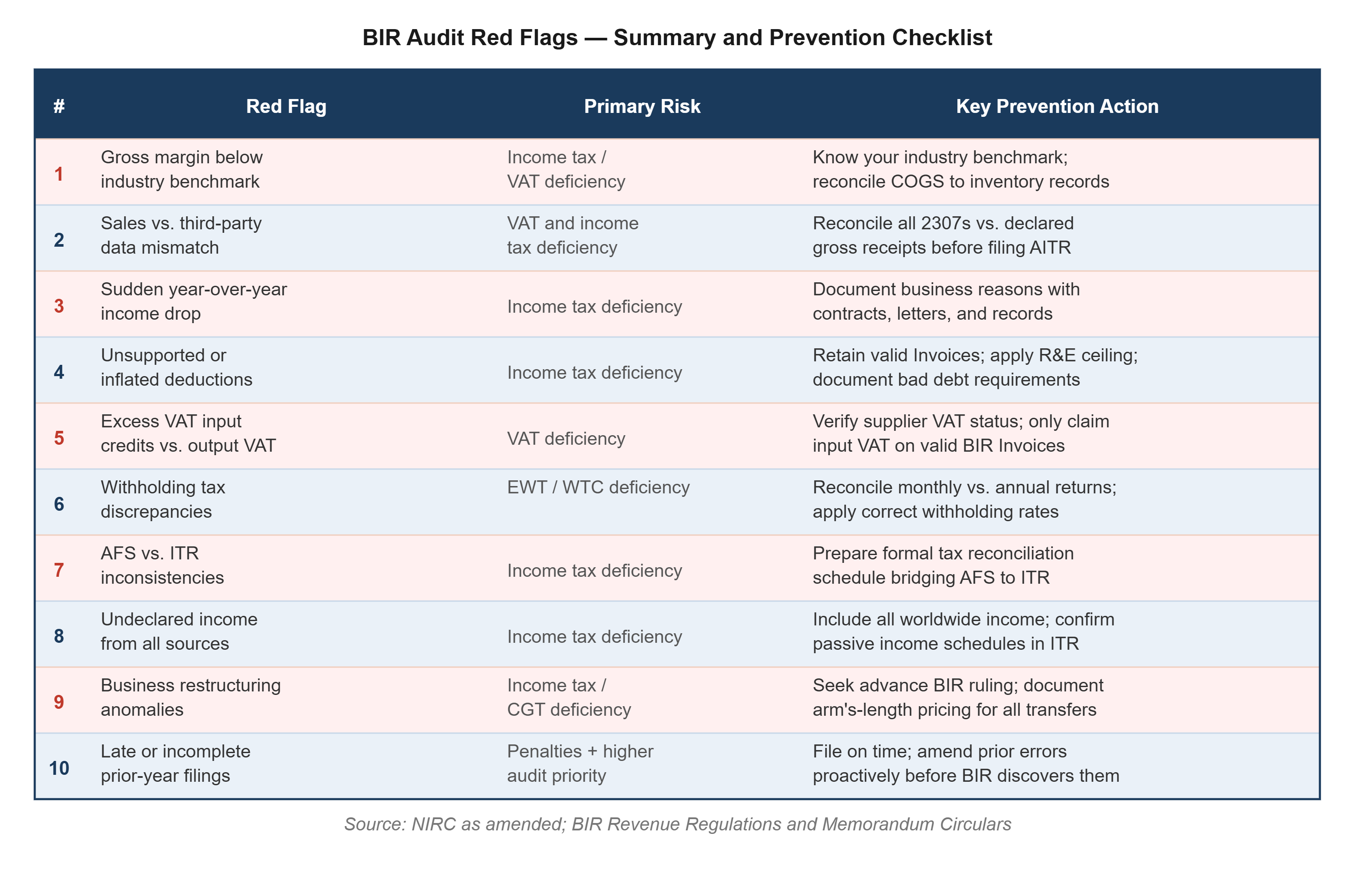
Summary: BIR Audit Red Flags and Prevention Checklist
Conclusion
A BIR audit is not an unavoidable risk of doing business, it is a predictable outcome of specific compliance gaps that the BIR's systems are specifically designed to detect. Gross income ratios far below the industry norm, unexplained income drops, inflated deductions without documentation, withholding tax mismatches, and discrepancies between audited financials and tax returns are not accidents. They are patterns that generate Letters of Authority.
The businesses that consistently avoid BIR examinations, or navigate them successfully when they do occur, share a common discipline: accurate, complete, and timely bookkeeping; proper expense documentation; quarterly self-reconciliation of all filed returns; and professional tax return preparation that anticipates and addresses the specific ratios and data points the BIR monitors.
If it has been more than a year since you reviewed your books and tax filings for the red flags covered in this guide, now is the time to do it, before the BIR does it for you.
References
Bureau of Internal Revenue. National Internal Revenue Code (NIRC), Sections 5, 6, 23, 27, 34, 40, 110–112, 203, 222, 228, 235, 248–249, as amended by RA 10963 (TRAIN Law). https://www.bir.gov.ph
Bureau of Internal Revenue. Revenue Regulations No. 12-99: Procedures Governing the Assessment and Collection of Taxes. BIR, 1999.
Bureau of Internal Revenue. Revenue Regulations No. 11-2018: Revised Withholding Tax Regulations. BIR, 2018.
Bureau of Internal Revenue. Revenue Regulations No. 7-2024: Invoicing Requirements under the EOPT Act. BIR, 2024. https://www.bir.gov.ph
Bureau of Internal Revenue. Revenue Memorandum Circular No. 40-2003: Industry Benchmarking Guidelines. BIR, 2003.
Bureau of Internal Revenue. Revenue Memorandum Order No. 19-2007: BIR Examination Procedures. BIR, 2007.
Bureau of Internal Revenue. Revenue Regulations No. 12-2010: Run After Tax Evaders (RATE) Program. BIR, 2010. https://www.bir.gov.ph
Upcloud Accounting: Virtual Outsourced Accounting and Bookkeeping Services in the Philippines
Upcloud Accounting offers accounting, bookkeeping, tax compliance, and business licensing services specializing with startups and SMEs in the Philippines.
Our goal is to increase efficiency, automation, and transparency across the accounting and finance functions of our clients with our cutting-edge technology. If you want to move your company’s finance function online, contact our Team of Expert Accountants and Bookkeepers directly via [email protected] or visit www.upcloudaccounting.comto learn more about how Upcloud Accounting accounting services can support your PH business!
Disclaimer: This article or blog is only for general knowledge and guidance and is not a substitute for an expert opinion. For technical advice, please consult your tax / legal advisor for your specific business concerns. For comments, suggestions, and feedback, feel free to email us at [email protected].