Fuel Up. Peso Down. Inflation Rising. Your Cashflow Will Make or Break Your Business in 2026
Published Date: April 29, 2026
Published By: Jac Cantos, Upcloud Accounting
If you are running a growing business in the Philippines right now, you may be sensing something that your revenue numbers alone cannot fully explain. Sales are moving. Operations are running. But margins feel tighter. Cash feels different. Collections seem slower than they were this time last year.
That feeling is not paranoia, it is an accurate read of a business environment that has shifted significantly since January 2026. Diesel has surged past ₱130 per liter. The peso hit a historic low against the US dollar. Inflation reached a 20-month high. Suppliers are absorbing costs they will eventually pass on. Customers are spending more carefully. And multiple economic pressures, energy, foreign exchange, demand softening, and potential interest rate movement, are converging at the same time.
For Philippine SMEs, this convergence is where cash flow problems quietly take root. This article explains what happened, what it means for your business operations, and what financial actions you need to take now.
What Actually Happened in Q1 2026: Four Shocks, One Quarter
The economic pressures Philippine businesses are navigating in 2026 did not arrive gradually. They converged rapidly in the first quarter, compounding each other in ways that individually manageable pressures rarely do when they hit simultaneously.
The Energy Shock: A Regional Conflict Becomes a Local Cost Crisis
In February 2026, an escalation of conflict in the Middle East disrupted shipping through the Strait of Hormuz, the narrow waterway through which approximately one-fifth of the world's daily oil supply passes. For most major oil-importing economies, this was a significant but manageable disruption. For the Philippines, it was an immediate crisis.
The Philippines imports over 95% of its petroleum from Gulf-region suppliers. With the strait disrupted, the ripple effects were swift and severe:
Diesel prices rocketed from approximately ₱48 per liter to over ₱130 per liter within weeks
Transport inflation surged from -0.3% to 9.9% in a single month, the sharpest single-month transport cost spike in recent history
Every business relying on logistics, delivery, distribution, or a vehicle fleet absorbed an immediate and unbudgeted cost increase
For most Philippine SMEs, fuel and logistics are not line items they actively manage, they are background costs assumed to remain roughly stable. That assumption is now obsolete.
The Inflation Spike: Above Target and Accelerating
The energy shock fed directly into the broader inflation picture. Philippine headline inflation reached 4.1% in March 2026, a 20-month high and above the Bangko Sentral ng Pilipinas' (BSP) target corridor of 2–4%. The BSP has since revised its full-year 2026 inflation forecast upward to 5.1%.
For businesses, above-target inflation means three things happening at once: input costs rise, purchasing power of customers erodes, and pressure builds on the BSP to respond with interest rate adjustments, which carry their own consequences.
The Growth Downgrade: Revised Expectations, Real Consequences
In response to these developments, the International Monetary Fund (IMF) cut its 2026 growth forecast for the Philippines from 5.6% to 4.1%, making it the second-weakest performer among emerging Asian economies this year. This is not a collapse, but it is a meaningful gap between the growth environment businesses planned for and the one they are now operating in.
The Domestic Confidence Hit: A Corruption Scandal's Timing
Compounding the external shocks, a domestic corruption scandal involving flood control projects weakened investor sentiment in the first quarter. The timing, arriving just as external pressures were building, dampened business confidence at precisely the moment the economy could least afford it.
Sources: Bangko Sentral ng Pilipinas, Q1 2026 Inflation Report; IMF World Economic Outlook, April 2026; Philippine Statistics Authority (PSA), Transport CPI Data Q1 2026
Six Ways These Shocks Are Hitting Your Business Right Now
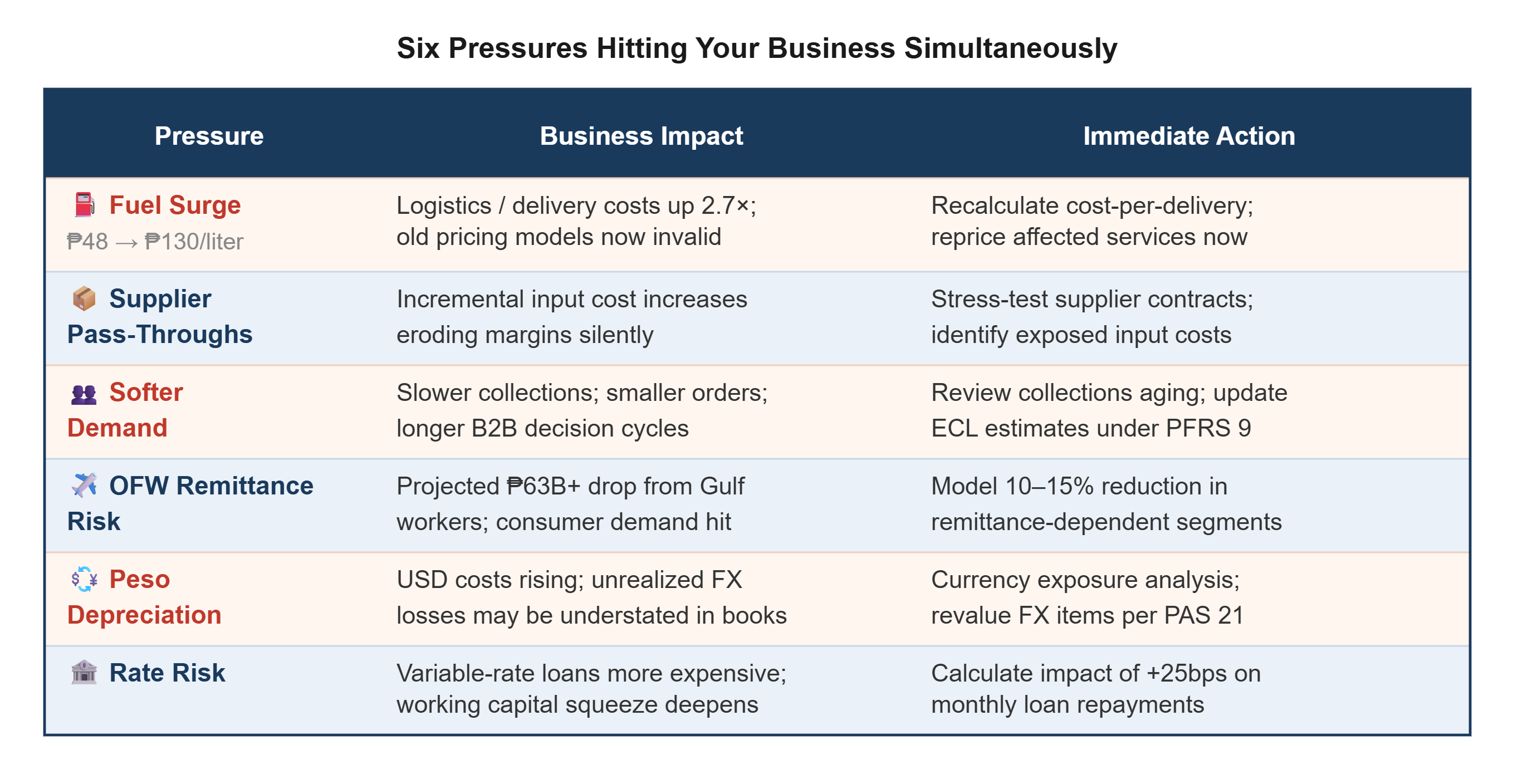
1. Your Operating Cost Structure Has a New Baseline
If your business involves delivery, logistics, field operations, or a vehicle fleet, your cost-per-transaction has changed materially, and the old numbers you used for pricing, margin calculation, and profitability projections are no longer valid.
This is not a matter of adjusting a fuel surcharge. It is a structural reset. A business that priced its delivery services at ₱48/liter now has a cost floor more than 2.7 times higher. Gross margins calculated on pre-March fuel rates are overstating profitability. Cash is going out faster than your books are capturing.
What to do: Recalculate your actual cost per delivery, service call, or client visit at current fuel prices. Update your pricing model and gross margin calculations immediately. Any pricing decision made before March 2026 should be revisited before it is renewed.
2. Your Suppliers Are About to Pass On Their Costs
Many Philippine suppliers are currently absorbing the energy shock, keeping prices stable in the short term to retain clients. This will not last. Transport, raw materials, manufacturing inputs, and cold chain operations are all more expensive today than they were in January. Suppliers have their own margins to protect.
When the pass-through begins, and it will, it will arrive in the form of incremental price increases across multiple supplier relationships, often with limited notice. Businesses that have not stress-tested their supplier cost exposure will absorb these increases reactively, one invoice at a time.
What to do: Review your supplier contracts for price adjustment clauses. Identify your top five most fuel-exposed or import-exposed input costs. Build a 90-day scenario, if each of those inputs increases by 10–15%, what happens to your gross margin? Where is your repricing flexibility?
3. Your Customers Are Spending More Carefully
Philippine unemployment rose from 3.8% to 5.8% in early 2026. Combined with above-target inflation, real wages have declined, meaning households have less actual purchasing power even if their nominal income has not changed.
Both consumer and B2B customers are responding predictably: tighter approval cycles, smaller transaction sizes, delayed purchasing decisions, and slower payment. Collections that previously moved in 30 days are stretching to 45 or 60. Discretionary spending is being deferred.
For B2B businesses, the impact is compounding: your client is facing the same pressures you are, and their slower payments create a cash flow gap on your side that you may be absorbing without fully recognizing it yet.
What to do: Pull your collections aging report for the last 60 days and compare it to the same period last year. If the average days-to-collect has lengthened, quantify the cash flow impact. Update your Expected Credit Loss (ECL) estimates in your books under PFRS 9 (Financial Instruments) to reflect the changed debtor environment.
4. OFW Remittances, A Hidden Demand Risk for Many Businesses
Overseas Filipino Worker remittances contribute 8–9% of Philippine GDP and are one of the most consistent drivers of domestic consumer demand, particularly in retail, food service, real estate, and consumer goods. The Middle East disruption poses a direct threat to this income stream.
Early projections indicate a potential reduction of ₱63 billion or more from Gulf-based OFW remittances in 2026. This is not a forecast of catastrophe, it is a reduction in a reliable demand driver that many Philippine businesses have unknowingly built their revenue models around.
If your customer base is concentrated in areas or income segments with high OFW household income, Metro Manila periphery, Cebu, Iloilo, Pampanga, and similar regions, your revenue may be more remittance-sensitive than your current financial model reflects.
What to do: Assess whether your customer base has significant exposure to remittance-dependent households. If it does, model a 10–15% reduction in that segment's spending as a downside scenario in your 2026 revenue forecast.
5. The Peso's Depreciation Is Repricing Your Costs
The peso depreciated from approximately ₱58 to ₱60 against the US dollar in the first quarter of 2026, and currency analysts are projecting continued weakness as the energy-driven current account deficit widens.
For businesses with any of the following, this is a direct cost increase that may not yet be fully reflected in your books:
Imported goods or raw materials priced in USD
Foreign-currency-denominated software subscriptions (cloud platforms, SaaS tools)
Foreign equipment leases or loan repayments in USD
Suppliers who invoice in USD regardless of where they operate
Under PAS 21 (The Effects of Changes in Foreign Exchange Rates), all foreign-currency-denominated monetary items must be revalued at the closing exchange rate at each reporting date. Unrealized foreign exchange losses on outstanding USD payables should already be reflected in your books, if they are not, your reported profitability is overstated.
What to do: Conduct a full currency exposure analysis. List every cost line that is directly or indirectly priced in USD. Revalue all outstanding foreign-currency balances at the current exchange rate. Build the projected cost of continued peso weakness into your 2026 financial plan, at minimum, model a ₱62–65 scenario for planning purposes.
6. Interest Rates Could Still Move, and They Matter More Than You Think
The BSP held benchmark interest rates steady at its March 2026 meeting, but explicitly communicated its vigilance on inflation. If the BSP's own revised 5.1% full-year inflation forecast materializes or is exceeded, a rate adjustment remains on the table.
For businesses carrying variable-rate working capital loans, revolving credit facilities, or floating-rate term loans, a 25–50 basis point increase translates directly into higher monthly interest costs, reducing the cash available for operations, supplier payments, and growth investment.
What to do: Identify every credit facility your business carries that has a variable or floating interest rate. Calculate the peso impact of a 25 basis point increase on your monthly cash outflow. If your working capital is heavily dependent on revolving credit, this sensitivity analysis is not optional.
The Compounding Risk: All of These at Once
The most important thing to understand about the 2026 economic environment is not any single pressure in isolation, it is the simultaneity.
Fuel costs rise → logistics costs increase → supplier pass-throughs build
Inflation rises → customer purchasing power falls → collections slow
Peso weakens → import costs rise → margin pressure intensifies
Demand softens → revenue growth slows → fixed costs represent a larger share of revenue
Rates potentially move → financing costs increase → liquidity tightens
Each of these dynamics, on its own, is manageable. Philippine businesses have navigated each of them before at different points in time. What makes 2026 unusual is that they are all active simultaneously, hitting different parts of the business at different moments. A business whose operations team is managing the fuel cost issue while the finance team is monitoring FX exposure may not see the compounding effect until it shows up in the bank account at the end of the month.
The Philippines is not in a crisis. It is navigating a disruption year with strong long-term fundamentals. But disruption years punish businesses that confuse revenue stability with financial resilience.
Cashflow Clarity is Your Competitive Edge in 2026
This moment does not call for panic. It calls for precision.
The businesses that will emerge from 2026 in a stronger competitive position are not necessarily those with the highest revenues or the widest margins, they are the ones with real-time visibility into their financial position: what is coming in, what is going out, where their exposure is, and how much runway they have under different scenarios.
That clarity enables the decisions that matter:
Pricing decisions made on actual current cost structures, not last year's assumptions
Supplier negotiations informed by documented cost exposure data
Hiring and expansion decisions stress-tested against a 90-day cash flow forecast
Credit management guided by live collections aging data, not end-of-quarter summaries
Banking conversations supported by financial statements that accurately reflect current FX and inflation impacts
Five Questions Every Philippine SME Should Be Able to Answer Today
1. Do you have a 90-day cash flow forecast built on current fuel prices, FX rates, and supplier costs? Not last quarter's forecast updated with a single adjustment, a rebuilt forecast from the ground up using current inputs.
2. Which of your variable costs are most exposed to fuel price or FX movements, and do you have real-time visibility into them? If the answer requires pulling data from multiple spreadsheets and reconciling manually, the answer is effectively no.
3. How quickly can you reprice your products or services if input costs continue to rise? What is your contractual flexibility? What is your customers' tolerance? What is the competitive risk?
4. Has your collections cycle changed in the last 60 days, and do you have data to confirm this? If you are not monitoring your average days-to-collect monthly, you are likely the last person in your business to know when it changes.
5. What is your financial buffer against simultaneous supplier price increases, a slowdown in collections, and a potential interest rate adjustment? How many months of operating expenses does your current cash position represent under a realistic stress scenario?
If you can answer all five confidently, you are well-positioned. If even one or two are unclear, the time to build that visibility is now, before circumstances force your hand.
Conclusion
The Q1 2026 convergence of fuel shocks, peso depreciation, above-target inflation, demand softening, and weakened investor sentiment has created a financial environment that rewards preparation and punishes assumptions. Your revenue may still look fine. But the gap between revenue stability and actual financial resilience, built on accurate books, live cash flow visibility, and stress-tested forecasts, is where 2026 will separate businesses that thrive from those that merely survive.
The tools exist. The data is available. What most Philippine SMEs need is not more information, it is a cleaner, faster, more accurate financial reporting process that turns that data into the decisions that matter.
References
Bangko Sentral ng Pilipinas (BSP). Q1 2026 Inflation Report and Monetary Policy Statement. BSP, March 2026. https://www.bsp.gov.ph
International Monetary Fund (IMF). World Economic Outlook, April 2026 - Philippines Growth Forecast Revision. IMF, April 2026. https://www.imf.org
Philippine Statistics Authority (PSA). Consumer Price Index - Transport Sector, Q1 2026. PSA, 2026. https://psa.gov.ph
Financial Reporting Standards Council (FRSC). PAS 21 - The Effects of Changes in Foreign Exchange Rates. https://www.frsc.gov.ph
Financial Reporting Standards Council (FRSC). PFRS 9 - Financial Instruments; Expected Credit Loss Model. https://www.frsc.gov.ph
Bangko Sentral ng Pilipinas (BSP). OFW Remittance Data and Gulf-Region Projections, Q1 2026. BSP, 2026. https://www.bsp.gov.ph
Upcloud Accounting: Virtual Outsourced Accounting and Bookkeeping Services in the Philippines
Upcloud Accounting offers accounting, bookkeeping, tax compliance, and business licensing services specializing with startups and SMEs in the Philippines.
Our goal is to increase efficiency, automation, and transparency across the accounting and finance functions of our clients with our cutting-edge technology. If you want to move your company’s finance function online, contact our Team of Expert Accountants and Bookkeepers directly via [email protected] or visit www.upcloudaccounting.comto learn more about how Upcloud Accounting accounting services can support your PH business!
Disclaimer: This article or blog is only for general knowledge and guidance and is not a substitute for an expert opinion. For technical advice, please consult your tax / legal advisor for your specific business concerns. For comments, suggestions, and feedback, feel free to email us at [email protected].