Latest Bookkeeping & Accounting Updates Philippines | May 2026
Published Date: May 13, 2026
Published By: Jac Cantos, Upcloud Accounting
The second quarter of 2026 brings a concentrated wave of regulatory changes that every business owner, accountant, and bookkeeper in the Philippines must act on, from mandatory digital book registration, a simplified SEC audit exemption for small companies, and critical filing deadline extensions, to new financial reporting standards that will reshape how income and sustainability are disclosed.
Whether you are a sole proprietor managing your own books or a finance team handling a mid-sized corporation, these updates are not optional reading. Here is everything you need to stay compliant and avoid penalties this quarter.
1. BIR Update: All Books of Accounts Must Now Be Registered via ORUS
Effective under Revenue Memorandum Circular No. 004-2026, the BIR has mandated that all business taxpayers, regardless of the type of books they maintain, must register their books of accounts exclusively through the Online Registration and Update System (ORUS). Manual walk-in registration at the Revenue District Office (RDO) is no longer permitted under normal circumstances, and will only be accommodated when the ORUS system is confirmed to be unavailable.
This directive applies to all three types of books currently in use:
Manual Books of Accounts Registration is completed online through ORUS. Once registered, the system generates a QR code that must be printed and affixed to the cover of each registered book. The physical books are still maintained in the traditional format, but registration and tracking are fully digital.
Loose-Leaf Books of Accounts Taxpayers must submit their digital records through ORUS and attach the QR code confirmation to the bound printed copies of their loose-leaf records. Loose-leaf users should also ensure their bound submissions are organized and date-stamped per the applicable permit conditions.
Computerized Books of Accounts (CAS) Taxpayers using a CAS must retain the QR proof of registration in their records. This QR confirmation serves as the official evidence of registration in the absence of a physically stamped book.
⚠️ Penalty exposure: Failure to register books through ORUS constitutes non-registration of books of accounts under Section 232 of the NIRC, which carries administrative penalties. The BIR has indicated that this will be a compliance checkpoint during examinations and LOA-based audits.
Reference: BIR Revenue Memorandum Circular No. 004-2026; Section 232, National Internal Revenue Code (NIRC), as amended
2. SEC Simplifies Compliance: The Php 3 Million Audit Exemption Threshold
One of the most business-friendly regulatory updates of 2026 comes from the Securities and Exchange Commission. Under SEC Memorandum Circular No. 4-2026, corporations whose total assets and total liabilities are each Php 3,000,000 or below are no longer required to submit Audited Financial Statements (AFS) with their annual reportorial filings.
Qualifying corporations may instead file:
Unaudited Financial Statements, and
A Statement of Management Responsibility (SMR) signed by authorized officers
This exemption eliminates the cost of an independent CPA audit for small and micro-sized corporations, representing significant savings for startups, single proprietorship corporations (OPCs), and small domestic companies.
Who Is Covered?
The exemption applies to:
One Person Corporations (OPCs)
Domestic corporations (stock and non-stock)
Foreign corporations registered with the SEC
Important Threshold Conditions
Both total assets and total liabilities must each be Php 3,000,000 or below to qualify. Exceeding either threshold on its own disqualifies the corporation from the exemption.
Corporations with assets or liabilities above Php 3,000,000 continue to be required to file audited financial statements prepared by an independent CPA.
Effectivity and Filing Deadlines
This circular takes effect for FY 2025 annual filings, with submission deadlines falling between May 15 and June 15, 2026, depending on the corporation's SEC registration number and applicable staggered schedule.
Reference: SEC Memorandum Circular No. 4-2026; Republic Act No. 11232 (Revised Corporation Code), Section 177
3. Extended Filing Deadlines: What Has Been Moved and Until When
Several major filing deadlines have been extended for the current period. Businesses and their accountants should update their compliance calendars immediately.
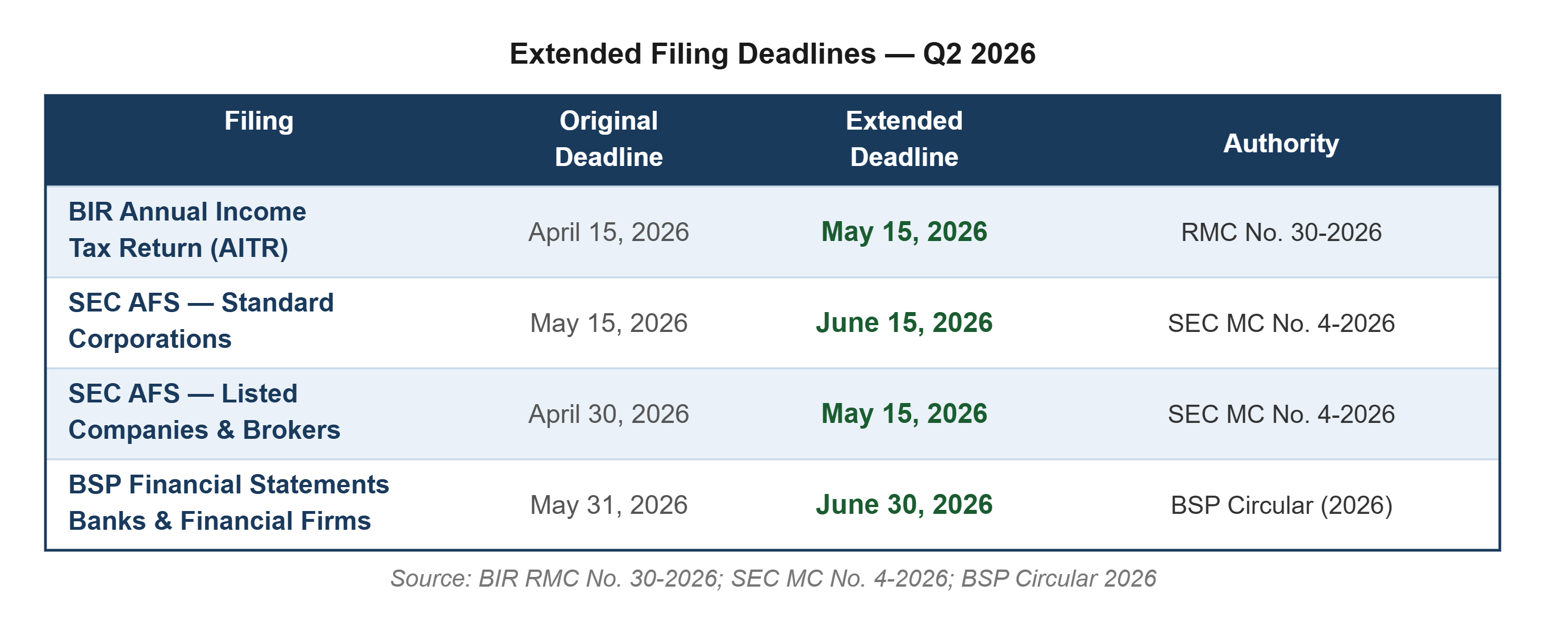
⚠️ Do not wait until the extended deadline. Extensions reduce the penalty for late filing, but they do not eliminate it. Businesses that delay preparation until the last day risk missing the extended cutoff due to system congestion, incomplete documents, or unresolved bookkeeping discrepancies. Filing early also allows time to correct errors before submission.
Reference: BIR RMC No. 30-2026; SEC Memorandum Circular No. 4-2026; BSP Circular (2026)
4. New Reporting Standards: PFRS 18 and Sustainability Disclosures
Two significant changes to Philippine financial reporting standards are either already in effect or require immediate preparation. Finance teams and their accountants need to understand these now, not at year-end.
PFRS 18: Replaces PAS 1 on Presentation of Financial Statements (Effective 2027)
Philippine Financial Reporting Standard 18 (PFRS 18) replaces PAS 1 (Presentation of Financial Statements) and introduces material changes to how the statement of profit or loss must be structured. The standard is effective for annual reporting periods beginning on or after January 1, 2027, with early adoption permitted.
Key changes under PFRS 18 include:
A revised structure for the income statement, requiring separate subtotals for operating profit, profit before financing and income taxes, and profit for the period
New requirements for management performance measures (MPMs), any non-GAAP metrics used in external communications must be reconciled to PFRS line items in the financial statements
Enhanced disclosure requirements for unusual income and expenses
What to do now: Begin mapping your current income statement structure against the new PFRS 18 categories. Entities that use non-GAAP metrics (adjusted EBITDA, core income) in investor presentations or reports must prepare for the MPM reconciliation requirement. Waiting until 2027 to assess the impact is too late for entities with complex revenue or expense structures.
PFRS S1 and S2: Sustainability and Climate Reporting
The Financial Reporting Standards Council (FRSC) has adopted PFRS S1 (General Requirements for Disclosure of Sustainability-related Financial Information) and PFRS S2 (Climate-related Disclosures), aligned with the IFRS Sustainability Disclosure Standards issued by the ISSB.
PFRS S1 requires entities to disclose material sustainability-related risks and opportunities that could reasonably be expected to affect cash flows, access to finance, or the cost of capital.
PFRS S2 requires specific disclosures on climate-related risks, including governance, strategy, risk management, and metrics and targets (including Scope 1, 2, and 3 greenhouse gas emissions).
The phased rollout begins in 2026 for large listed corporations, with broader application to follow in subsequent years.
PAS 1 Amendment: Materiality in Accounting Policy Disclosures
A targeted amendment to PAS 1 (now superseded by PFRS 18 for presentation purposes, but still relevant for current-period filings) requires entities to disclose material accounting policies rather than merely "significant" ones. This is a substantive shift: entities must now evaluate whether a policy disclosure is actually useful to users, rather than applying a blanket checklist of standard policies.
Reference: PFRS 18 (effective January 1, 2027); PFRS S1 and S2 (FRSC adoption, phased from 2026); PAS 1 Amendment, Disclosure of Accounting Policies
5. Economic Impact: How Inflation and Peso Weakness Affect Your Bookkeeping
Regulatory compliance does not happen in a vacuum. The current macroeconomic environment, sustained inflation, rising input costs, and a peso trading at Php 60 and above against the US dollar, has direct and material implications for how businesses record and report their financials.
Rising Costs: Reclassify and Reallocate
Higher fuel, logistics, and raw material prices are compressing margins across industries. From a bookkeeping standpoint, businesses should:
Review expense classification - costs that were previously immaterial may now be large enough to warrant their own line item or reclassification (e.g., fuel costs that previously sat in "general expenses" may now warrant their own account code)
Update cost allocations - businesses with multiple products, branches, or cost centers should revisit their allocation bases to ensure overhead and indirect costs are accurately distributed
Adjust standard costs - manufacturing and trading businesses using standard costing should update their cost standards to reflect current input prices, or variance accounts will accumulate distortions
Foreign Exchange: Track, Disclose, Manage
With the peso at elevated depreciation levels, businesses with foreign currency transactions, whether import purchases, export receivables, or USD-denominated service contracts, must:
Record FX gains and losses on all foreign currency-denominated transactions at each reporting date under PAS 21 (The Effects of Changes in Foreign Exchange Rates)
Revalue outstanding foreign-currency balances (receivables, payables, loans) at the closing rate at each reporting period
Review inventory and asset valuations for imported goods that are carried at historical peso cost, the replacement cost may now differ materially
Receivables and Cash Flow: Provision for Bad Debts
Tight economic conditions tend to slow collections and increase credit risk. Businesses should:
Update allowance for expected credit losses (ECL) in accordance with PFRS 9 (Financial Instruments), if debtor behavior has deteriorated in 2026, the ECL model inputs must reflect this
Review aging schedules monthly rather than quarterly, a quarterly review may miss a significant deterioration in the 30–60 day bucket before it becomes a write-off risk
Update cash flow forecasts to reflect longer collection cycles when planning for VAT remittances, loan amortizations, and other fixed payment obligations
Reference: PAS 21,The Effects of Changes in Foreign Exchange Rates; PFRS 9, Financial Instruments; BSP Inflation Reports Q1–Q2 2026
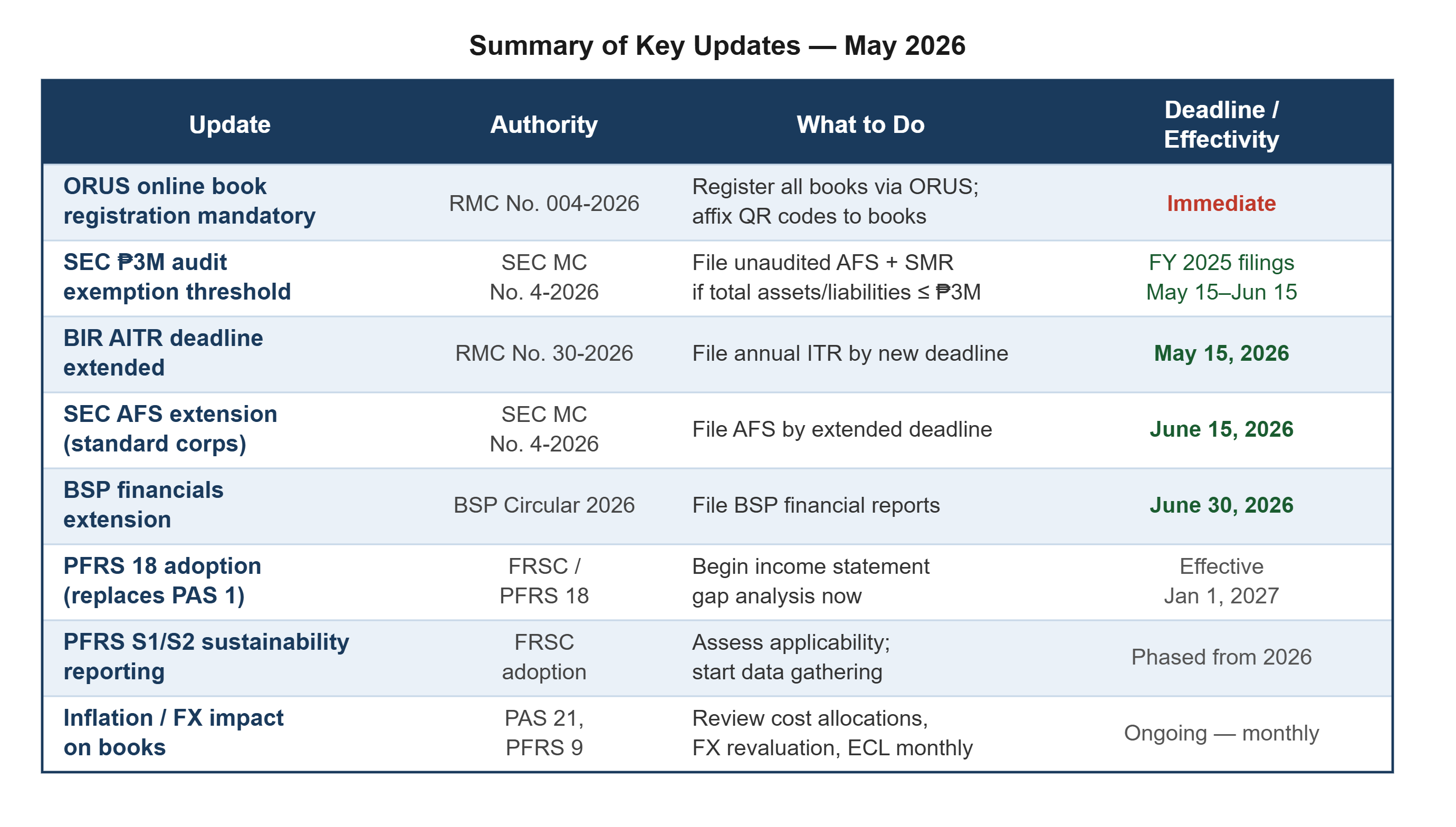
Summary of Key Updates May 2026
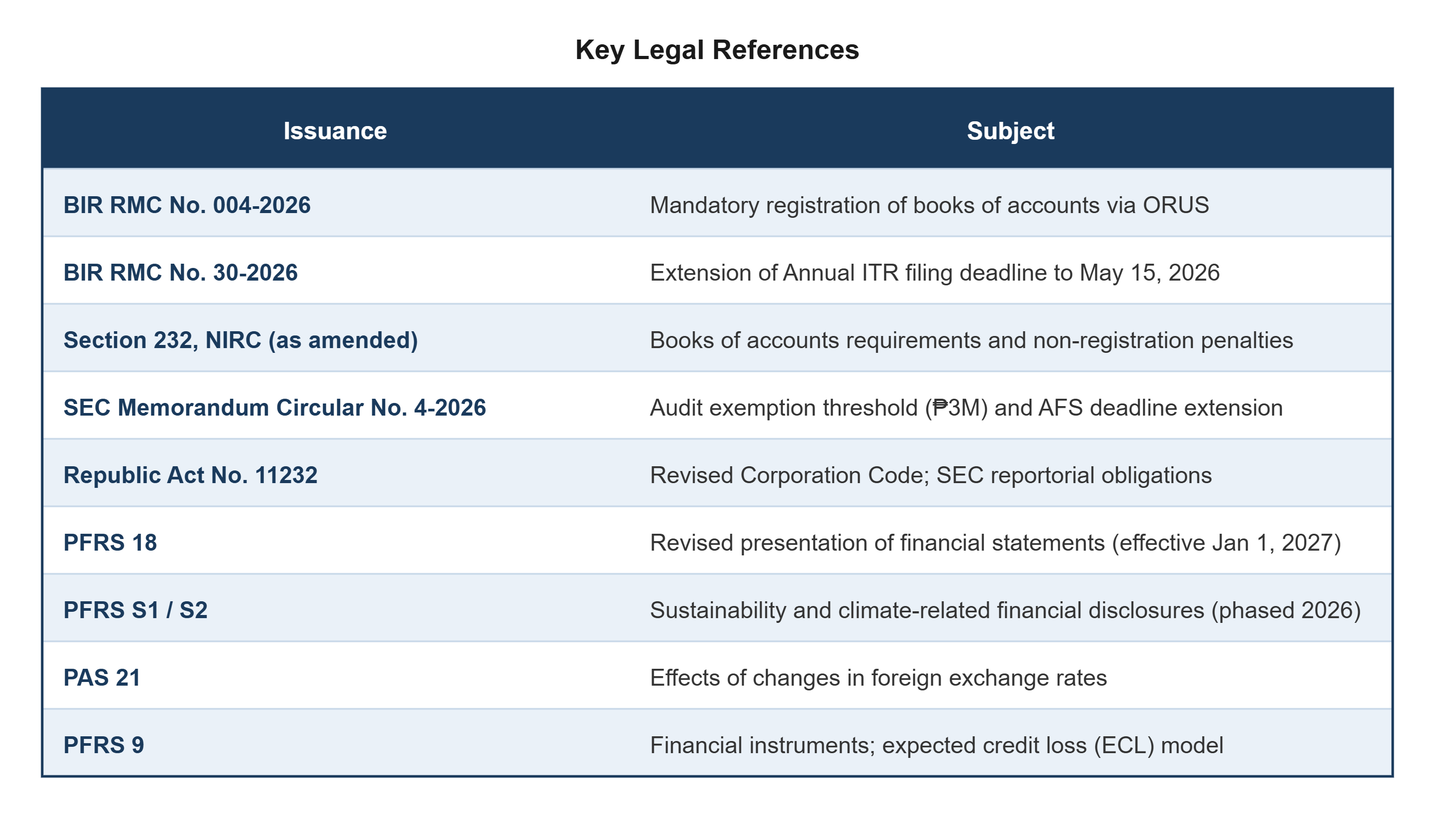
Key Legal References
Conclusion
May 2026 is a compliance-intensive month for Philippine businesses. The shift to ORUS-only book registration, the new SEC audit exemption for small corporations, a cluster of extended filing deadlines, and the arrival of PFRS 18 and sustainability reporting standards all require immediate attention, not year-end scrambling.
The businesses that navigate this period cleanly will be those that treat compliance as a continuous process: updating systems, reviewing records monthly, and engaging qualified accounting professionals before problems arise rather than after assessments land.
References
Bureau of Internal Revenue. Revenue Memorandum Circular No. 004-2026: Mandatory Registration of Books of Accounts via ORUS. BIR, 2026. https://www.bir.gov.ph
Bureau of Internal Revenue. Revenue Memorandum Circular No. 30-2026: Extension of Annual ITR Filing Deadline. BIR, 2026. https://www.bir.gov.ph
Securities and Exchange Commission. Memorandum Circular No. 4-2026: Simplified Reportorial Requirements and Audit Exemption Threshold. SEC, 2026. https://www.sec.gov.ph
Republic of the Philippines. Republic Act No. 11232, Revised Corporation Code of the Philippines, Section 177. https://www.sec.gov.ph
Financial Reporting Standards Council (FRSC). PFRS 18, Presentation and Disclosure in Financial Statements (effective January 1, 2027). https://www.frsc.gov.ph
Financial Reporting Standards Council (FRSC). PFRS S1 and PFRS S2, Sustainability and Climate-related Disclosures (phased adoption from 2026). https://www.frsc.gov.ph
Financial Reporting Standards Council (FRSC). PAS 21, The Effects of Changes in Foreign Exchange Rates; PFRS 9, Financial Instruments. https://www.frsc.gov.ph
Upcloud Accounting: Virtual Outsourced Accounting and Bookkeeping Services in the Philippines
Upcloud Accounting offers accounting, bookkeeping, tax compliance, and business licensing services specializing with startups and SMEs in the Philippines.
Our goal is to increase efficiency, automation, and transparency across the accounting and finance functions of our clients with our cutting-edge technology. If you want to move your company’s finance function online, contact our Team of Expert Accountants and Bookkeepers directly via [email protected] or visit www.upcloudaccounting.comto learn more about how Upcloud Accounting accounting services can support your PH business!
Disclaimer: This article or blog is only for general knowledge and guidance and is not a substitute for an expert opinion. For technical advice, please consult your tax / legal advisor for your specific business concerns. For comments, suggestions, and feedback, feel free to email us at [email protected].