Navigating the Future: Key Bookkeeping and Accounting Updates in the Philippines (Q2 2026)
Published Date: May 07, 2026
Published By: Jac Cantos, Upcloud Accounting
For Philippine businesses, accountants, and finance professionals, staying current with regulatory and industry developments is not optional, it is the foundation of sound financial management. The second quarter of 2026 has brought a convergence of notable changes: a landmark merger reshaping local accounting technology, an important shift in how financial statements must disclose accounting policies, and encouraging macroeconomic data signaling continued growth momentum.
This edition covers three key developments every business and accountant in the Philippines should understand heading into the second half of 2026.
1. AI-Driven Accounting Arrives: JuanTax and Jaz Philippines Merge to Launch JUAN Accounting Software
In what is being described as a pivotal moment for local financial technology, JuanTax, one of the Philippines' leading electronic tax filing and compliance software providers, and Jaz Philippines have formally merged to launch Juan Accounting Software (JUAN). The combined platform represents a significant step forward in purpose-built, AI-powered accounting solutions designed specifically for Filipino businesses.
What Is JUAN?
JUAN is an integrated cloud-based platform that consolidates four functions that Philippine SMEs have historically managed across separate systems:
Accounting and bookkeeping: chart of accounts, journal entries, ledger management
Tax compliance: BIR-aligned tax return preparation, eBIRForms integration, and electronic filing
Payments processing: invoicing, collections, and payment tracking
Financial reporting: income statements, balance sheets, and other financial statements prepared in accordance with local standards
The platform is designed to comply with BIR regulations, including the invoicing requirements under RR 7-2024 and the electronic book registration requirements under RMC 004-2026, making it directly aligned with the most current compliance mandates.
Why This Matters for Philippine SMEs
The Philippine market has long been served primarily by international accounting software platforms, such as QuickBooks, Xero, and Sage, that require significant customization or workarounds to accommodate local BIR forms, tax rates, and reporting formats. JUAN's localization-first design is intended to eliminate that gap.
Key differentiators include:
BIR-native compliance - tax returns, alphalists, and certificate generation built around Philippine requirements from the ground up, not adapted from a foreign tax framework
AI-assisted bookkeeping - automated transaction categorization, anomaly detection, and reconciliation suggestions designed to reduce manual data entry errors
SME accessibility - pricing and interface design targeted at micro, small, and medium enterprises and the accountants who serve them, rather than enterprise-scale deployments
For Upcloud Accounting clients using older or internationally-oriented software, the emergence of JUAN represents a locally relevant alternative worth evaluating, particularly for businesses that struggle with BIR form alignment or manual alphalist preparation.
What to Watch
As JUAN is a newly launched platform following the merger, businesses and accountants considering adoption should conduct appropriate due diligence, including reviewing data migration capabilities, BIR ORUS and CAS permit compatibility, and the maturity of its support infrastructure. Early adopters of new platforms always carry some implementation risk that should be weighed against the potential efficiency gains.
2. PAS 1 Amendment: From "Significant" to "Material" Accounting Policy Disclosures
The Auditing and Assurance Standards Council (AASC) has issued a formal alert regarding amendments to Philippine Accounting Standard 1 (PAS 1), Presentation of Financial Statements, which introduce a substantive change to how entities disclose their accounting policies in financial statements.
The Core Change: "Material" Replaces "Significant"
Under the previous version of PAS 1, entities were required to include "a summary of significant accounting policies" as part of the notes to their financial statements. The amendment replaces this requirement with a disclosure of "material accounting policy information."
While this may appear to be a semantic change, the practical implications are meaningful:
Under the old standard, companies often disclosed long, boilerplate lists of accounting policies, covering every applicable standard even when those policies were routine, widely understood, and not specific to the entity's circumstances.
Under the amended standard, entities must exercise judgment to identify which accounting policy disclosures are actually material, that is, which policies, if omitted or misstated, could reasonably be expected to influence the decisions of the users of the financial statements.
The result is intended to be shorter, more focused, and more entity-specific notes to financial statements, rather than generic policy templates reproduced across all companies in an industry.
Guidance Added on Applying Materiality
The amendments also add new application guidance to help entities apply the materiality concept to accounting policy disclosures. The guidance clarifies that:
An accounting policy is likely to be material if it relates to a material transaction, event, or condition in the entity's financial statements
Standard or routine policies that do not involve significant judgment or that are widely understood may generally be omitted from the notes
Where an entity has chosen an accounting policy from available options, or applies a policy in an unusual or non-standard way, disclosure is more likely to be material regardless of the transaction size
Impact on Auditors and Audit Reports
This amendment has a direct and mandatory effect on Philippine Standards on Auditing (PSAs) and, specifically, on the wording of the independent auditor's report. The AASC alert clarifies that the standard phrase found in the opinion paragraph of auditor's reports, "a summary of significant accounting policies", must now be updated to read:
"material accounting policy information"
Auditors issuing reports for financial periods covered by this amendment must update their report templates accordingly. Entities should also align with their external auditors on the revised disclosure approach before finalizing financial statements to avoid last-minute revisions.
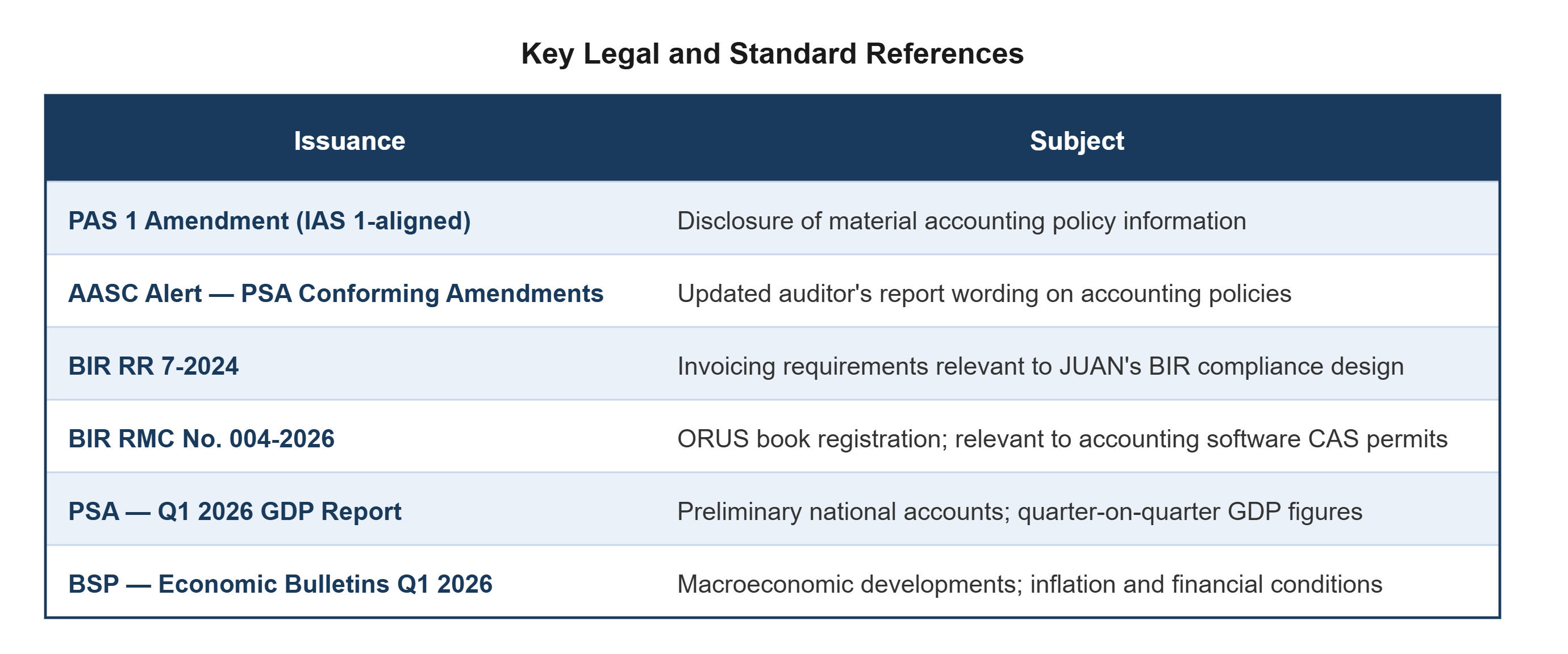
Reference: PAS 1 Amendment, Disclosure of Accounting Policies (aligned with IAS 1 Amendment issued by the IASB); AASC Alert on PSA Conforming Amendments
3. Philippine Economy Accelerates in Q1 2026: What It Means for Your Business
The Philippine economy continued its growth trajectory in the first quarter of 2026, with the Gross Domestic Product (GDP) expanding by 0.9% quarter-on-quarter in Q1 2026, an improvement from the 0.6% quarter-on-quarter growth recorded in Q4 2025.
Reading the Numbers
Quarter-on-quarter GDP growth measures the change in economic output relative to the immediately preceding quarter. The Q1 2026 figure of 0.9%, compared to 0.6% in Q4 2025, indicates that the pace of economic expansion has accelerated, not merely continued. This is a meaningful distinction for business planning purposes.
The uptick reflects improved performance across key sectors and suggests that domestic economic activity gained momentum at the start of the year, despite ongoing global headwinds including elevated interest rates in major economies and continued supply chain adjustments.
Implications for Business and Financial Planning
Macroeconomic acceleration has direct, practical implications for how Philippine businesses should approach their bookkeeping, financial reporting, and strategic planning:
Revenue projections and budgets. Businesses that built their 2026 budgets on conservative Q4 2025 assumptions may now have room to revise revenue projections upward, but should do so based on sector-specific data rather than aggregate GDP alone.
Credit and collections. Improved economic activity generally supports better collections and reduced credit risk. Finance teams should review their expected credit loss (ECL) estimates under PFRS 9 in light of improving macroeconomic conditions, ECL models that rely on historical default rates from slower-growth periods may be overstating provisioning requirements.
Capital expenditure and investment. Growing economic momentum often precedes increased capital spending. Businesses considering asset acquisitions, leasehold improvements, or equipment purchases should ensure their books and depreciation schedules are current and that any new assets are properly tagged for BIR purposes.
Cost management. While GDP growth is positive, inflationary pressures and peso volatility remain active concerns. Businesses should not interpret economic acceleration as a signal to relax cost controls, expense monitoring and monthly budget-vs-actual reviews remain essential discipline.
Reference: Philippine Statistics Authority (PSA), GDP and National Accounts, Q1 2026 Preliminary Estimates; Bangko Sentral ng Pilipinas (BSP) Economic Bulletins Q1 2026
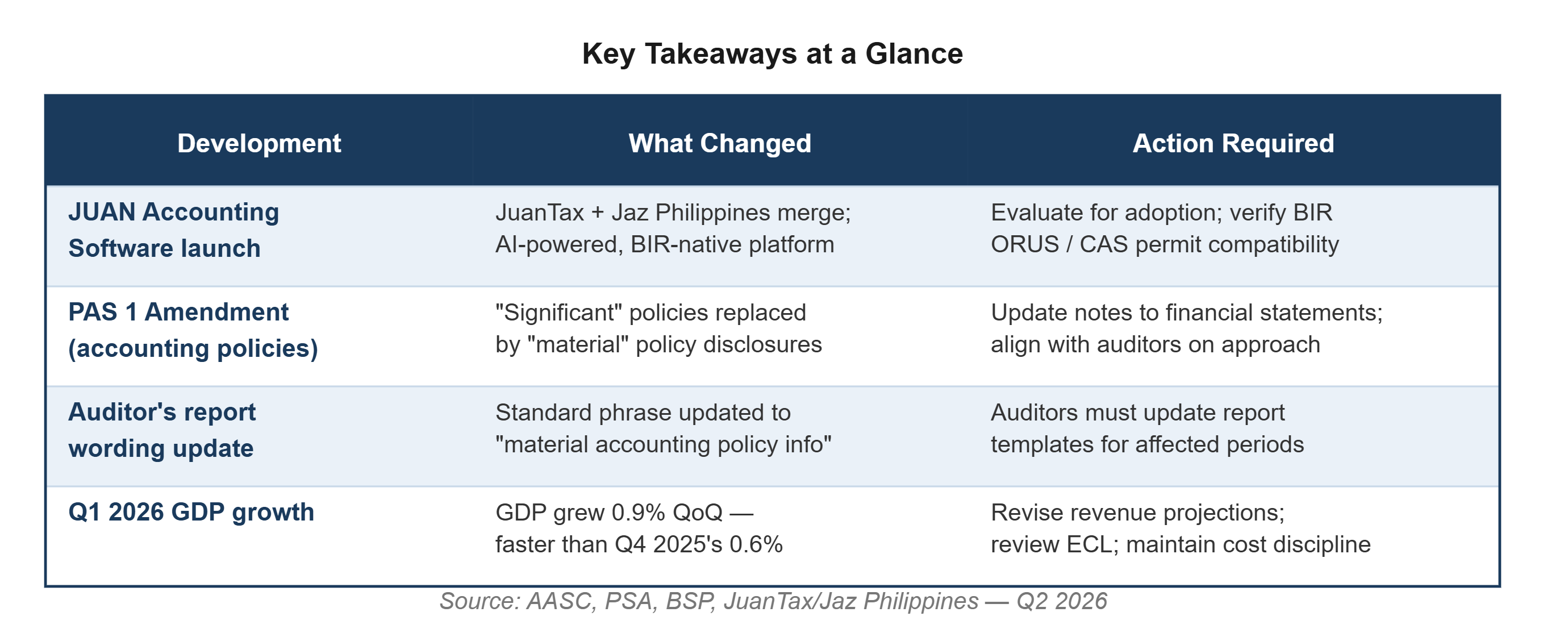
Key Takeaways at a Glance
Key Legal and Standard References
Conclusion
The second quarter of 2026 is shaping up to be a period of meaningful transition for Philippine businesses and accounting professionals. The launch of JUAN signals a maturing local fintech ecosystem that is increasingly capable of meeting BIR-specific compliance needs without relying on international software adaptations. The PAS 1 amendment pushes financial reporting toward greater relevance and away from boilerplate disclosure. And the Q1 2026 GDP data offers a measured dose of optimism, tempered by the continued need for disciplined financial management in an environment that remains complex.
For businesses and their accountants, the common thread across all three developments is the same: staying informed, updating systems and disclosures promptly, and treating compliance as an ongoing practice rather than a year-end exercise.
References
JuanTax / Jaz Philippines. Announcement of the Merger and Launch of Juan Accounting Software (JUAN). 2026.
Auditing and Assurance Standards Council (AASC). AASC Alert: Amendments to PAS 1, Disclosure of Accounting Policies and Conforming Amendments to Philippine Standards on Auditing. AASC, 2026.
International Accounting Standards Board (IASB). Amendments to IAS 1 and IFRS Practice Statement 2, Disclosure of Accounting Policies. IASB (adopted locally as PAS 1 Amendment).
Philippine Statistics Authority (PSA). Gross Domestic Product, First Quarter 2026 Preliminary Estimates. PSA, 2026. https://psa.gov.ph
Bangko Sentral ng Pilipinas (BSP). Economic and Financial Developments,Q1 2026. BSP, 2026. https://www.bsp.gov.ph
Bureau of Internal Revenue. Revenue Regulations No. 7-2024: Invoicing Requirements under the EOPT Act. BIR, 2024. https://www.bir.gov.ph
Bureau of Internal Revenue. Revenue Memorandum Circular No. 004-2026: Mandatory ORUS Book Registration. BIR, 2026. https://www.bir.gov.ph
Upcloud Accounting: Virtual Outsourced Accounting and Bookkeeping Services in the Philippines
Upcloud Accounting offers accounting, bookkeeping, tax compliance, and business licensing services specializing with startups and SMEs in the Philippines.
Our goal is to increase efficiency, automation, and transparency across the accounting and finance functions of our clients with our cutting-edge technology. If you want to move your company’s finance function online, contact our Team of Expert Accountants and Bookkeepers directly via [email protected] or visit www.upcloudaccounting.comto learn more about how Upcloud Accounting accounting services can support your PH business!
Disclaimer: This article or blog is only for general knowledge and guidance and is not a substitute for an expert opinion. For technical advice, please consult your tax / legal advisor for your specific business concerns. For comments, suggestions, and feedback, feel free to email us at [email protected].