
Philippine Payroll Compliance: What Every Business Must Know About BIR, SSS, PhilHealth, Pag-IBIG, SEC, and DTI Requirements
Published Date: June 03, 2026
Published By: Jac Cantos, Upcloud Accounting
Running a business in the Philippines means more than managing day-to-day operations. Every employer, from a startup with two employees to an established SME with a growing workforce, carries a set of mandatory payroll and regulatory compliance obligations enforced by six government agencies: the BIR, SSS, PhilHealth, Pag-IBIG Fund, SEC, and DTI.
Missing a filing deadline, under remitting a contribution, or letting a registration lapse can trigger penalties, interest charges, and even suspension of business registration. In 2026, these obligations remain firmly in place, and government agencies are increasingly leveraging digital systems to detect non-compliance faster.
This guide breaks down what each agency requires, the legal basis for each obligation, and the most common compliance pitfalls to avoid.
Why Payroll Compliance Is a Legal Obligation, Not Just Good Practice
Philippine employers are subject to multiple layers of compliance under national law. Payroll processing sits at the intersection of several statutes, each administered by a different agency:
Tax obligations under the National Internal Revenue Code (NIRC), administered by the BIR
Social security contributions under Republic Act No. 11199 (Social Security Act of 2018), administered by SSS
Health insurance premiums under Republic Act No. 11223 (Universal Health Care Act), administered by PhilHealth
Housing fund contributions under Republic Act No. 9679 (Home Development Mutual Fund Law of 2009), administered by Pag-IBIG / HDMF
Corporate reportorial duties under the Revised Corporation Code (Republic Act No. 11232), administered by SEC
Business name registration under Republic Act No. 3883, as amended, administered by DTI
Failure to comply with any of these can result in penalties, interest charges, criminal liability for responsible officers, and operational disruption.
1. BIR Tax Compliance
The Bureau of Internal Revenue administers all national tax obligations. For employers, BIR compliance covers the proper withholding, filing, and remittance of taxes on employee compensation and business income.
Key Employer Obligations
Withholding Tax on Compensation (WTC) Under Section 79 of the NIRC, every employer is required to withhold income tax from the compensation of employees and remit it to the BIR on a monthly and annual basis.
BIR Form 1601-C — Monthly remittance of withheld taxes on compensation
BIR Form 0619-E — Monthly remittance of expanded withholding taxes
BIR Form 1604-C — Annual information return of income taxes withheld on compensation
BIR Form 2316 — Certificate of Compensation Payment / Tax Withheld; must be issued to each employee annually
Substituted Filing Qualified employees whose sole income is from one employer may be covered by substituted filing — meaning the employer's BIR Form 2316 substitutes for the employee's individual income tax return. However, employees with multiple employers, or those with other taxable income, must still file their own returns.
Payroll Records Employers are required to maintain accurate payroll records as part of their books of accounts under Section 232 of the NIRC. These are subject to BIR audit and must be retained for at least ten years.
Reference: NIRC Sections 79–83 (Withholding of Tax on Wages), as amended by RA 10963 (TRAIN Law); RR No. 11-2018 (Revised Withholding Tax Regulations)
2. SSS (Social Security System) Contributions
The Social Security System provides social protection to private sector employees through mandatory contributions from both employer and employee. Employer compliance is governed by Republic Act No. 11199 (Social Security Act of 2018).
Key Employer Obligations
Register all employees with the SSS upon commencement of employment
Deduct the employee's share of SSS contributions from monthly compensation
Remit both the employer's and employee's shares on or before the applicable deadline
Submit monthly contribution lists (R3 Collection List or via My.SSS portal)
2025–2026 Contribution Schedule Under the revised contribution schedule pursuant to RA 11199, SSS contribution rates have been gradually increasing. As of 2025, the total contribution rate is 15% of monthly salary credit, split between employer (10%) and employee (5%), subject to the applicable salary credit brackets.
⚠️ Penalty for late remittance: Under Section 22(b) of RA 11199, employers who fail to remit contributions on time are subject to a penalty of 3% per month on the unremitted amount, plus potential criminal liability for responsible officers.
Reference: Republic Act No. 11199 (Social Security Act of 2018); SSS Circular No. 2023-010 (Contribution Schedule)
3. PhilHealth (Philippine Health Insurance Corporation)
PhilHealth administers the National Health Insurance Program, which provides health coverage for all Filipinos. Under Republic Act No. 11223 (Universal Health Care Act), enrollment and contribution are mandatory for all employees and employers.
Key Employer Obligations
Enroll all employees in PhilHealth upon hiring
Deduct the employee's share of monthly premiums from compensation
Remit the total premium (employer + employee shares) on time
Submit monthly premium remittance reports (RF-1 Form or via PhilHealth Online Employer Registration and Reporting System / EPRS)
2026 Premium Rate Pursuant to PhilHealth Circular No. 2023-0009, the premium rate has been progressively increasing under the UHC Act's implementation schedule. As of 2025–2026, the monthly premium rate is 5% of basic monthly salary, shared equally between employer and employee (2.5% each), subject to the applicable income floor and ceiling.
⚠️ Penalty for non-compliance: Employers who fail to enroll employees or remit premiums face surcharges, penalties, and potential criminal prosecution under Section 28 of RA 7875, as amended by RA 11223.
Reference: Republic Act No. 11223 (Universal Health Care Act); PhilHealth Circular No. 2023-0009
4. Pag-IBIG Fund (HDMF) Contributions
The Home Development Mutual Fund (Pag-IBIG) provides employees with savings, housing loans, and other financial benefits. Membership and contribution are mandatory for all employees under Republic Act No. 9679 (Home Development Mutual Fund Law of 2009).
Key Employer Obligations
Register all employees with Pag-IBIG upon hiring
Deduct the employee's mandatory contribution (minimum Php 100/month for employees earning Php 1,500 and below; Php 200/month for employees earning above Php 1,500)
Remit both employer and employee contributions on or before the applicable deadline
Maintain complete contribution records for audit purposes
Modified Pag-IBIG II (MP2) and Voluntary Contributions Employers may also facilitate employees' voluntary contributions under the MP2 savings program, which offers higher dividend rates and tax-free earnings upon maturity.
⚠️ Penalty for non-compliance: Failure to remit contributions on time subjects the employer to a penalty of 1/10 of 1% per day of the unremitted amount under Section 28 of RA 9679.
Reference: Republic Act No. 9679 (HDMF Law of 2009); Pag-IBIG Fund Circular No. 274 (Revised Contribution Schedule)
5. SEC Reportorial Requirements for Corporations
Corporations and partnerships registered with the Securities and Exchange Commission are required to submit annual reportorial documents under the Revised Corporation Code (Republic Act No. 11232) and SEC Memorandum Circulars.
Key Filing Obligations
General Information Sheet (GIS) The GIS must be filed within 30 calendar days from the date of the annual stockholders' or members' meeting. It contains information on the corporation's officers, directors, stockholders, and paid-up capital.
Audited Financial Statements (AFS) Corporations must file their AFS — prepared in accordance with Philippine Financial Reporting Standards (PFRS) and audited by an independent Certified Public Accountant — within 120 calendar days from the end of the fiscal year.
Under SEC Memorandum Circular No. 2-2020 and subsequent amendments, the AFS submission deadline is staggered by the last numerical digit of the corporation's SEC registration number.
Other Reportorial Documents Depending on the nature and size of the corporation, additional reports may be required, including the Sustainability Report for large corporations under SEC Memorandum Circular No. 4-2019.
⚠️ Penalty for late filing: Under Section 158 of RA 11232, corporations that fail to submit required reports face administrative fines. Continued failure to file may result in revocation of the Certificate of Incorporation.
Reference: Republic Act No. 11232 (Revised Corporation Code); SEC Memorandum Circular No. 2-2020; SEC Memorandum Circular No. 4-2019
6. DTI Business Name Registration
For sole proprietors, the Department of Trade and Industry (DTI) issues the Certificate of Business Name Registration under Republic Act No. 3883, as amended by RA 863 and RA 7042. This registration is a prerequisite for other business licenses, including BIR registration and Mayor's Permit.
Key Obligations for Sole Proprietors
Register the business name before commencing operations at the DTI or through the BNRS (Business Name Registration System) online portal
Renew the registration every five years before the expiration date
Update registration upon changes in business name, address, business activity, or business structure
⚠️ Penalty for operating without registration: Using an unregistered business name is a violation under RA 3883 and may subject the proprietor to fines, closure of business, and penalties from other agencies whose requirements build upon DTI registration.
Reference: Republic Act No. 3883 (Business Name Law), as amended; DTI Department Administrative Order No. 20-12-A
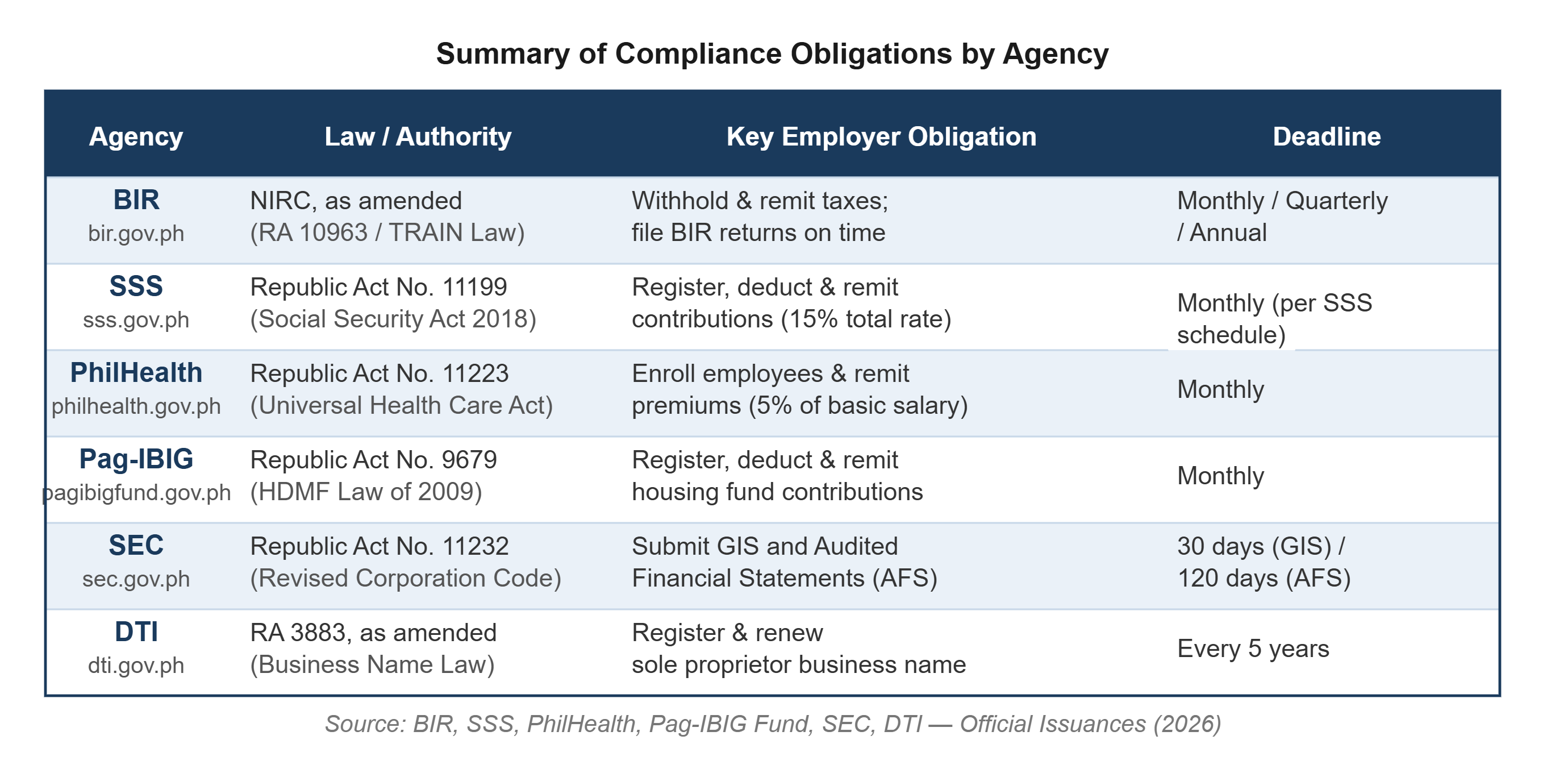
Summary of Compliance Obligations by Agency
Common Compliance Challenges for Growing Businesses
Even well-intentioned businesses can fall behind on compliance. The most common pain points include:
1. Manual payroll processing errors. Manually computing withholding taxes, pro-rated contributions, and salary adjustments across multiple compensation structures is error-prone. A single miscalculation can cascade into BIR deficiency tax assessments or SSS penalty notices.
2. Missing government remittance deadlines. Each agency has its own remittance schedule, reference numbers, and filing channels. Managing five sets of monthly deadlines simultaneously — without an automated system — leads to late payments and accumulating penalties.
3. Incomplete or inaccurate payroll records. BIR, SSS, and PhilHealth all reserve the right to audit contribution and withholding records. Businesses that rely on informal timekeeping or spreadsheet-based payroll often struggle to produce compliant documentation during audits.
4. Failure to update registrations upon headcount changes. Newly hired employees must be enrolled with SSS, PhilHealth, and Pag-IBIG immediately upon hiring. Failure to enroll in a timely manner can result in benefit gaps for employees and penalties for employers.
5. Overlooking SEC and DTI renewal deadlines. Annual GIS submissions and five-year DTI renewals are easy to miss in the absence of a compliance calendar. Late or missing SEC filings carry escalating fines that can jeopardize corporate standing.
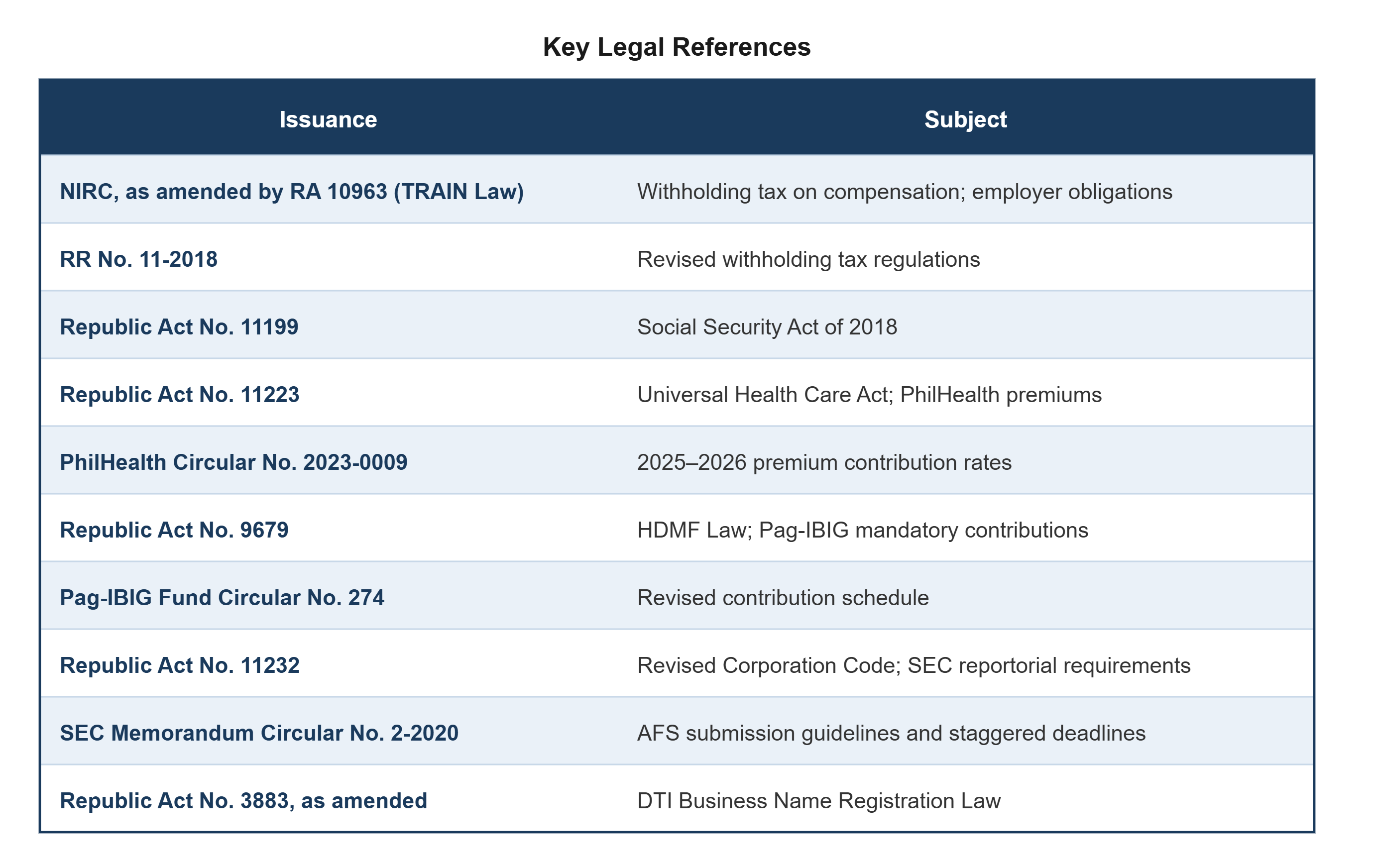
Key Legal References
Conclusion
Philippine payroll compliance is not a single task, it is an ongoing, multi-agency responsibility that touches every payroll cycle, every new hire, and every year-end close. The combined obligations of the BIR, SSS, PhilHealth, Pag-IBIG, SEC, and DTI form the legal backbone of how businesses in the Philippines operate and are accountable to both the government and their employees.
Staying current requires not just awareness of the rules, but the right systems and expertise to execute them accurately, on time, and in full.
References
Bureau of Internal Revenue. National Internal Revenue Code of the Philippines (NIRC), as amended by RA 10963 (TRAIN Law). https://www.bir.gov.ph
Bureau of Internal Revenue. Revenue Regulations No. 11-2018: Revised Withholding Tax Regulations. BIR, 2018.
Republic of the Philippines. Republic Act No. 11199 — Social Security Act of 2018. https://www.sss.gov.ph
Republic of the Philippines. Republic Act No. 11223 — Universal Health Care Act. PhilHealth Circular No. 2023-0009. https://www.philhealth.gov.ph
Republic of the Philippines. Republic Act No. 9679 — Home Development Mutual Fund Law of 2009. Pag-IBIG Fund Circular No. 274. https://www.pagibigfund.gov.ph
Republic of the Philippines. Republic Act No. 11232 — Revised Corporation Code of the Philippines. SEC Memorandum Circular No. 2-2020. https://www.sec.gov.ph
Republic of the Philippines. Republic Act No. 3883 — Business Name Law, as amended. https://www.dti.gov.ph
Upcloud Accounting: Virtual Outsourced Accounting and Bookkeeping Services in the Philippines
Upcloud Accounting offers accounting, bookkeeping, tax compliance, and business licensing services specializing with startups and SMEs in the Philippines.
Our goal is to increase efficiency, automation, and transparency across the accounting and finance functions of our clients with our cutting-edge technology. If you want to move your company’s finance function online, contact our Team of Expert Accountants and Bookkeepers directly via [email protected] or visit www.upcloudaccounting.comto learn more about how Upcloud Accounting accounting services can support your PH business!
Disclaimer: This article or blog is only for general knowledge and guidance and is not a substitute for an expert opinion. For technical advice, please consult your tax / legal advisor for your specific business concerns. For comments, suggestions, and feedback, feel free to email us at [email protected].