
Setting Up Payroll for the First Time in the Philippines: What Every New Employer Needs to Know
Published Date: August 20, 2026
Published By: Jac Cantos, Upcloud Accounting
Hiring your first employee is one of the most significant milestones in building a business. It means your operations have grown beyond what you alone can manage, and that is worth celebrating. But it also means that from the moment your first employee starts work, you are an employer in the eyes of the law, and a new set of mandatory obligations immediately applies to you.
Philippine payroll is not simply the act of paying someone a salary. It is a structured compliance system governed by multiple agencies, the Bureau of Internal Revenue (BIR), the Social Security System (SSS), PhilHealth, and the Pag-IBIG Fund, each with its own registration requirements, contribution schedules, remittance deadlines, and penalties for non-compliance. On top of these, the Department of Labor and Employment (DOLE) enforces mandatory monetary benefits, and the BIR requires proper withholding and reporting of taxes on all compensation paid.
Step 1: Register as an Employer with the BIR
Before you process your first payroll, your business must be properly registered with the Bureau of Internal Revenue as an employer. This requires updating your existing BIR registration to reflect your status as an employer with withholding tax obligations.
Update Your BIR Registration (BIR Form 1905)
If you are already registered with the BIR as a sole proprietor, corporation, or partnership, file BIR Form 1905 (Application for Registration Update) at your Revenue District Office (RDO) to add the following tax types to your registration:
Withholding Tax on Compensation (WTC) — for withholding income tax from employee salaries
Expanded Withholding Tax (EWT) — for withholding tax on payments to non-employees (contractors, consultants, etc.)
If you are registering a new business and hiring employees simultaneously, these tax types should be included in your initial BIR Form 1901 or 1903 registration application.
Secure Your Employer TIN
Your business TIN (Taxpayer Identification Number) is the reference number used in all withholding tax filings and reports. Ensure it is properly reflected on all payroll documents and government remittances.
⚠️ Common mistake: Many first-time employers begin paying employees before updating their BIR registration to include withholding tax obligations. Any compensation paid after the start of employment, even for the first week, is already subject to withholding tax requirements. Retroactive registration does not eliminate the obligation for prior pay periods.
Reference: Section 79, NIRC as amended by RA 10963 (TRAIN Law); BIR Form 1905
Step 2: Register Your Employees with SSS, PhilHealth, and Pag-IBIG
Every employee must be registered with all three mandatory government benefit agencies from the first day of employment. This is not optional, it is a legal obligation under three separate national laws.
Social Security System (SSS)
Under Republic Act No. 11199 (Social Security Act of 2018), all private sector employees must be covered by SSS from the start of their employment.
Employer obligations:
Register as an employer with the SSS using SS Form R-1 (Employer Registration) if not yet registered
Register each new employee using SS Form R-1A (Employment Report)
Employees who already have an SSS number simply need to be reported under your employer number, they do not need to re-register
Important: Employee registration with SSS must be completed on or before the 10th day of the month following the employee's date of hiring.
Reference: Republic Act No. 11199 (Social Security Act of 2018); SSS Circular No. 2023-010
PhilHealth (Philippine Health Insurance Corporation)
Under Republic Act No. 11223 (Universal Health Care Act), all employees must be enrolled in PhilHealth from day one of employment.
Employer obligations:
Register as an employer with PhilHealth using PHIC Form ER1
Register each new employee using PHIC Form RF1 (Member Registration Form) if they do not yet have a PhilHealth number
For employees with existing PhilHealth numbers, update their records to reflect their new employer
Reference: Republic Act No. 11223 (Universal Health Care Act); PhilHealth Circular No. 2023-0009
Pag-IBIG Fund (HDMF)
Under Republic Act No. 9679 (Home Development Mutual Fund Law of 2009), membership in the Pag-IBIG Fund is mandatory for all employees earning at least ₱1,000 per month.
Employer obligations:
Register as an employer with Pag-IBIG using the Employer's Data Form (EDF)
Register each new employee by submitting the Membership Registration Form (MDF)
Employees who are already Pag-IBIG members simply need to be linked to your employer account
Reference: Republic Act No. 9679 (HDMF Law of 2009); Pag-IBIG Fund Circular No. 274
Step 3: Understand the Mandatory Salary and Benefit Requirements
Before computing your first payroll, you must understand the floor rates and mandatory benefits required by Philippine labor law. These are non-negotiable minimums, offering less than what the law prescribes exposes you to DOLE complaints, back wages, and penalties.
Regional Minimum Wage
The minimum wage in the Philippines is set by Regional Tripartite Wages and Productivity Boards (RTWPBs) and varies by region and industry. As an employer, you must pay at least the current minimum wage applicable in your region.
For reference, as of mid-2026:
National Capital Region (NCR): ₱645 per day (non-agricultural)
Other regions: Rates vary, check the current wage order issued by your regional RTWPB
⚠️ Minimum wages are periodically adjusted by wage orders. Always verify the current rate for your region before finalizing your payroll structure.
Reference: Republic Act No. 6727 (Wage Rationalization Act); RTWPB Wage Orders
Mandatory Monetary Benefits
In addition to basic pay, Philippine law mandates the following monetary benefits for all rank-and-file employees:
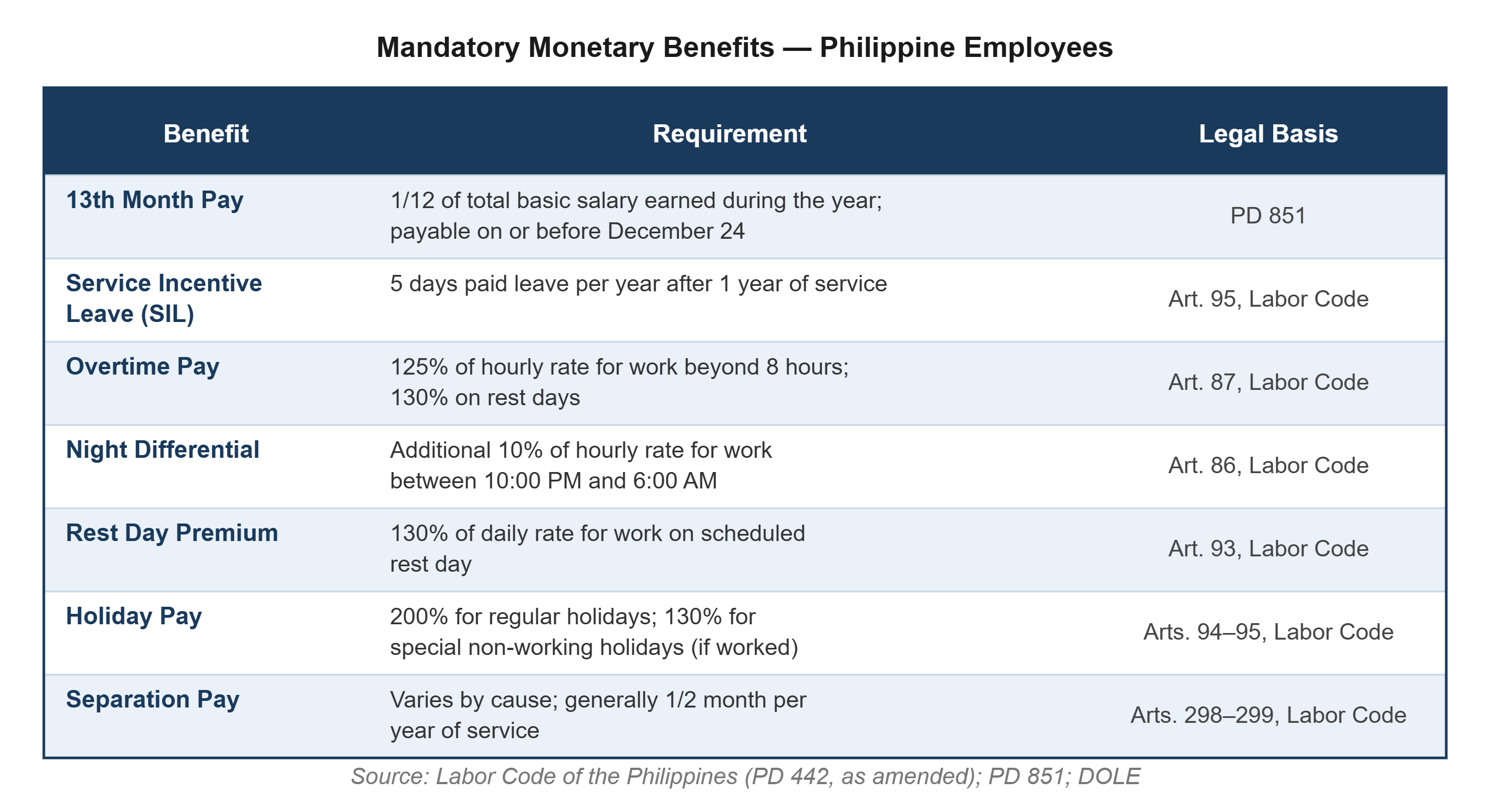
⚠️ The 13th month pay is not the same as a Christmas bonus. It is a statutory entitlement for all employees who have worked for at least one month during the calendar year, not a discretionary benefit that management can choose to give or withhold.
Reference: PD 851 (13th Month Pay Law); Articles 82–100, Labor Code of the Philippines
Step 4: Compute the Mandatory Deductions for Each Employee
For each payroll period, you must compute and deduct the employee's share of the following from gross pay before releasing the net salary:
A. Withholding Tax on Compensation (BIR)
Under Section 79 of the NIRC, every employer must withhold income tax from the compensation of employees and remit it to the BIR. The amount withheld is based on the employee's annualized compensation and the graduated income tax rates under the TRAIN Law.
How to compute:
Determine the employee's regular compensation for the payroll period (basic pay, fixed allowances)
Annualize the regular compensation (multiply by 12 for monthly payroll; by 26 for semi-monthly; by 24 for bi-monthly)
Apply the TRAIN Law tax table to the annualized figure to get the annual tax due
Divide the annual tax by the number of pay periods to get the per-period withholding
Add any supplementary compensation (bonuses, overtime above the ₱90,000 tax-exempt ceiling) at the applicable rate
Tax-exempt compensation items (not subject to withholding):
13th month pay and other bonuses up to ₱90,000 per year (Section 32(B)(7)(e), NIRC as amended)
SSS, PhilHealth, and Pag-IBIG contributions (employee's share)
De minimis benefits within prescribed limits (meal allowance up to ₱25/meal, rice subsidy up to ₱2,000/month, etc.)
Reference: Section 79, NIRC as amended; RR No. 11-2018; RMC No. 50-2018 (De Minimis Benefits)
B. SSS Contribution (Employee's Share)
As of 2025–2026, the total SSS contribution rate is 15% of the employee's Monthly Salary Credit (MSC), split as follows:
Employee's share: 5% of MSC
Employer's share: 9.5% of MSC
Employer's EC (Employees' Compensation) contribution: 0.5% of MSC (employer only)
The MSC is determined by the SSS contribution table based on the employee's actual monthly compensation. The minimum MSC is ₱4,000 and the maximum is ₱30,000.
Example:
Employee monthly salary: ₱25,000
Applicable MSC: ₱25,000
Employee's SSS deduction: ₱25,000 × 5% = ₱1,250
Employer's SSS contribution: ₱25,000 × 9.5% = ₱2,375
EC contribution: ₱25,000 × 0.5% = ₱125
Reference: RA 11199; SSS Circular No. 2023-010 (Contribution Schedule)
C. PhilHealth Premium (Employee's Share)
As of 2025–2026, the PhilHealth premium rate is 5% of basic monthly salary, shared equally:
Employee's share: 2.5% of basic monthly salary
Employer's share: 2.5% of basic monthly salary
The premium is subject to a floor of ₱500/month per share and a ceiling based on the maximum salary credit under the current PhilHealth circular.
Example:
Employee basic monthly salary: ₱25,000
Employee's PhilHealth deduction: ₱25,000 × 2.5% = ₱625
Employer's PhilHealth contribution: ₱25,000 × 2.5% = ₱625
Reference: RA 11223; PhilHealth Circular No. 2023-0009
D. Pag-IBIG Contribution (Employee's Share)
The mandatory Pag-IBIG contribution is structured as follows:
Monthly Compensation Employee Share Employer Share₱1,500 and below1%2%Over ₱1,5002%2%
The contribution is subject to a maximum monthly compensation of ₱5,000 for mandatory contribution purposes, meaning the maximum mandatory deduction is ₱100/month for the employee and ₱100/month for the employer. Employees may voluntarily contribute more than the mandatory amount.
Example:
Employee monthly salary: ₱25,000
Employee's Pag-IBIG deduction: ₱5,000 × 2% = ₱100 (maximum mandatory)
Employer's Pag-IBIG contribution: ₱5,000 × 2% = ₱100 (maximum mandatory)
Reference: RA 9679; Pag-IBIG Fund Circular No. 274
Step 5: Set Up Your Payroll Structure and Payslips
Choose a Pay Frequency
Philippine employers may choose from several pay frequency options, subject to the minimum requirement under the Labor Code (Article 103) that wages be paid at least twice a month at intervals not exceeding 16 days:
Pay Frequency - Periods per Year - Common For
Semi-monthly - 24 - Most Philippine companies
Monthly - 12 - Some professional firms
Weekly - 52 - Production or labor-intensive businesses
Daily - Variable - Daily wage earners
⚠️ Monthly payroll (paying once a month) is technically non-compliant with Article 103 of the Labor Code unless the employee's contract provides for it as an alternative arrangement acceptable to both parties. Semi-monthly payroll is the safest standard.
Issue Payslips for Every Pay Period
Under DOLE Department Order No. 115-12, employers are required to provide employees with a payslip for each pay period. The payslip must show, at minimum:
Employee name and period covered
Gross earnings (basic pay, overtime, allowances, bonuses)
Itemized deductions (SSS, PhilHealth, Pag-IBIG, withholding tax, other authorized deductions)
Net pay released to the employee
Payslips may be issued in printed form or electronically, provided the employee has reasonable access to the electronic format.
Reference: DOLE Department Order No. 115-12; Article 103, Labor Code
Step 6: Remit Contributions and File Returns on Time
After processing payroll, you must remit the withheld taxes and contributions to the respective agencies within their prescribed deadlines. Late remittance carries automatic penalties.
BIR - Withholding Tax on Compensation
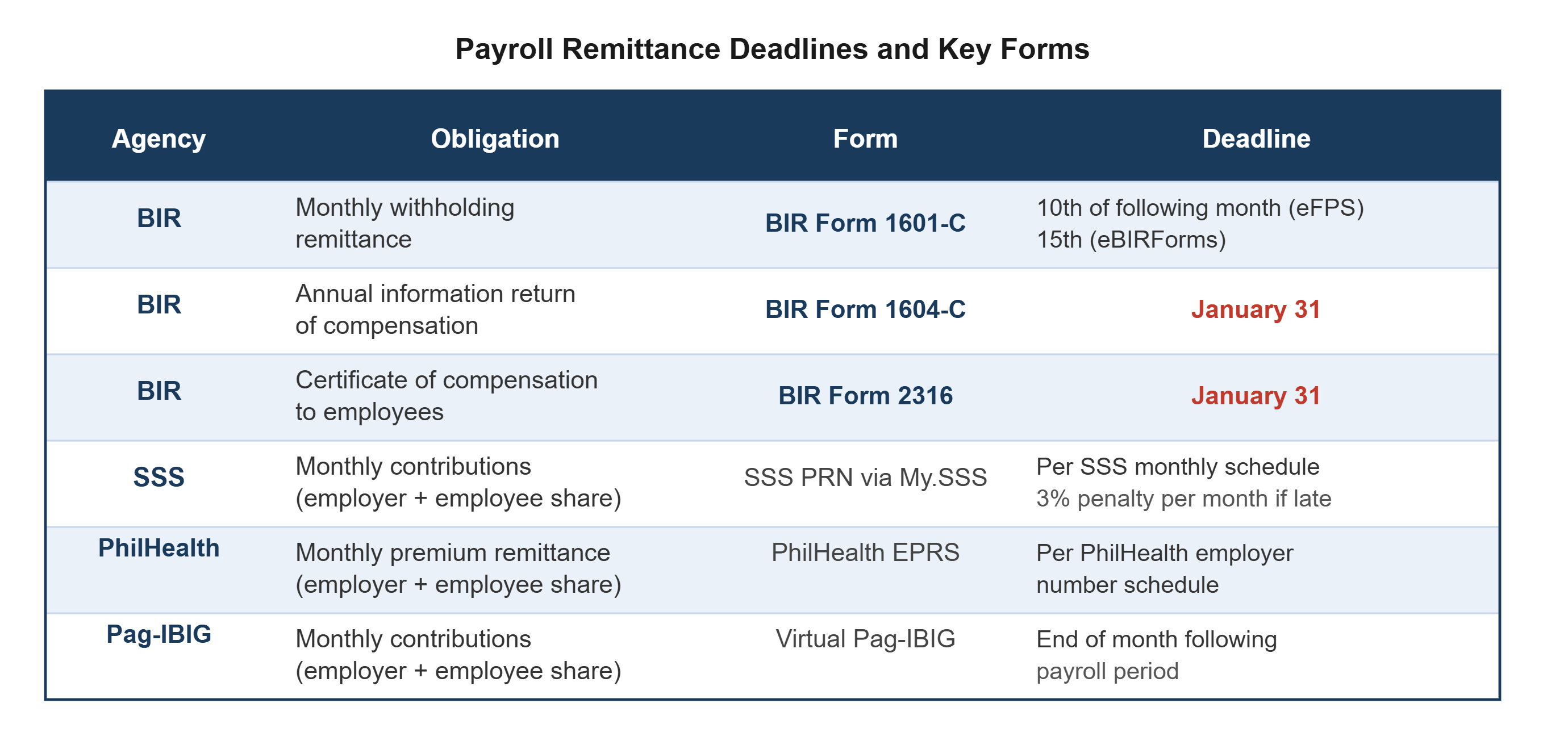
Monthly withholding remittance: BIR Form 1601-C - 10th of the following month (eFPS) / 15th (eBIRForms)
Annual information return: BIR Form 1604-C - January 31 of the following year
Certificate to employees: BIR Form 2316 - January 31 of the following year
SSS Contributions
SSS contributions (both employer and employee shares) must be remitted on or before the applicable deadline based on the employer's SSS number, as indicated in the SSS monthly contribution schedule. Contributions are remitted using the SSS Payment Reference Number (PRN) generated through the My.SSS portal.
Penalty for late SSS remittance: 3% per month on the unremitted amount under Section 22(b) of RA 11199.
PhilHealth Premiums
PhilHealth premiums are remitted monthly. The deadline depends on the employer's PhilHealth Employer Number. Remittances are made via the PhilHealth Electronic Premium Remittance System (EPRS) or accredited payment facilities.
Penalty for non-remittance: Surcharges and penalties under Section 28 of RA 7875, as amended.
Pag-IBIG Contributions
Pag-IBIG contributions are remitted monthly using the Virtual Pag-IBIG portal or accredited payment channels. The deadline is on or before the end of the month following the applicable payroll period.
Penalty for late remittance: 1/10 of 1% per day on the unremitted amount under Section 28 of RA 9679.
Step 7: Maintain Complete Payroll Records
Proper payroll records are essential both for day-to-day compliance and for surviving a government audit, whether from the BIR, SSS, PhilHealth, Pag-IBIG, or DOLE.
Minimum payroll records to maintain:
☐ Payroll register — a complete record of all compensation paid and deductions made for each employee, for each pay period
☐ Time and attendance records — daily time records (DTR) or biometric logs showing actual hours worked, overtime, absences, and tardiness
☐ Employment contracts and job offer letters — signed copies on file for each employee
☐ BIR Form 2316 copies — retained for each employee for the applicable taxable year
☐ SSS, PhilHealth, and Pag-IBIG remittance records — official receipts, portal confirmation, and contribution schedules
☐ Payslip records — copies or electronic records of payslips issued to each employee
Under Section 235 of the NIRC, payroll records must be retained for ten (10) years. DOLE inspection requirements similarly call for records to be kept and available for inspection.
Reference: Section 235, NIRC; DOLE Department Order No. 174-17; Article 110, Labor Code
Common Payroll Mistakes New Employers Make
Not registering employees with all four agencies on day one. Registration with SSS, PhilHealth, and Pag-IBIG is required at the start of employment, not at the end of the first month or after the employee passes probation. Delays in registration deprive employees of coverage for that period and expose the employer to penalties.
Applying incorrect withholding tax amounts. Many first-time employers use a flat rate or estimate for withholding tax rather than computing it properly using the annualized method prescribed by the BIR. Under-withholding results in a tax deficiency for the employee at year-end, and potentially a penalty for the employer as the withholding agent.
Treating the employer's share of contributions as an employee deduction. The employer's share of SSS, PhilHealth, and Pag-IBIG is a cost the employer must absorb, it cannot be deducted from the employee's salary. Only the employee's share is deducted from the paycheck. Deducting the employer's share from an employee's pay is a labor law violation.
Missing the 13th month pay deadline. The 13th month pay must be paid on or before December 24 of each year. Many new employers confuse this with an optional Christmas bonus and pay it late or not at all. The 13th month pay is a statutory entitlement under PD 851, and failure to pay it on time constitutes a labor law violation.
Failing to issue BIR Form 2316 and file Form 1604-C by January 31. Both obligations fall on the employer. Missing the January 31 deadline exposes the employer to penalties under the NIRC and leaves employees without the documentation they need for their own income tax filings.
Computing overtime incorrectly. Many employers compute overtime based on the basic daily rate alone, without including the appropriate premium percentage. Overtime must be computed at 125% of the regular hourly rate, which itself must be based on actual worked hours, not a contractual fixed monthly rate applied uniformly.
Not computing and paying holiday pay correctly. Regular holiday pay (200% for work rendered, 100% even if not worked) and special non-working holiday pay (130% for work rendered, no pay if not worked) are frequently miscalculated. Errors compound across every payroll period and become a significant back-wage liability.
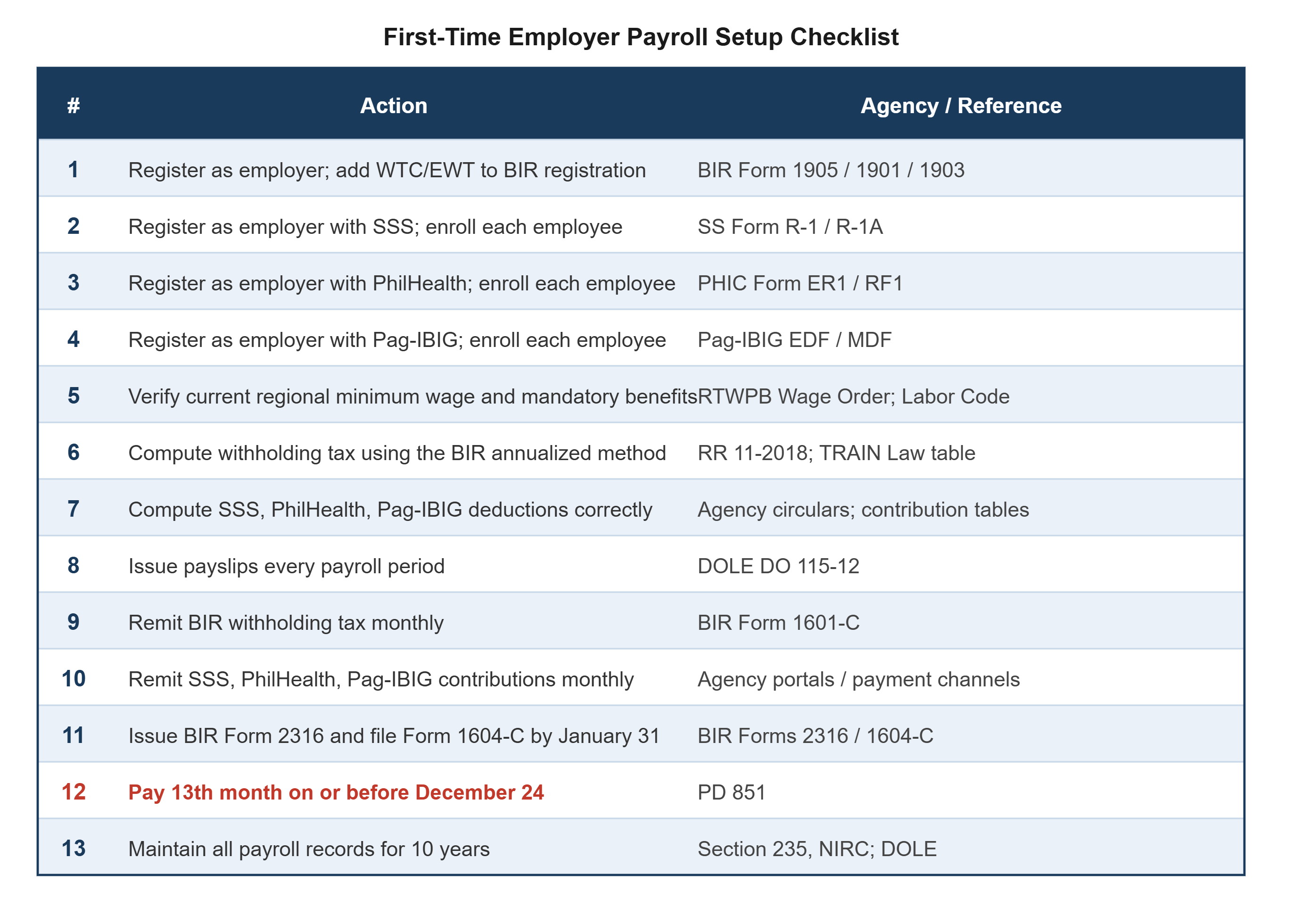
Summary: First-Time Employer Payroll Setup Checklist
Conclusion
Setting up payroll correctly the first time is not just about avoiding penalties, it is about establishing the foundation of a professional, compliant employer-employee relationship from day one. Every employee you hire is entitled to the full protection of Philippine labor law from the first moment of their employment, and every government agency expects you to comply from that same moment.
The agencies will not wait for you to learn the rules before enforcing them. But with the right setup, proper registrations, accurate deduction computations, timely remittances, and complete records, payroll becomes a manageable, predictable compliance process rather than a source of ongoing risk.
If you are setting up payroll for the first time and need support with government registrations, payroll computation, BIR filing, or monthly remittances, a licensed accounting firm can set up your payroll system correctly from the start and keep it running smoothly as your team grows.
References
Bureau of Internal Revenue. National Internal Revenue Code (NIRC), Section 79, as amended by RA 10963 (TRAIN Law). https://www.bir.gov.ph
Bureau of Internal Revenue. Revenue Regulations No. 11-2018: Revised Withholding Tax Regulations. BIR, 2018.
Republic of the Philippines. Republic Act No. 11199 — Social Security Act of 2018. SSS Circular No. 2023-010. https://www.sss.gov.ph
Republic of the Philippines. Republic Act No. 11223 — Universal Health Care Act. PhilHealth Circular No. 2023-0009. https://www.philhealth.gov.ph
Republic of the Philippines. Republic Act No. 9679 — Home Development Mutual Fund Law of 2009. Pag-IBIG Fund Circular No. 274. https://www.pagibigfund.gov.ph
Republic of the Philippines. Presidential Decree No. 851 — 13th Month Pay Law, as clarified by DOLE Labor Advisories.
Republic of the Philippines. Labor Code of the Philippines (PD 442, as amended), Articles 82–103. https://www.dole.gov.ph
Department of Labor and Employment (DOLE). Department Order No. 115-12: Prescribing the Guidelines on the Issuance of Payslips. DOLE, 2012.
Republic of the Philippines. Republic Act No. 6727 — Wage Rationalization Act. NWPC / RTWPB Wage Orders. https://www.nwpc.dole.gov.ph
Bureau of Internal Revenue. Section 235, NIRC — Preservation of Books of Accounts and Records. https://www.bir.gov.ph
Upcloud Accounting: Virtual Outsourced Accounting and Bookkeeping Services in the Philippines
Upcloud Accounting offers accounting, bookkeeping, tax compliance, and business licensing services specializing with startups and SMEs in the Philippines.
Our goal is to increase efficiency, automation, and transparency across the accounting and finance functions of our clients with our cutting-edge technology. If you want to move your company’s finance function online, contact our Team of Expert Accountants and Bookkeepers directly via [email protected] or visit www.upcloudaccounting.comto learn more about how Upcloud Accounting accounting services can support your PH business!
Disclaimer: This article or blog is only for general knowledge and guidance and is not a substitute for an expert opinion. For technical advice, please consult your tax / legal advisor for your specific business concerns. For comments, suggestions, and feedback, feel free to email us at [email protected].