Understanding Back Pay Guidelines for Employers in the Philippines
Published Date: March 11, 2026
Published By: Jac Cantos, Upcloud Accounting
When an employee leaves your company in the Philippines, questions often arise about how to properly compute and process their back pay.
Have they returned company assets?
Have they completed exit procedures?
When and how should they receive their final compensation?
In the Philippines, specific rules govern the calculation and release of back pay to departing employees. The Department of Labor and Employment (DOLE) has issued guidelines to clarify these processes, ensuring employers comply with legal obligations while maintaining good employee relations.
What is Back Pay in the Philippines?
Back pay refers to the total amount owed to an employee at the time of employment termination, including unpaid wages, accrued benefits, and other monetary entitlements.
Under Labor Advisory No. 06-20, back pay may include:
Unpaid salary or compensation earned up to the last day of employment
Unused Service Incentive Leave converted to cash, if applicable
Unused sick leave, vacation leave, or other benefits provided for by company policy or contract
Separation pay, where applicable under the law
Pro-rated 13th Month Pay for the year of separation
Retirement pay, if applicable
Refund of excess withholding taxes paid
Any other benefits or entitlements specified in employment agreements or company policies
Back Pay vs. Final Pay
In the Philippine context, the terms “back pay” and “final pay” are often used interchangeably, both referring to the last compensation paid to an employee upon separation. While “back pay” emphasizes the owed amounts, “final pay” often includes all final settlements.
Who is Entitled to Back Pay?
All employees who leave the company, whether through resignation, termination, or end of a fixed-term contract, are generally entitled to receive their back pay. This applies regardless of the reason for separation, including layoffs, business closures, or voluntary resignation.
Is Back Pay Mandatory?
Yes. Philippine labor law mandates that employees must be paid their due back pay within 30 days of employment separation. This period balances the employer’s need to process the settlement with the employee’s right to timely compensation.
However, internal policies, employment contracts, or collective bargaining agreements may specify shorter periods, so employers should verify their own policies.
How to Calculate Back Pay
The calculation depends on the circumstances of employment and the specifics of the separation. Generally, the formula includes:
Unpaid salary or wages for days worked but not yet paid
Last salary balance for the final month of employment
Unused leave credits, converted to cash
Pro-rated 13th Month Pay, based on the months worked in the year
Deductions such as outstanding loans, government contributions (SSS, PhilHealth, Pag-IBIG), and company liabilities
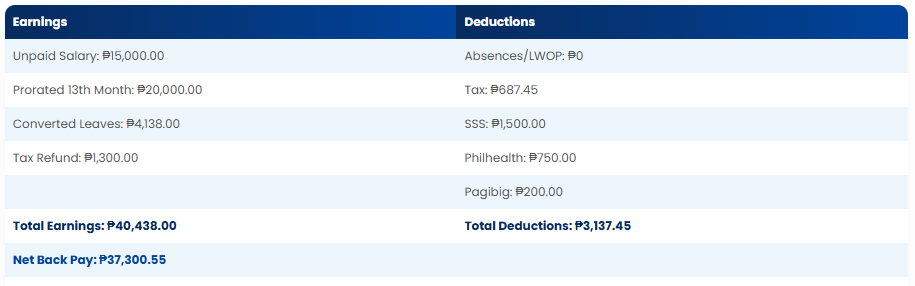
Example Calculation:
Suppose an employee earning Php 30,000 monthly resigns in August. Their unpaid salary for the final period, accrued leave, and pro-rated 13th Month Pay are calculated accordingly, minus any outstanding deductions. The result is the total net back pay owed to the employee, which should be paid promptly.
Ensuring Employee Compliance and Proper Exit Procedures
When an employee leaves, it’s essential to verify that all exit procedures are completed, asset returns, access deactivation, client handovers, and exit interviews. Proper documentation and process controls help prevent administrative or operational issues.
Employer Obligations Upon Employee Departure
In addition to calculating back pay, employers must provide the departing employee with:
BIR Form 2316: This form reports total compensation paid and taxes withheld during the calendar year. It must be issued upon final salary payment and is often required by new employers for tax purposes.
Certificate of Employment (COE): Confirming employment dates, role, and responsibilities, issued within three days of request.
Full Payment of Mandatory Contributions: Ensure all SSS, Pag-IBIG, and PhilHealth contributions are up to date, as missed payments can be difficult to rectify later.
Partnering with a payroll service provider like Upcloud Accounting can streamline these processes, ensuring compliance and avoiding penalties for late or incomplete payments.
Ready to Manage Your Employee Departures Effectively?
Proper management of back pay and exit procedures is crucial for maintaining compliance and protecting your business. We offers expert payroll and HR support to ensure your employee separations are handled smoothly, accurately, and in accordance with current regulations.
Upcloud Accounting: Virtual Outsourced Accounting and Bookkeeping Services in the Philippines
Upcloud Accounting offers accounting, bookkeeping, tax compliance, and business licensing services specializing with startups and SMEs in the Philippines.
Our goal is to increase efficiency, automation, and transparency across the accounting and finance functions of our clients with our cutting-edge technology. If you want to move your company’s finance function online, contact our Team of Expert Accountants and Bookkeepers directly via [email protected] or visit www.upcloudaccounting.comto learn more about how Upcloud Accounting accounting services can support your PH business!
Disclaimer: This article or blog is only for general knowledge and guidance and is not a substitute for an expert opinion. For technical advice, please consult your tax / legal advisor for your specific business concerns. For comments, suggestions, and feedback, feel free to email us at [email protected].