VAT vs. Non-VAT: Which Tax Regime is Right for Your Philippine Business?
Published Date: June 20, 2026
Published By: Jac Cantos, Upcloud Accounting
One of the most consequential decisions a new or growing business in the Philippines faces is whether to register as a VAT taxpayer or remain under the Non-VAT (Percentage Tax) regime. The choice affects how much tax you pay, how you price your products or services, what documents you issue, and the administrative complexity of your compliance obligations.
Many business owners make this decision reactively, either by defaulting to Non-VAT without understanding the implications of growth, or by registering as VAT-registered without fully appreciating the compliance burden it carries. Done correctly, choosing the right tax regime from the start can save your business significant money and administrative effort.
This guide explains both regimes in full, walks you through the threshold rules, and helps you identify which registration is most appropriate for your type of business.
What is VAT?
Value-Added Tax (VAT) is a consumption tax imposed at every stage of the supply chain, from production to the final sale to the consumer. In the Philippines, VAT is governed by Sections 105 to 115 of the National Internal Revenue Code (NIRC), as amended by Republic Act No. 10963 (TRAIN Law).
The standard VAT rate is 12%, applied to the gross selling price of goods or the gross receipts from services.
How VAT Works in Practice
A VAT-registered business collects Output VAT from its customers on every taxable sale, and in turn pays Input VAT on its own purchases of goods and services from VAT-registered suppliers. The business remits to the BIR only the net difference between Output VAT and Input VAT.
Example: A VAT-registered marketing agency bills a client Php 100,000 for services.
Output VAT collected: Php 12,000
Input VAT paid on its own expenses (software, rent, etc.): Php 4,000
VAT payable to BIR: Php 8,000
This mechanism means that VAT-registered businesses act as tax collectors on behalf of the government, passing on to the BIR only the portion of VAT that represents value added at their stage of the supply chain.
What is Non-VAT (Percentage Tax)?
The Non-VAT regime, also called the Percentage Tax regime, applies to taxpayers who are not VAT-registered. Instead of collecting and remitting VAT, these businesses pay a flat Percentage Tax on their gross sales or receipts.
The Percentage Tax is governed by Section 116 of the NIRC, which imposes a tax on persons who are not VAT-registered and whose annual gross sales or receipts do not exceed the VAT threshold.
Current Percentage Tax Rate
Under the CREATE Law (Republic Act No. 11534), the Percentage Tax rate was temporarily reduced to 1% from July 1, 2020 to June 30, 2023. Since July 1, 2023, the rate has reverted to its permanent level of 3% of gross sales or gross receipts.
Example: A Non-VAT freelance graphic designer earns Php 80,000 in gross receipts for the month.
Percentage Tax due: Php 80,000 × 3% = Php 2,400
Unlike VAT, there is no Input Tax credit mechanism under the Percentage Tax regime. The 3% is applied to gross receipts in full, with no offset for business expenses or purchases.
The VAT Registration Threshold
The single most important rule governing the choice between VAT and Non-VAT is the annual gross sales or receipts threshold, which determines whether VAT registration is mandatory or optional.
Under Section 109(BB) of the NIRC, as amended by the TRAIN Law:
Any person whose annual gross sales or receipts exceed Php 3,000,000 is required to register as a VAT taxpayer.
Conversely, any person whose annual gross sales or receipts do not exceed Php 3,000,000 may opt to register as VAT or remain Non-VAT.
This creates three distinct scenarios:
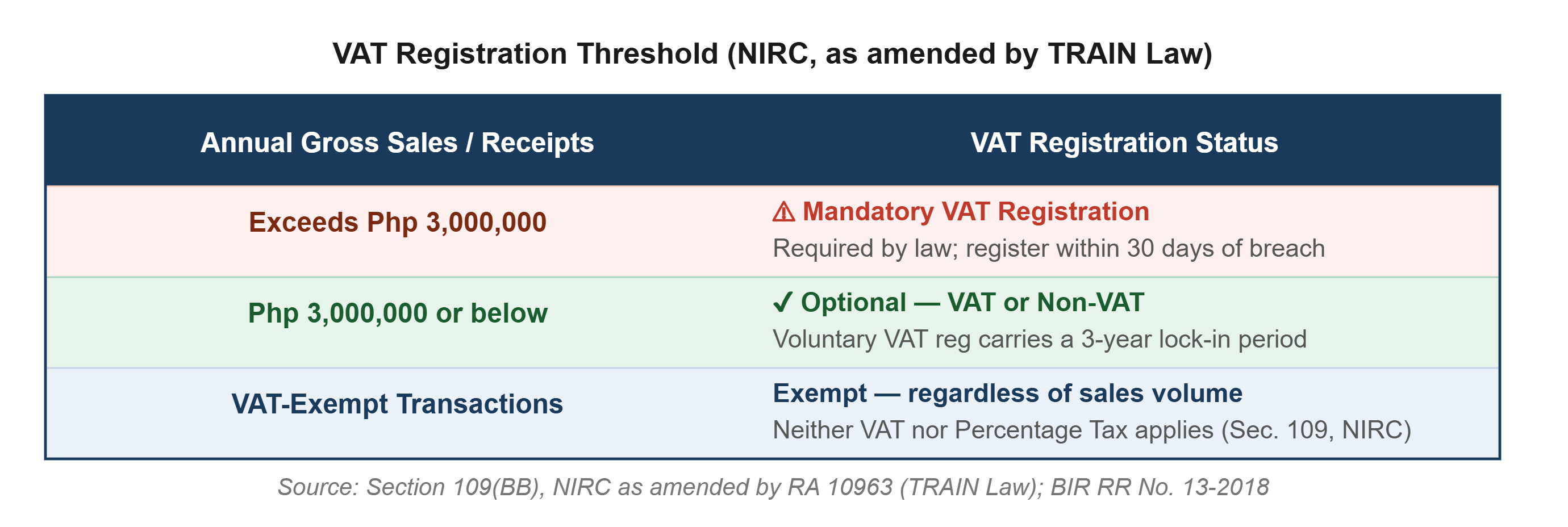
Reference: Section 109(BB), NIRC as amended by RA 10963 (TRAIN Law); BIR Revenue Regulations No. 13-2018
VAT-Exempt Transactions: A Special Category
Not all businesses below the threshold face a simple VAT vs. Non-VAT choice. The NIRC enumerates specific VAT-exempt transactions under Section 109, transactions that are neither subject to VAT nor Percentage Tax, regardless of sales volume.
Common VAT-exempt categories include:
Sale of agricultural goods in their original form (fruits, vegetables, livestock, poultry)
Sale or importation of prescription drugs and medicines (expanded under CREATE Law)
Educational services rendered by private educational institutions duly accredited by DEPED, CHED, or TESDA
Services rendered by individuals pursuant to an employer-employee relationship (employment income is not a business transaction subject to VAT or Percentage Tax)
Export sales by VAT-registered persons (zero-rated, not exempt, a separate category)
Sale of real property not primarily held for sale in the ordinary course of business
⚠️ VAT-exempt and zero-rated are not the same. Zero-rated sales (e.g., exports, certain BPO services) are subject to VAT at 0%, the seller is still VAT-registered but can claim input VAT refunds. Exempt transactions are entirely outside the VAT system.
Reference: Section 109, NIRC, as amended by RA 10963 (TRAIN Law) and RA 11534 (CREATE Law)
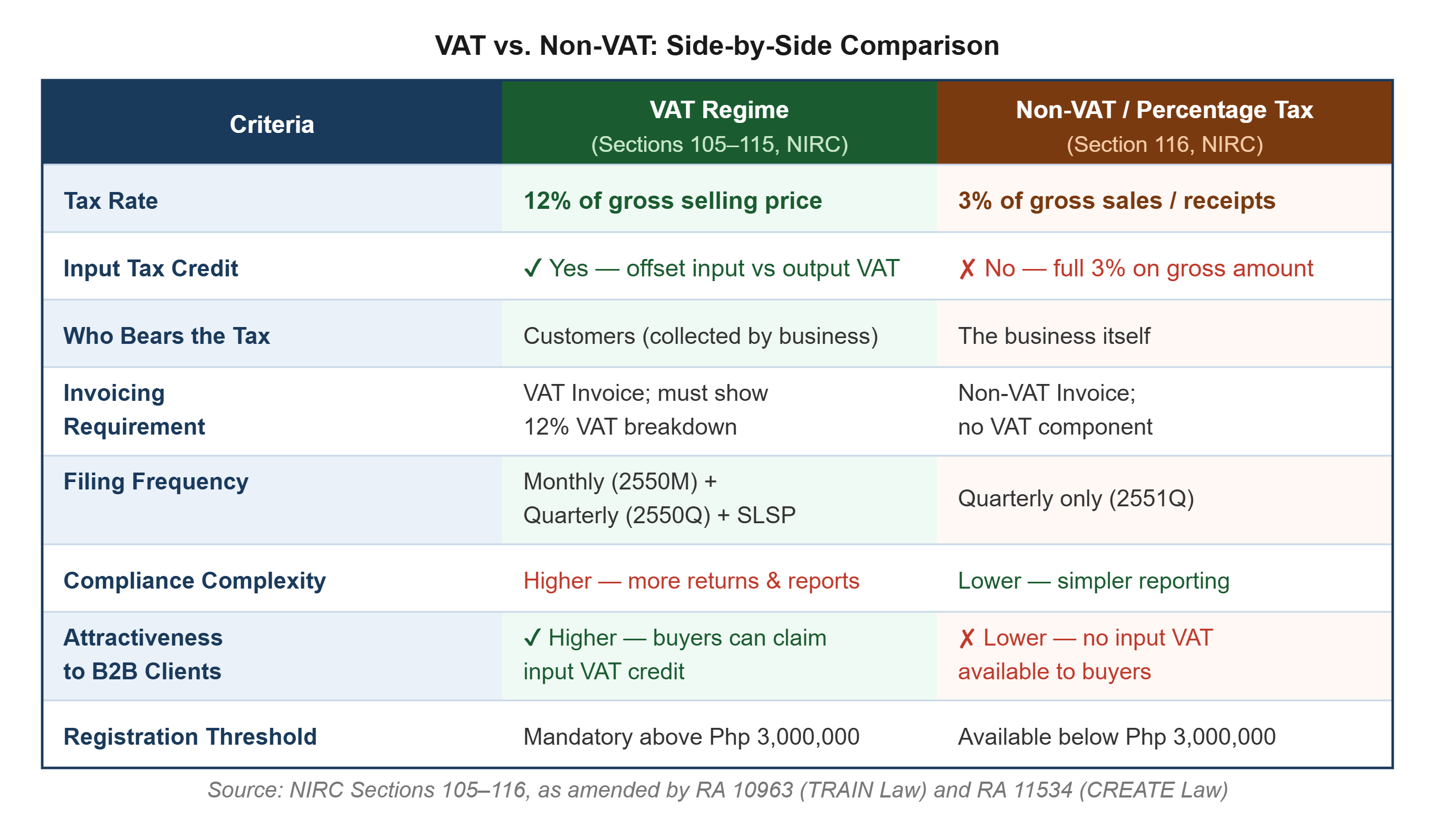
VAT vs. Non-VAT: Side-by-Side Comparison
Who Should Register as VAT?
VAT registration makes the most sense for businesses in the following situations:
1. Businesses That Have Crossed or Are Approaching the Php 3M Threshold
This is non-negotiable. once your annual gross sales or receipts exceed Php 3,000,000, you are legally required to register as VAT within 30 days of the end of the month you exceeded the threshold. Failure to register exposes you to back taxes, penalties, and surcharges on all sales from the date the threshold was breached.
2. Businesses That Sell Primarily to Other Businesses (B2B)
If your customers are other VAT-registered businesses, corporations, partnerships, or other registered enterprises, they will want a VAT Invoice so they can claim the 12% input VAT you charge as a credit against their own output VAT. Issuing a Non-VAT invoice to a corporate client means they cannot claim that input credit, making your services effectively 12% more expensive for them compared to a VAT-registered competitor.
3. Businesses With High Input Costs
If your business incurs significant VAT-able expenses, imported equipment, office rent, professional services, raw materials, voluntary VAT registration may reduce your overall tax burden because you can offset the input VAT you paid against your output VAT obligation. A Non-VAT business cannot claim any credit for the VAT it pays on its purchases.
4. Businesses Planning to Export
Export sales are zero-rated under VAT, not exempt. A VAT-registered exporter charges 0% VAT on export invoices but can claim a refund or tax credit certificate for all input VAT paid on its domestic purchases. This is a significant cash flow advantage that is unavailable to Non-VAT businesses.
Who Should Stay Non-VAT?
Remaining in the Non-VAT regime is generally more appropriate for:
1. Businesses Well Below the Php 3M Threshold With No Near-Term Growth to That Level
If your gross sales or receipts are well below Php 3,000,000 and are likely to remain so, the Non-VAT regime is simpler and less burdensome. You file one Percentage Tax return per quarter (BIR Form 2551Q) instead of monthly and quarterly VAT returns.
2. Businesses That Sell Primarily to End Consumers (B2C)
If your customers are individual end consumers who do not need input VAT credits, retail shops, personal service providers, restaurants, sari-sari stores, VAT registration may add compliance costs without a corresponding business benefit. Your customers will not care whether their receipt carries a VAT breakdown or not.
3. Businesses With Low Input Costs
If you are a service-based professional or freelancer with minimal taxable purchases, your main cost is your own time, the input VAT credit mechanism offers little practical advantage. The simpler Percentage Tax regime may be more cost-effective when compliance costs are factored in.
4. Newly Registered Businesses in the Early Ramp-Up Phase
If your business is still in its first year and revenues are uncertain, starting under the Non-VAT regime keeps your compliance obligations manageable. You can always voluntarily register for VAT when your business reaches a scale where it becomes advantageous.
Voluntary VAT Registration: Can You Choose VAT Even Below the Threshold?
Yes. Under Section 236(H) of the NIRC, any person who is not otherwise required to register for VAT, because their sales are at or below Php 3,000,000, may voluntarily register as a VAT taxpayer.
However, this comes with an important condition:
Once you voluntarily register for VAT, you are locked in for at least three (3) years from the date of registration. You cannot deregister from VAT before the three-year period expires, even if your sales fall or you change your mind.
This lock-in period means voluntary VAT registration is a decision that should be made deliberately, not impulsively. Consider whether the input VAT credits and B2B competitive advantage are worth the sustained compliance burden of monthly VAT returns, alphalist submissions, and BIR audit readiness.
Reference: Section 236(H), NIRC as amended; BIR Revenue Regulations No. 16-2005 (as amended)
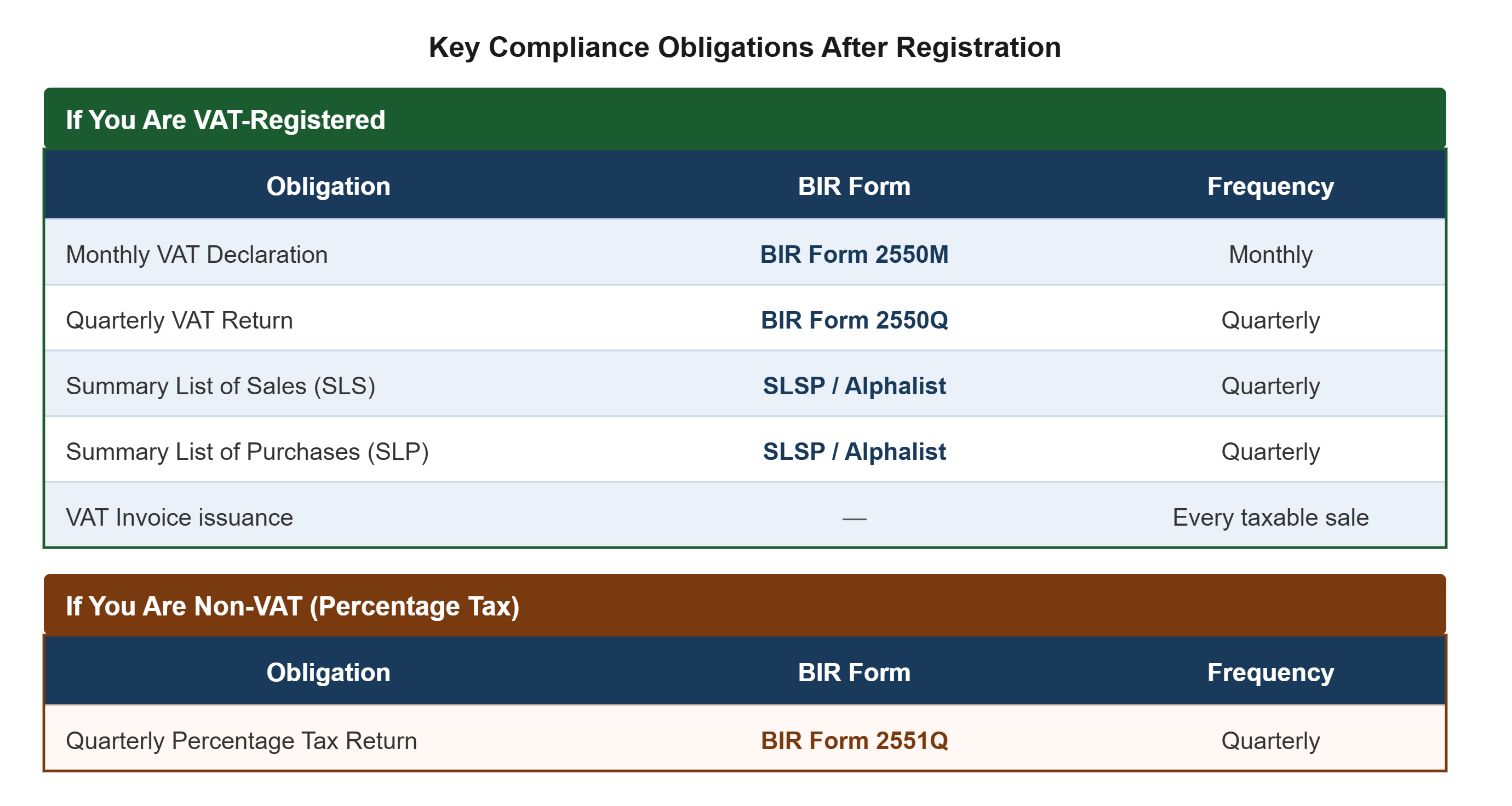
Key Compliance Obligations After Registration
Common Mistakes to Avoid
1. Exceeding the threshold without registering for VAT. The BIR monitors sales volumes through alphalists, third-party information returns, and eFPS/eBIRForms data. Businesses that silently exceed the Php 3M threshold without registering for VAT face deficiency VAT assessments covering the entire period from breach of threshold to the assessment date, plus a 25% surcharge, 12% annual interest, and possible criminal liability.
2. Voluntarily registering for VAT without understanding the three-year lock-in. Several business owners voluntarily register for VAT at the advice of a client or supplier, then discover the compliance burden is too heavy for their current scale, and find they cannot deregister for three years. Understand the commitment before you register.
3. Issuing VAT Invoices without a valid Authority to Print or CAS permit reflecting VAT registration. Your invoice must be authorized for your registered tax type. A Non-VAT business that issues a document showing 12% VAT is not only non-compliant, it may be penalized for issuing unauthorized documents and for effectively collecting VAT without remitting it.
4. Failing to update registration within 30 days of exceeding the threshold. The 30-day window for mandatory VAT registration after crossing the Php 3M threshold is strict. Missing it is a violation that triggers penalties independently of any VAT deficiency assessment.
5. Confusing VAT-exempt with Non-VAT. A business engaged in VAT-exempt transactions is exempt from both VAT and Percentage Tax on those specific transactions. A Non-VAT business is subject to 3% Percentage Tax on all gross sales. The two categories operate under entirely different legal frameworks and should not be conflated.
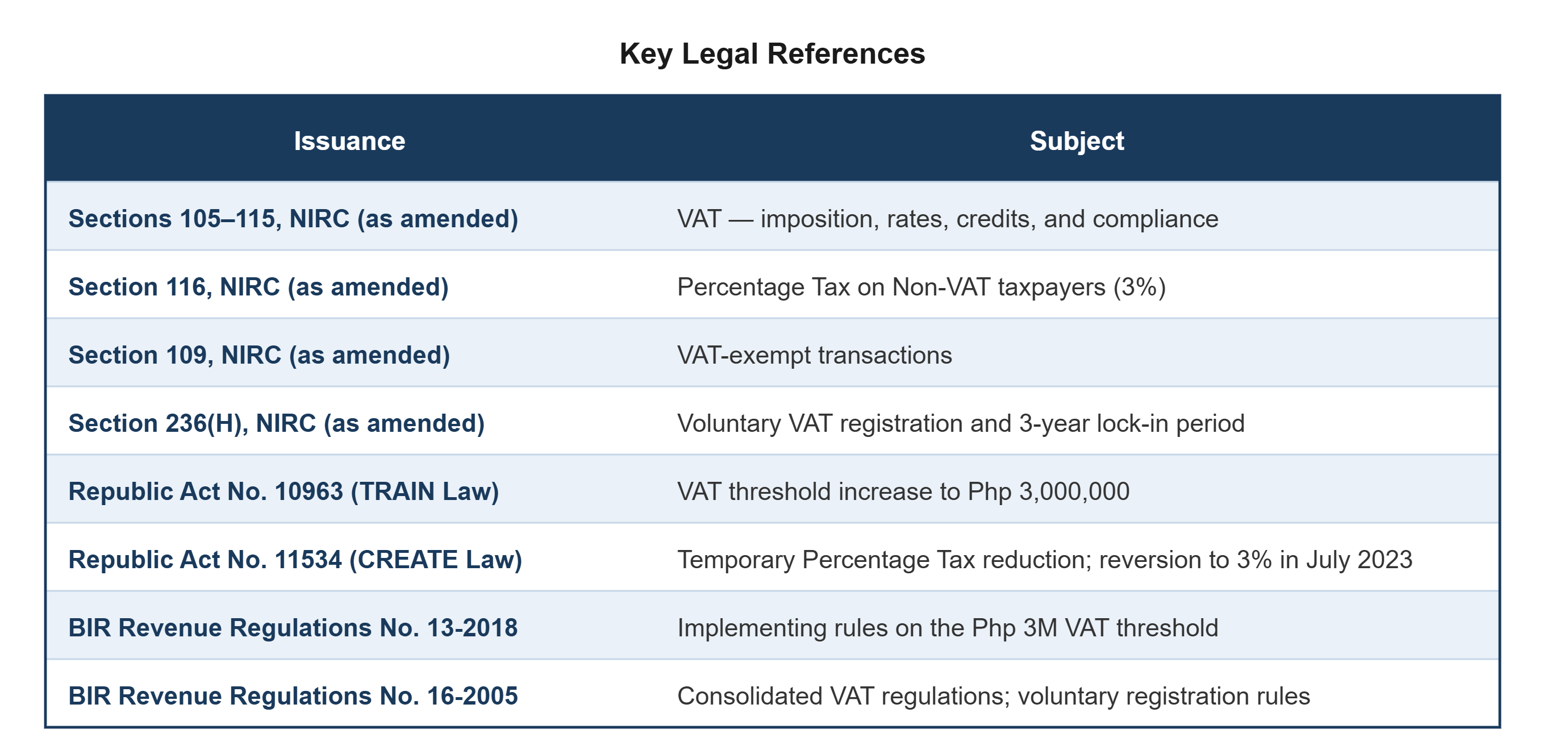
Key Legal References
Conclusion
The decision between VAT and Non-VAT is not simply about which rate is lower, it is about the complete picture of your business: who you sell to, what you spend on, how fast you are growing, and how much administrative capacity you have for compliance.
For businesses below the threshold, the right answer depends on your cost structure, customer base, and growth trajectory. For businesses that have crossed or are approaching Php 3,000,000 in annual sales, mandatory VAT registration is the law, and the time to prepare for it is before you cross the threshold, not after.
When in doubt, consult a licensed accountant or tax adviser who can assess your specific circumstances and help you choose the registration that minimizes your tax burden and keeps you fully compliant.
References
Bureau of Internal Revenue. National Internal Revenue Code of the Philippines (NIRC), Sections 105–116, 109, 236, as amended by RA 10963 (TRAIN Law) and RA 11534 (CREATE Law). https://www.bir.gov.ph
Republic of the Philippines. Republic Act No. 10963, Tax Reform for Acceleration and Inclusion (TRAIN Law). Congress of the Philippines, 2017.
Republic of the Philippines. Republic Act No. 11534 ,Corporate Recovery and Tax Incentives for Enterprises (CREATE) Act. Congress of the Philippines, 2021.
Bureau of Internal Revenue. Revenue Regulations No. 13-2018: Implementing Guidelines on the Php 3,000,000 VAT Threshold. BIR, 2018. https://www.bir.gov.ph
Bureau of Internal Revenue. Revenue Regulations No. 16-2005 (as amended): Consolidated Value-Added Tax Regulations. BIR, 2005. https://www.bir.gov.ph
Bureau of Internal Revenue. BIR Form 2550M, Monthly VAT Declaration; BIR Form 2550Q, Quarterly VAT Return; BIR Form 2551Q, Quarterly Percentage Tax Return. https://www.bir.gov.ph
Upcloud Accounting: Virtual Outsourced Accounting and Bookkeeping Services in the Philippines
Upcloud Accounting offers accounting, bookkeeping, tax compliance, and business licensing services specializing with startups and SMEs in the Philippines.
Our goal is to increase efficiency, automation, and transparency across the accounting and finance functions of our clients with our cutting-edge technology. If you want to move your company’s finance function online, contact our Team of Expert Accountants and Bookkeepers directly via [email protected] or visit www.upcloudaccounting.comto learn more about how Upcloud Accounting accounting services can support your PH business!
Disclaimer: This article or blog is only for general knowledge and guidance and is not a substitute for an expert opinion. For technical advice, please consult your tax / legal advisor for your specific business concerns. For comments, suggestions, and feedback, feel free to email us at [email protected].