What Happened to Official Receipts in the Philippines? Key Changes Under the EOPT Act
Published Date: May 20, 2026
Published By: Jac Cantos, Upcloud Accounting
You pay for a service and ask for an Official Receipt, only to be told: "We only issue invoices now."
For decades, the rule was simple: Sales Invoices for goods, Official Receipts for services. Every accountant, bookkeeper, finance officer, and auditor in the Philippines built their documentation practices around this distinction. It shaped how businesses issued documents, how employees filed reimbursements, and how VAT taxpayers supported their input tax claims.
That rule no longer exists.
Under the Ease of Paying Taxes (EOPT) Act (Republic Act No. 11976) and its implementing regulations, Revenue Regulations Nos. 7-2024 and 11-2024, the entire framework for business documentation has been overhauled. The transition deadlines have passed. The rules are now final and enforceable.
This article explains exactly what changed, what it means for your business in 2026, and what you need to do to stay compliant.
The Old System: How Official Receipts Used to Work
Under the previous BIR framework, two principal documents governed business transactions:
Sales Invoice, issued for the sale of goods (tangible products, merchandise, inventory items)
Official Receipt (OR), issued for the rendition of services (professional fees, consultancy, rent, repair, and all other service-based transactions)
This distinction was deeply embedded in Philippine tax practice. Official Receipts were the standard requirement for employee reimbursements, audit substantiation, input VAT claims on service purchases, and deductible expense documentation. The OR was, for all practical purposes, the tax document of the service economy.
That system has been replaced.
What Changed Under RR 7-2024 and RR 11-2024?
The EOPT Act mandated a fundamental simplification of tax documentation. The BIR implemented this through Revenue Regulations No. 7-2024 (primary implementing rules) and Revenue Regulations No. 11-2024 (supplementary clarifications), establishing a new documentary hierarchy that applies to all registered taxpayers.
The Invoice Is Now the Only Principal Document
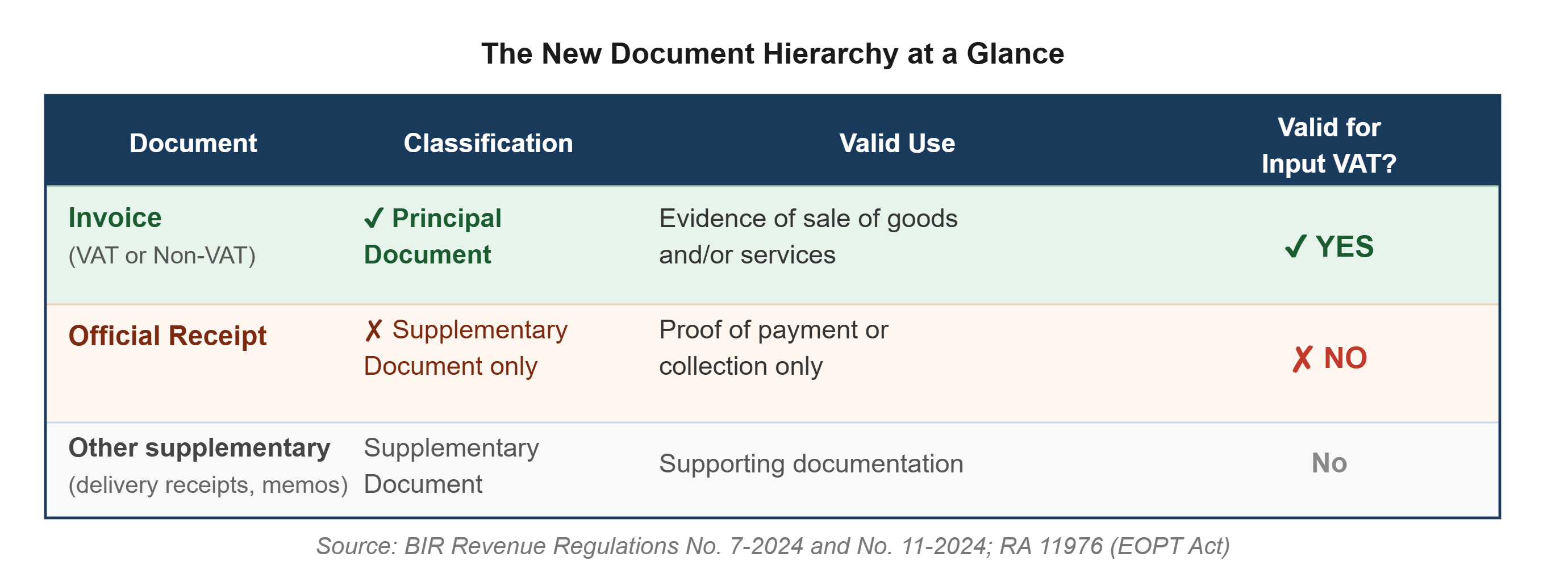
Under the new framework, the Invoice, whether VAT or Non-VAT, is the sole primary document required to evidence the sale of both goods and services. The old goods/services distinction is abolished.
This means: whether your business sells merchandise, provides legal advice, delivers software subscriptions, renders construction work, or charges professional fees, you must issue an Invoice, not an Official Receipt.
"The invoice shall be the primary document that shall be issued for every sale, barter, or exchange of goods or properties and for every lease of goods or properties and rendition of services." , RR No. 7-2024
The Official Receipt Has Been Downgraded
The Official Receipt has been reclassified as a supplementary document. It may still be issued, but only as proof of payment or collection, not as evidence of the underlying transaction itself.
This is a critical distinction. Under the old rules, an OR simultaneously served as both proof of the transaction and proof of payment. Under the new rules, it serves only the latter function.
Official Receipts Are No Longer Valid for Input VAT Claims
This is the single most consequential change for VAT-registered businesses. An Official Receipt issued today, regardless of how it is formatted, cannot be used to substantiate an input VAT claim. Only a properly issued BIR-registered Invoice qualifies as the supporting document for VAT credits.
⚠️ Critical compliance risk: If your suppliers continue issuing Official Receipts instead of Invoices, and you use those ORs to support input VAT claims, those claims may be disallowed during a BIR audit. The tax cost falls on your business, not your supplier.
Reference: Republic Act No. 11976 (EOPT Act), Sections 5–8; BIR Revenue Regulations No. 7-2024; BIR Revenue Regulations No. 11-2024
The New Document Hierarchy at a Glance
Transition Rules: What Happened to Existing OR Stocks?
When RR 7-2024 was issued, businesses with existing stocks of printed Official Receipts were given two options for the transitional period. Understanding these options, and whether they were applied correctly, remains important for audit purposes.
Option 1: Use as Supplementary Documents
Businesses could continue using unused OR booklets as supplementary documents only, provided each document was clearly stamped with the following phrase before issuance:
"THIS DOCUMENT IS NOT VALID FOR CLAIM OF INPUT TAX"
ORs stamped this way serve solely as proof of payment. They do not constitute evidence of the sale transaction and cannot support input VAT claims.
Option 2: Convert Unused ORs Into Invoices
Businesses were permitted to convert existing unused manual or loose-leaf OR stocks into valid Invoices by:
Striking through the words "Official Receipt" on the face of the document
Stamping "Invoice," "Cash Invoice," or "Service Invoice" as applicable
Submitting the required inventory list and conversion report to the registered Revenue District Office (RDO)
Ensuring all required information fields were present and complete (see Required Invoice Details below)
Important: The frequently cited deadline of December 31, 2024 applied primarily to the updating of electronic systems and computerized accounting configurations. Properly converted manual OR stocks could continue to be used until exhausted, provided the conversion requirements above were fully satisfied.
What Must Appear on a Compliant Invoice?
Renaming a document "Invoice" is not sufficient for compliance. Under RR 7-2024, a valid Invoice must contain all of the following required information fields:
Seller's registered name, TIN, and complete business address
Buyer's registered name, TIN, and address (for VAT transactions above the threshold)
Description and quantity of goods sold or services rendered
Unit cost and total amount of the transaction
VAT breakdown, VAT-exempt amount, zero-rated amount, and 12% VAT amount (where applicable)
Date of transaction
Duly authorized serial number range (as approved in the Authority to Print or via CAS/e-invoicing permit)
The word "Invoice," "Cash Invoice," or "Service Invoice" clearly stated as the document title
⚠️ A document that bears the title "Invoice" but is missing required fields, particularly the VAT breakdown, buyer's TIN, or authorized serial number, is not a compliant Invoice and cannot support input VAT claims or deductible expense substantiation.
Reference: RR No. 7-2024, Section 6 (Required Information on Invoice); RMC No. 65-2024 (Clarifications on Invoice Requirements)
Common Misconceptions That Lead to Penalties
Misconception 1: "Invoices are only for goods." This was the old rule. Under RR 7-2024, Invoices are required for all transactions, goods and services alike. A legal retainer, a haircut, a consulting engagement, a software license, or a construction project all require an Invoice, not an Official Receipt.
Misconception 2: "We still accept Official Receipts for reimbursements." Many HR and Finance teams continue to require employees to submit Official Receipts for expense reimbursements, citing years of internal policy. This policy is now outdated and creates audit risk. Reimbursable business expenses must be supported by a BIR-registered Invoice. An OR submitted for reimbursement may not be treated as a valid deductible expense during a BIR examination.
Misconception 3: "This only affects large businesses." The rules apply universally, to sole proprietors, freelancers, SMEs, and large corporations alike. Whether you issue documents from a manual booklet, a POS machine, or an enterprise ERP system, your documentation titles, content, and processes must comply with RR 7-2024.
Misconception 4: "I just need to change the title to 'Invoice' and I'm done." Changing the document title is the first step, not the last. Compliance requires that the renamed document also contains all required fields listed under RR 7-2024, including the correct VAT breakdown, authorized serial number, and buyer information. A blank or incomplete "Invoice" carries the same compliance risk as an OR.
Action Plan: What Your Business Must Do Now
If You Issue Documents
Update your systems. If your POS, accounting software, ERP, or manual booklet templates still print "Official Receipt" as the document title, update them to "Invoice," "Cash Invoice," or "Service Invoice" as applicable. This includes CAS-registered systems, which may require a new or amended BIR permit.
Audit your remaining OR stock. Identify any unconverted OR booklets. If they have not been stamped as non-valid for input tax or converted in accordance with the RDO-approved procedure, retire them immediately and order new Invoice booklets.
Verify your Authority to Print (ATP). Ensure your current ATP or CAS permit reflects the correct document titles. An Invoice printed under an ATP that still says "Official Receipt" is not properly authorized.
Update client-facing materials. Change references on your website, quotations, engagement letters, and email signatures from "Official Receipt upon request" to "BIR-registered Invoice issued upon payment."
If You Receive Documents
Update your reimbursement policy. Remove "Official Receipt" as an acceptable proof of purchase. Specify clearly in your expense and procurement policies that only a BIR-registered Invoice is an acceptable supporting document for reimbursement, deductible expenses, and input VAT claims.
Review your current payables. Any Official Receipt issued by a supplier after December 31, 2024 that was not properly stamped as supplementary is highly unlikely to be accepted as valid support for input VAT. Notify your suppliers immediately. If they continue issuing ORs in lieu of Invoices, you bear the risk of disallowed VAT credits during audit.
Check supplier documents proactively. Before filing your VAT return, review each purchase document to confirm it is titled "Invoice" and contains all required fields. Catching a non-compliant document before filing is far less costly than a BIR deficiency assessment after the fact.
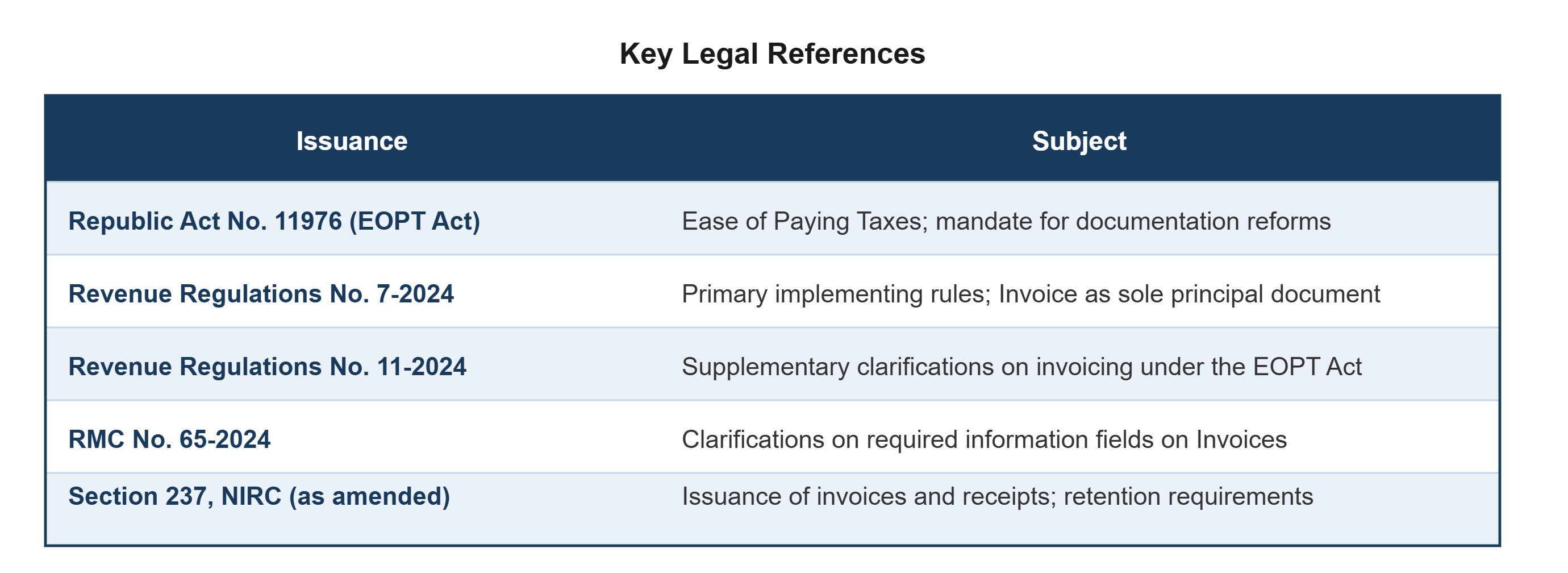
Key Legal References
Conclusion
The shift from Official Receipts to Invoices as the principal tax document in the Philippines is not a minor administrative update, it is a structural change to how every business transaction is recorded, supported, and audited. The EOPT Act and its implementing regulations have fundamentally redefined what constitutes a valid tax document, and the consequences of non-compliance, disallowed input VAT, rejected deductions, and BIR assessments, are concrete and immediate.
For businesses still operating under pre-2024 documentation habits, now is the time to update systems, policies, and supplier relationships. The rules are final. The compliance burden is yours.
References
Republic of the Philippines. Republic Act No. 11976, Ease of Paying Taxes (EOPT) Act. Congress of the Philippines, 2024.
Bureau of Internal Revenue. Revenue Regulations No. 7-2024: Implementing Rules and Regulations of the EOPT Act on Invoicing. BIR, 2024. https://www.bir.gov.ph
Bureau of Internal Revenue. Revenue Regulations No. 11-2024: Supplementary Clarifications on Invoicing Requirements. BIR, 2024. https://www.bir.gov.ph
Bureau of Internal Revenue. Revenue Memorandum Circular No. 65-2024: Clarifications on Required Invoice Information Fields. BIR, 2024.
Bureau of Internal Revenue. National Internal Revenue Code (NIRC), Section 237, Issuance of Invoices and Receipts, as amended. https://www.bir.gov.ph
Upcloud Accounting: Virtual Outsourced Accounting and Bookkeeping Services in the Philippines
Upcloud Accounting offers accounting, bookkeeping, tax compliance, and business licensing services specializing with startups and SMEs in the Philippines.
Our goal is to increase efficiency, automation, and transparency across the accounting and finance functions of our clients with our cutting-edge technology. If you want to move your company’s finance function online, contact our Team of Expert Accountants and Bookkeepers directly via [email protected] or visit www.upcloudaccounting.comto learn more about how Upcloud Accounting accounting services can support your PH business!
Disclaimer: This article or blog is only for general knowledge and guidance and is not a substitute for an expert opinion. For technical advice, please consult your tax / legal advisor for your specific business concerns. For comments, suggestions, and feedback, feel free to email us at [email protected].