Why US Small Businesses Are Outsourcing Their Accounting to the Philippines (And Saving Up to 70%)
Published Date: June 20, 2026
Published By: Jac Cantos, Upcloud Accounting
What if you could cut your accounting costs by more than half, without cutting corners on accuracy, compliance, or professionalism?
That's not a marketing promise. It's a financial reality that thousands of US small business owners are already living. Over the past decade, the Philippines has emerged as one of the world's leading destinations for outsourced accounting and bookkeeping services, attracting startups, freelancers, e-commerce operators, and growing SMEs from across the United States. The reason is straightforward: the cost arbitrage between US-based accounting staff and equally qualified Filipino accountants is significant, and the quality gap that many business owners fear simply does not exist.
1. The Cost Gap Is Real, and It's Large
The most compelling reason US businesses outsource to the Philippines is cost. According to the U.S. Bureau of Labor Statistics (BLS), the median annual wage for bookkeeping, accounting, and auditing clerks in the United States was $47,440 in 2023, with full-charge bookkeepers and staff accountants in metropolitan areas regularly commanding $55,000–$75,000 per year when you factor in benefits, payroll taxes, and overhead.1
By contrast, a skilled Filipino accountant or bookkeeper working for an outsourced accounting firm typically costs a US client between $8,000 and $18,000 per year, inclusive of management, software tools, and quality review processes.2 That represents a cost reduction of 60% to 70% for comparable work.
This is not about exploiting cheap labor. The Philippines has a mature, professional accounting workforce governed by the Professional Regulation Commission (PRC) and the Philippine Accountancy Act of 2004 (Republic Act No. 9298), which sets rigorous licensure requirements for Certified Public Accountants (CPAs).3 Filipino CPAs must pass the Licensure Examination for Certified Public Accountants, a comprehensive board exam administered by the PRC Board of Accountancy, before they can practice.
Cost Snapshot: A full-time US bookkeeper costs approximately $50,000–$70,000/year in total compensation. The equivalent outsourced role in the Philippines typically runs $9,000–$15,000/year, a savings of $35,000–$55,000 annually for a single position.
2. The Philippines Is Built for This Kind of Work
The Philippines' emergence as a global outsourcing hub is not accidental. It is the result of decades of deliberate investment in English-language education, professional services training, and business process outsourcing (BPO) infrastructure.
English proficiency is foundational. The Philippines consistently ranks among the top non-native English-speaking countries in the world. The EF English Proficiency Index 2023 ranked the Philippines 2nd in Asia for English proficiency, with a score placing it in the "Very High Proficiency" tier.4 This matters for accounting work: financial reporting, client communication, audit documentation, and software interfaces are all conducted in English with no friction.
BPO sector maturity is equally important. The IT and Business Process Association of the Philippines (IBPAP) reports that the Philippine BPO industry generated over $29.49 billion in revenues in 2022, employing more than 1.44 million full-time employees.5 Finance and accounting outsourcing (FAO) is one of the sector's fastest-growing verticals, with demand from the US, Australia, and the United Kingdom driving consistent year-over-year expansion.
Filipino accounting professionals are trained in US GAAP, IFRS, and are deeply familiar with US tax concepts, payroll structures, and financial reporting conventions, making the transition far smoother than most business owners anticipate.
3. Cloud Technology Has Eliminated the Distance Barrier
A decade ago, outsourcing accounting overseas required clunky file transfers, version control nightmares, and significant trust gaps. That world no longer exists.
Modern cloud accounting platforms have made geographic distance functionally irrelevant for bookkeeping and accounting work. Platforms such as QuickBooks Online, Xero, FreshBooks, and Wave allow US business owners and their Philippine accounting teams to work in the same books, in real time, from opposite sides of the world.
According to Intuit's 2023 QuickBooks Global Accountant Survey, over 70% of accounting firms globally now use cloud-based software as their primary platform, with cross-border collaboration cited as a key driver of adoption.6 The Philippines ranks among the highest in Asia for QuickBooks and Xero certification rates, reflecting the workforce's active alignment with tools US businesses already use.
Beyond accounting software, tools like Slack, Zoom, Google Workspace, and Microsoft Teams ensure that communication with an outsourced Philippine team is no different from communicating with a remote employee in another US time zone.
4. Time Zone Alignment Works in Your Favor
One practical concern US business owners raise is time zone differences. The Philippines is in Philippine Standard Time (PST), which is UTC+8, 12 to 15 hours ahead of US time zones depending on daylight saving time. At first glance, this sounds like a significant operational challenge.
In practice, it is often an advantage.
Many Philippine outsourced accounting teams offer flexible or overlapping shift arrangements, working evening Philippine hours to align with US business hours. Others operate on an asynchronous workflow model: US business owners submit tasks, receipts, or queries at the end of their workday, and Philippine accountants complete the work overnight, delivering results first thing the next US morning. This effectively gives small businesses a "while you sleep" back-office operation, transactions reconciled, reports generated, and invoices processed before the business owner has had their first cup of coffee.
For businesses that require real-time collaboration, many Philippine outsourcing firms, including Upcloud Accounting, offer dedicated teams that work partially on US business hours to ensure live communication windows.
5. Quality Control, Data Security, and Professional Standards
The most important concern for US business owners is not cost, it's trust. Can a remote team in the Philippines really handle my books with the same accuracy and confidentiality as a local accountant?
The answer, with the right partner, is yes. Here is what to look for:
Professional Credentials: Ensure the accounting firm employs licensed CPAs or accounting professionals with demonstrable credentials. In the Philippines, CPAs are licensed under RA 9298 and are subject to continuing professional education (CPE) requirements administered by the PRC.
Data Security Protocols: Reputable Philippine accounting firms operate under documented data security policies. Look for firms that reference compliance with the Philippine Data Privacy Act of 2012 (Republic Act No. 10173), which imposes obligations on personal data processors comparable in spirit to US frameworks. Firms should also use encrypted file transfer, role-based access controls, and non-disclosure agreements.
AICPA Engagement Standards: While Philippine accountants are not subject to AICPA jurisdiction, US business owners should ensure their engagement letter with an outsourced accounting provider clearly defines the scope of services, deliverables, turnaround commitments, and liability boundaries, consistent with best practices outlined in AICPA's Statement on Standards for Accounting and Review Services (SSARS).
Software Access Controls: Use the accountant access or advisory role in QuickBooks Online or Xero, these roles allow your outsourced accountant to work within your books without having full administrative control over banking credentials or payment approvals.
6. Real Savings, Real Use Cases
Consider the following scenarios where outsourcing to the Philippines delivers measurable ROI for US small businesses:
E-commerce operators with high transaction volumes often spend 15–20 hours per week on bookkeeping. At $50/hour for a US bookkeeper, that is $3,000–$4,000 per month, or up to $48,000 per year. A comparable outsourced Philippine bookkeeper handling the same volume typically costs $800–$1,500/month.
Freelancers and independent contractors who previously handled their own books, at the cost of billable hours, can outsource basic bookkeeping for $300–$600/month and reclaim 10+ hours weekly for income-generating work.
Growing SMEs that need a fractional controller or full-charge bookkeeper but cannot yet justify a full-time US hire can access that level of expertise at fractional cost through Philippine outsourcing, scaling hours as the business grows.
Common Mistakes US Businesses Make When Outsourcing Accounting
Choosing on price alone: without verifying credentials, references, or data security practices.
Not establishing a clear scope of work: vague engagement terms lead to missed deliverables and cost overruns.
Skipping onboarding: the first 30 days of an outsourced engagement require active knowledge transfer; businesses that rush this phase experience the most friction.
Failing to retain oversight: outsourcing accounting is not the same as abandoning it. Business owners should review monthly reports, reconcile key accounts quarterly, and maintain an audit trail.
Not using cloud-native software: attempting to outsource while still using desktop-only accounting software creates unnecessary friction and limits collaboration.
Key References
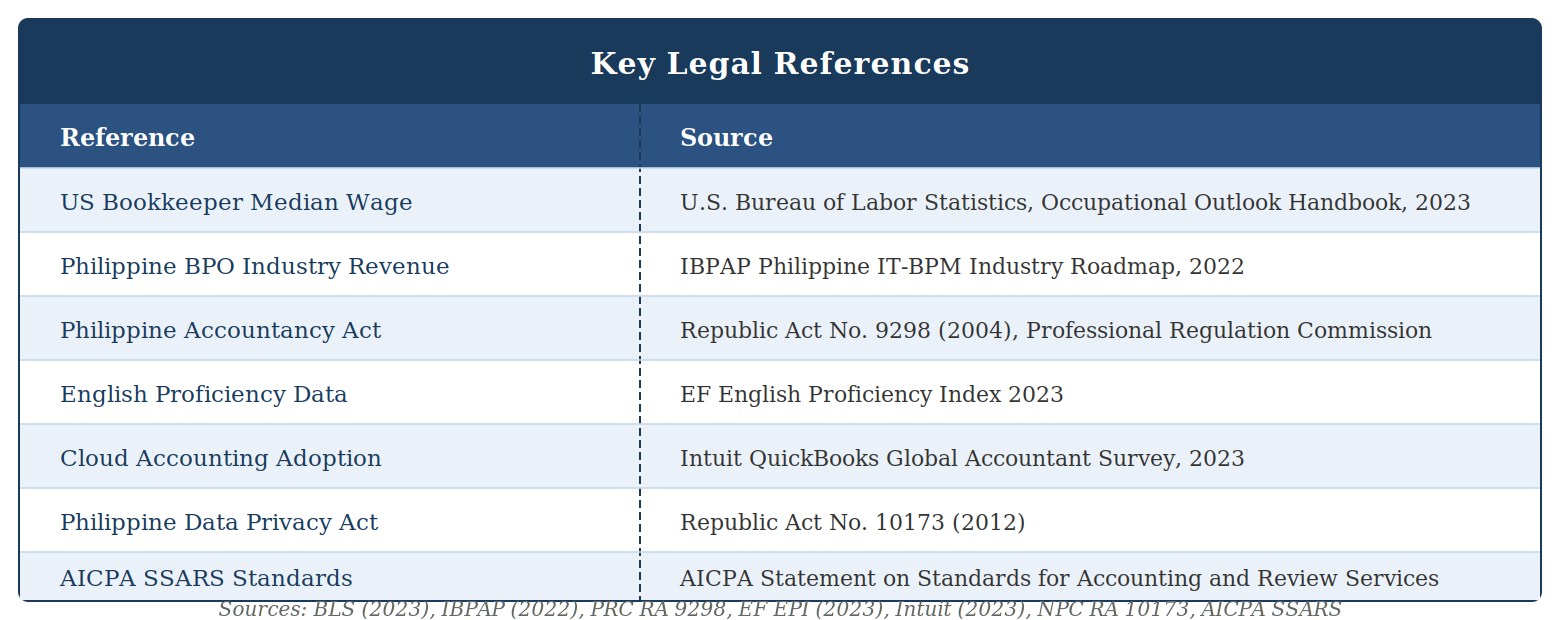
References
U.S. Bureau of Labor Statistics. Occupational Outlook Handbook: Bookkeeping, Accounting, and Auditing Clerks. Updated April 2024. https://www.bls.gov/ooh/office-and-administrative-support/bookkeeping-accounting-and-auditing-clerks.htm ↩
Outsource Accelerator. Guide to Outsourcing Accounting to the Philippines. 2023. https://www.outsourceaccelerator.com/articles/outsourcing-accounting-philippines/ ↩
Republic Act No. 9298. Philippine Accountancy Act of 2004. Professional Regulation Commission, Republic of the Philippines. https://www.prc.gov.ph/accountancy ↩ ↩2
EF Education First. EF English Proficiency Index 2023. https://www.ef.com/epi ↩
IT and Business Process Association of the Philippines (IBPAP). Philippine IT-BPM Industry Report 2022. https://www.ibpap.org ↩
Intuit Inc. QuickBooks Global Accountant Survey. 2023. https://quickbooks.intuit.com/accountants/ ↩
Republic Act No. 10173. Data Privacy Act of 2012. National Privacy Commission, Republic of the Philippines. https://www.privacy.gov.ph ↩
American Institute of Certified Public Accountants (AICPA). Statement on Standards for Accounting and Review Services (SSARS). https://www.aicpa-cima.com/resources/article/ssars ↩
Upcloud Accounting: Virtual Outsourced Accounting and Bookkeeping Services in the Philippines
Upcloud Accounting provides reliable, tech-enabled virtual accounting and bookkeeping services designed for startups, freelancers, and growing small businesses across the United States. Our team of experienced accountants and bookkeepers delivers streamlined financial management so you can focus on scaling your business, without worrying about the back-office workload.
We specialize in increasing efficiency, automation, and transparency across your financial operations using modern cloud accounting tools. Whether you're a solo entrepreneur or an expanding company, our flexible and affordable bookkeeping plans ensure you get expert support at every stage of growth. For inquiries, contact our team at [email protected] or visit www.upcloudaccounting.com to learn more.
Disclaimer: This content is for general informational purposes only and should not be considered professional financial or legal advice. For guidance tailored to your specific business needs, please consult with a licensed accountant or tax advisor. For questions, comments, or feedback, feel free to email us at[email protected].