Year-End Tax Compliance Checklist for Philippine MSMEs
Published Date: June 27, 2026
Published By: Jac Cantos, Upcloud Accounting
For most micro, small, and medium enterprises (MSMEs) in the Philippines, the fourth quarter is not just the busiest season for business, it is also the most compliance-intensive period of the year. Annual income tax returns, mandatory book closing, alpha list submissions, employee tax certificates, government contribution reconciliations, and SEC reportorial requirements all converge in the final months of the calendar year and spill over into the first quarter of the next.
Missing a year-end deadline is never just a paperwork issue. Late filings trigger penalties, surcharges, and interest under the National Internal Revenue Code (NIRC). Accumulated lapses can escalate into a BIR audit. And for corporations, failure to file required SEC reports on time can lead to administrative fines or suspension of registration.
This checklist is designed to help Philippine MSMEs, sole proprietors, partnerships, and corporations alike, complete their year-end compliance obligations systematically, on time, and without costly surprises.
Why Year-End Compliance Is Different for MSMEs
Large corporations typically have dedicated tax and finance teams that manage year-end compliance as a structured internal process. MSMEs rarely have that luxury. For most small business owners, year-end compliance competes directly with peak season operations, staff holidays, and cash flow pressures.
What makes year-end compliance particularly consequential is the compounding effect of accumulated gaps. A business that has been filing returns on time throughout the year but has maintained inaccurate books, miscalculated withholding taxes, or failed to reconcile government remittances will discover all of these problems at year-end, simultaneously, under deadline pressure.
The checklist that follows is organized into eight categories, each covering a distinct area of year-end compliance. Working through them systematically before December 31 gives your business the best chance of a clean close and a penalty-free first quarter.
Checklist 1: Books of Accounts - Close, Reconcile, and Register
Your books of accounts are the foundation of every tax return you will file. Year-end is the point at which your books must be closed, reconciled, and verified to be complete and accurate.
Close all subsidiary ledgers and reconcile to the general ledger. Every subsidiary ledger, accounts receivable, accounts payable, inventory, fixed assets, must be reconciled to the corresponding general ledger control account. Discrepancies identified at year-end are far less costly to resolve before the books are formally closed than after a tax return has been filed.
Reconcile bank accounts to book balances. Prepare a bank reconciliation statement for every bank account as of December 31. Unreconciled items, outstanding checks, undeposited collections, bank charges not yet recorded, must be identified and either cleared or appropriately recorded before year-end.
Verify the completeness of recorded sales and purchases. Under the matching principle, revenue earned and expenses incurred during the year must be recorded in the same period, regardless of when cash was received or paid. Review for unrecorded accruals, advances received, or expenses paid in advance that affect the current period.
Register new or renewal of books of accounts via ORUS. Under BIR RMC No. 004-2026, all books of accounts, manual, loose-leaf, and computerized, must be registered through the BIR Online Registration and Update System (ORUS). For manual books that are fully used up during the year, new books must be registered before use. For loose-leaf and CAS users, ensure your current registration and QR codes are in order.
Retain books for the required period. Under Section 235 of the NIRC, books of accounts and accounting records must be preserved for ten (10) years from the last entry date. Do not dispose of records from recent years.
Reference: Section 232–235, NIRC as amended; BIR RMC No. 004-2026
Checklist 2: Income Tax - Compute, Reconcile, and Prepare
The Annual Income Tax Return (AITR) is the single most significant tax filing of the year. Year-end preparation for the AITR should begin no later than November, not in April when the deadline looms.
Compute taxable income and compare against quarterly ITR filings. Add up your four quarterly income tax returns (BIR Form 1701Q for individuals; BIR Form 1702Q for corporations) and verify that the cumulative figures reconcile with your year-end books. Differences between quarterly filings and the annual return are a common audit trigger.
Review allowable deductions for completeness. Under Section 34 of the NIRC, businesses may deduct ordinary and necessary business expenses. Year-end is the time to ensure all deductible expenses are supported by BIR-registered Invoices, contracts, payroll records, or other valid documentation. Expenses without proper documentation are not deductible.
Assess optional standard deduction (OSD) vs. itemized deductions. Individual taxpayers (sole proprietors and professionals) may choose between itemized deductions and the 40% Optional Standard Deduction (OSD) on gross sales or receipts. Corporations may also elect the OSD at 40% of gross income. Compare both methods to determine which results in a lower tax liability for the current year.
Review creditable withholding taxes. Compile all BIR Form 2307 certificates issued to your business by customers who withheld expanded withholding tax on their payments to you. These are creditable against your annual income tax liability. Missing Form 2307s must be requested from customers before the AITR is filed.
Check for excess minimum corporate income tax (MCIT) credits. Corporations subject to the 2% Minimum Corporate Income Tax (MCIT) under Section 27(E) of the NIRC may carry forward any MCIT paid in excess of the regular income tax for up to three immediately succeeding taxable years. Review your MCIT position at year-end.
Note the AITR filing deadline. The AITR is due on April 15 of the following year (or the applicable extended deadline, if any, announced by the BIR for the current year). However, corporations whose fiscal year does not coincide with the calendar year must file within 60 days from the close of their fiscal year.
Reference: Sections 27, 34, 43, 74–77, NIRC as amended by RA 10963 (TRAIN Law); BIR Form 1701 / 1701A / 1702
Checklist 3: Value-Added Tax (VAT) - Final Quarter and Annual Reconciliation
VAT-registered businesses have monthly and quarterly filing obligations throughout the year. Year-end adds an additional layer: reconciling the full year's VAT position and ensuring the Q4 return is accurate and complete.
File the Q4 VAT return (BIR Form 2550Q) on time. The Q4 VAT return covers October to December and is due on the 25th day of the month following the close of the quarter (i.e., January 25 of the following year). Do not let the holiday season delay this filing.
Reconcile total output VAT with recorded gross sales. Your total output VAT declared across all four quarterly returns for the year must reconcile with your total gross sales or receipts as reported in your books and your AITR. Discrepancies are a common source of BIR audit findings and deficiency VAT assessments.
Reconcile total input VAT with recorded purchases. Similarly, input VAT claimed throughout the year must reconcile with your total purchases from VAT-registered suppliers. Input VAT claimed without a corresponding VAT Invoice may be disallowed.
Verify that all Invoices received from suppliers are BIR-compliant. Following the implementation of RR 7-2024, only properly issued Invoices (not Official Receipts) qualify as valid input VAT documents. Any Official Receipts from suppliers issued after December 31, 2024 and used to support input VAT claims are likely to be disallowed during audit.
Submit the Q4 Summary List of Sales and Purchases (SLSP). VAT-registered taxpayers must submit their quarterly SLSP (alphalist of sales and purchases) within 25 days after the close of each quarter. The Q4 SLSP is due in January of the following year alongside the Q4 VAT return.
Reference: Sections 110–114, NIRC as amended; BIR Form 2550M / 2550Q; BIR RR 7-2024
Checklist 4: Withholding Taxes, Reconcile and Issue Certificates
Withholding tax compliance is one of the most audit-sensitive areas of year-end compliance for Philippine MSMEs. The BIR cross-matches alphalist data from multiple sources, making discrepancies easy to detect.
Reconcile withholding tax remittances for the full year. Total withholding taxes remitted on BIR Forms 1601-C (compensation) and 1601-EQ / 0619-E (expanded withholding) for all twelve months must reconcile with the amounts to be reported in the annual information returns (BIR Forms 1604-C and 1604-E). Discrepancies between monthly remittances and annual reports are a red flag in BIR examination.
Prepare and issue BIR Form 2316 to all employees. Every employer is required to issue BIR Form 2316 (Certificate of Compensation Payment / Tax Withheld) to each employee on or before January 31 of the following year, or on the last day of employment if the employee resigns or is separated before year-end. Form 2316 reflects the employee's total compensation and total withholding tax for the year.
File BIR Form 1604-C (Annual Information Return of Compensation) by January 31. This return summarizes all compensation paid and taxes withheld from employees during the year. It must be filed electronically via eFPS or eBIRForms on or before January 31 of the following year.
File BIR Form 1604-E (Annual Information Return of Expanded Withholding Tax) by March 1. This return covers all expanded withholding tax remitted on non-compensation payments (professional fees, rent, commissions, etc.) during the year. The deadline is March 1 of the following year.
Issue BIR Form 2307 to all payees from whom you withheld expanded withholding tax. For every payment on which you withheld expanded withholding tax during Q4, professional fees, rent, commissions, contractor payments, you must issue the corresponding BIR Form 2307 to the payee within 20 days from the close of the taxable quarter.
Reference: Sections 79–83, NIRC as amended; RR No. 11-2018; BIR Forms 1601-C, 1604-C, 1604-E, 2307, 2316
Checklist 5: Government Contributions, SSS, PhilHealth, and Pag-IBIG Reconciliation
Year-end is the time to verify that every peso of mandatory government contributions has been correctly computed, deducted, and remitted, and that your records are complete for audit purposes.
Reconcile SSS contributions for the full year. Verify that the total SSS contributions remitted for all employees across all twelve months match your payroll records. Confirm that newly hired employees were enrolled with SSS upon hiring, and that separated employees' last contributions were remitted on time.
Reconcile PhilHealth premiums for the full year. Verify total PhilHealth premium remittances against your payroll records. As of 2025–2026, the applicable premium rate is 5% of basic monthly salary (shared equally between employer and employee at 2.5% each), subject to the applicable salary floor and ceiling under PhilHealth Circular No. 2023-0009.
Reconcile Pag-IBIG Fund contributions for the full year. Verify total Pag-IBIG contributions remitted for all employees. Confirm that contributions are correctly computed under the applicable brackets per Pag-IBIG Fund Circular No. 274.
Obtain contribution verification from each agency portal. Log in to the My.SSS portal, PhilHealth ePRS, and Pag-IBIG Virtual Pag-IBIG to download official remittance histories for the year. These records are essential if discrepancies arise during a BIR or DOLE inspection.
Prepare contribution reconciliation schedules. For each agency, prepare a schedule reconciling monthly payroll deductions per employee to total remittances. This document supports both internal controls and external audit readiness.
Reference: RA 11199 (SSS); RA 11223 and PhilHealth Circular No. 2023-0009 (PhilHealth); RA 9679 and Pag-IBIG Fund Circular No. 274 (Pag-IBIG)
Checklist 6: SEC Reportorial Requirements (for Corporations)
Corporations registered with the Securities and Exchange Commission carry annual reportorial obligations that are separate from BIR filings and operate on their own deadlines.
Prepare Audited Financial Statements (AFS). Most corporations are required to submit Audited Financial Statements for the fiscal year, prepared in accordance with Philippine Financial Reporting Standards (PFRS) and audited by an independent CPA accredited with the BOA. Engage your external auditor early, audit timelines are compressible only to a point, and delays in providing complete books will delay the audit.
Check eligibility for the SEC Php 3M audit exemption. Under SEC Memorandum Circular No. 4-2026, corporations with total assets and total liabilities each at Php 3,000,000 or below may file unaudited financial statements accompanied by a Statement of Management Responsibility (SMR) instead of audited financials. Verify whether your corporation qualifies before engaging an auditor.
File the General Information Sheet (GIS) within 30 days of the annual meeting. The GIS must be filed with the SEC within 30 calendar days from the date of the corporation's annual stockholders' or members' meeting. Update all information on officers, directors, stockholders, and paid-up capital accurately.
Note the AFS submission deadline. Under the staggered schedule in SEC MC No. 4-2026, the deadline for AFS submission for standard corporations for FY 2025 was June 15, 2026. For FY 2026, the standard deadline will be May 15, 2027 (subject to extension announcements from the SEC).
Reference: RA 11232 (Revised Corporation Code); SEC Memorandum Circular No. 4-2026; SEC MC No. 2-2020
Checklist 7: Business Permits and Registrations, Renewals Due in January
The first month of every new year is also renewal season for business permits and government registrations. Year-end is the time to prepare, not January 1.
Renew the BIR Annual Registration (BIR Form 0605) by January 31. Every registered taxpayer must pay the Annual Registration Fee of Php 500 using BIR Form 0605 on or before January 31 of each year. This is a fixed annual obligation that applies regardless of the volume of business activity.
Prepare documents for Mayor's Permit / Business Permit renewal. LGU business permit renewals are typically due in January of each year. Required documents commonly include the previous year's business permit, proof of BIR registration, barangay clearance, and proof of payment of local business taxes. Requirements vary by LGU, check your specific city or municipality's renewal requirements in advance.
Renew DTI business name registration if expiring (Sole Proprietors). DTI business name registrations are valid for five years from the date of registration. If your registration is due for renewal, file the renewal application at the DTI or through the BNRS online portal before it lapses.
Review the validity of BIR-registered invoices and receipts. Check whether your current stock of BIR-registered Invoices remains valid and has sufficient quantity for the coming year. If approaching exhaustion, file a new BIR Form 1906 (Application for Authority to Print) before you run out. Issuing unregistered or expired documents is a compliance violation.
Reference: BIR Form 0605; BIR Form 1906; RA 3883 (DTI Business Name Law); Local Government Code (LGU permit renewal)
Checklist 8: Financial Statements and Reporting Standards
Year-end financial statement preparation involves not just accurate numbers but also compliance with applicable reporting standards and disclosure requirements.
Apply current PFRS / PAS standards consistently. Ensure your financial statements are prepared in accordance with the applicable reporting framework, full PFRS for corporations required to file with the SEC, or the PFRS for Small Entities for qualifying smaller entities. Consistency with prior-year treatment is required unless a change in accounting policy is explicitly disclosed.
Update accounting policy disclosures in line with the PAS 1 amendment. Following the AASC-issued amendment to PAS 1, notes to financial statements must now disclose "material accounting policy information" rather than a summary of all significant policies. Work with your accountant or auditor to ensure notes reflect only material policies applicable to your business's actual transactions.
Assess the impact of PFRS 18 (effective 2027) on your income statement structure. PFRS 18, which replaces PAS 1 and is effective for annual periods beginning January 1, 2027, introduces new required subtotals in the income statement. Year-end 2026 financial statements are the last set prepared under the current structure, use this year-end to map your current income statement categories against the new PFRS 18 requirements so you are not scrambling in 2027.
Prepare comparative financial statements. Financial statements must present at least two years of comparative figures, the current year and the immediately preceding year. Ensure prior-year figures used for comparison agree with the prior-year audited or filed financial statements.
Review for subsequent events. Under PAS 10 (Events After the Reporting Period), significant events occurring between December 31 and the date the financial statements are authorized for issue must be assessed. Adjusting events (those that provide evidence of conditions existing at year-end) must be reflected in the year-end figures; non-adjusting events (those that arise after year-end) must be disclosed.
Reference: PFRS for Small Entities; PAS 1 Amendment (AASC); PFRS 18 (effective Jan 1, 2027); PAS 10
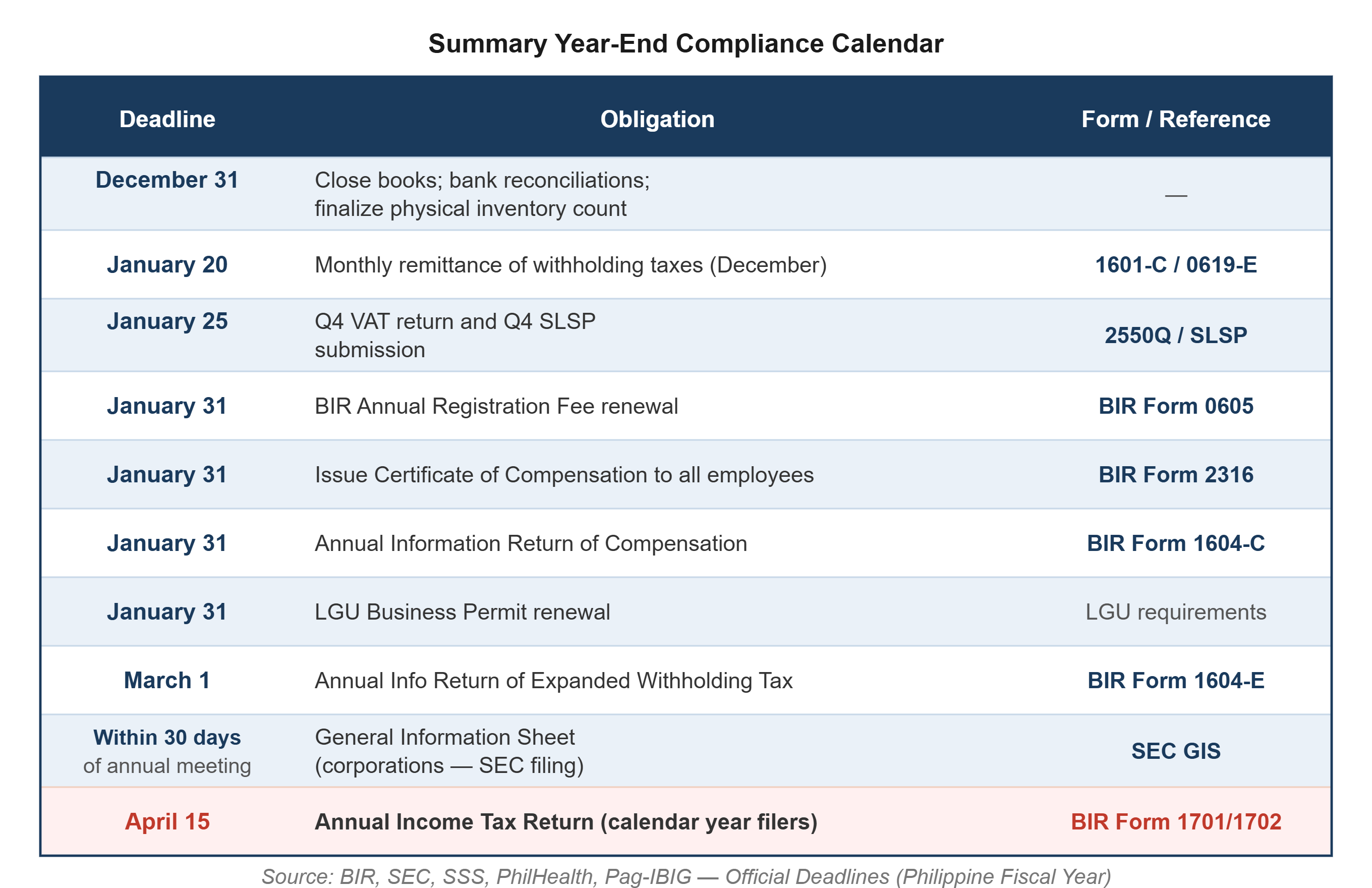
Summary Year-End Compliance Calendar
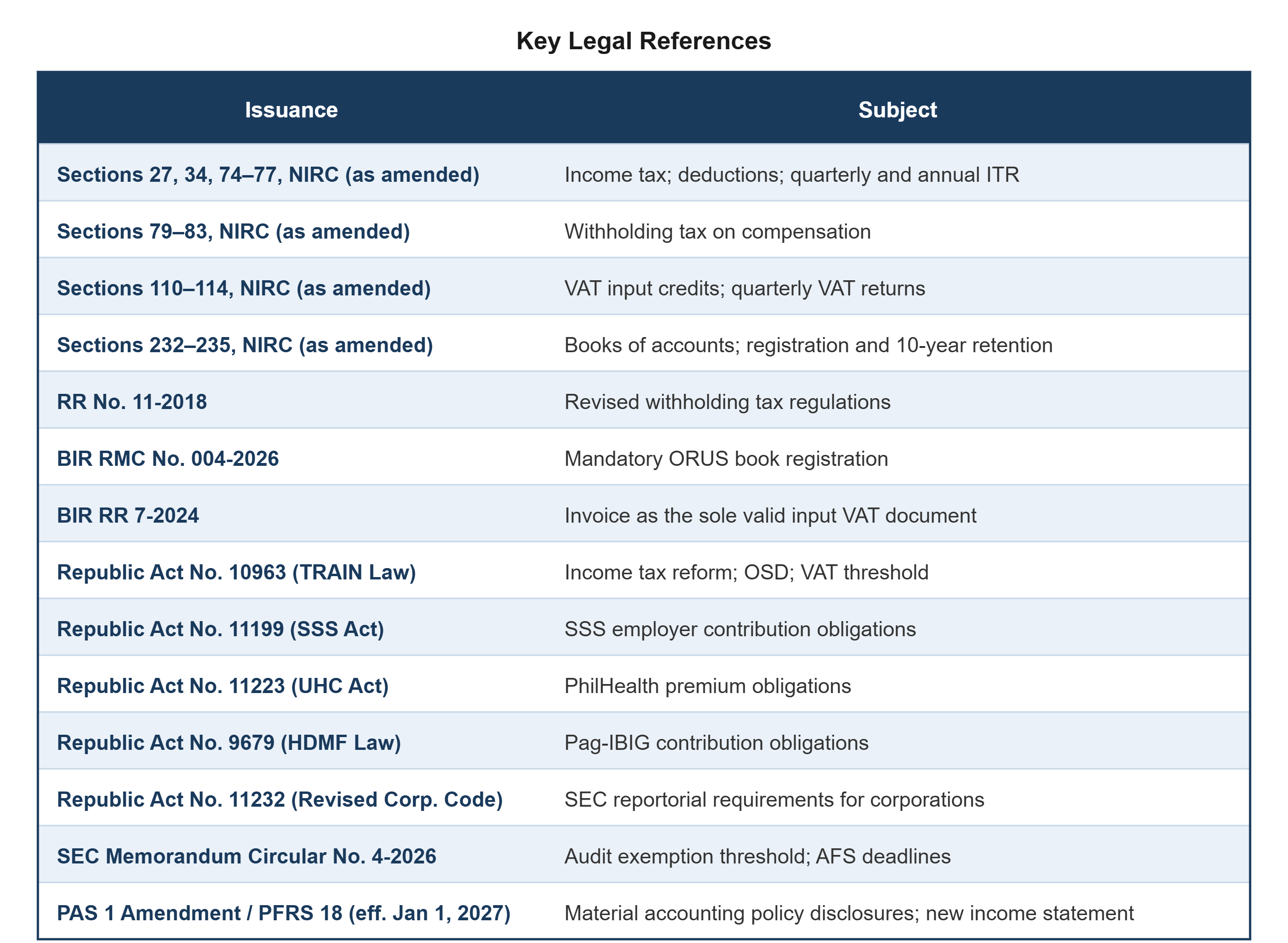
Key Legal References
Conclusion
Year-end tax compliance for Philippine MSMEs is not a single task, it is a structured sequence of obligations that spans bookkeeping, income tax, VAT, withholding taxes, government contributions, corporate reporting, and permit renewals. Each category has its own deadlines, its own documentation requirements, and its own penalty regime for non-compliance.
The businesses that close the year cleanly are those that treat compliance as a year-round discipline, not a last-minute scramble. Working through this checklist systematically, beginning no later than October, gives your business the time to identify gaps, correct errors, and file confidently before every deadline passes.
If you need support closing your books, preparing your annual returns, or managing your year-end compliance obligations, a licensed accountant can help ensure nothing is missed.
References
Bureau of Internal Revenue. National Internal Revenue Code of the Philippines (NIRC), as amended by RA 10963 (TRAIN Law). https://www.bir.gov.ph
Bureau of Internal Revenue. Revenue Regulations No. 11-2018: Revised Withholding Tax Regulations. BIR, 2018.
Bureau of Internal Revenue. Revenue Regulations No. 7-2024: Invoicing Requirements under the EOPT Act. BIR, 2024.
Bureau of Internal Revenue. Revenue Memorandum Circular No. 004-2026: Mandatory ORUS Book Registration. BIR, 2026. https://www.bir.gov.ph
Republic of the Philippines. Republic Act No. 11199 — Social Security Act of 2018. https://www.sss.gov.ph
Republic of the Philippines. Republic Act No. 11223 — Universal Health Care Act. PhilHealth Circular No. 2023-0009. https://www.philhealth.gov.ph
Republic of the Philippines. Republic Act No. 9679 — Home Development Mutual Fund Law of 2009. Pag-IBIG Fund Circular No. 274. https://www.pagibigfund.gov.ph
Republic of the Philippines. Republic Act No. 11232 — Revised Corporation Code of the Philippines. SEC Memorandum Circular No. 4-2026. https://www.sec.gov.ph
Financial Reporting Standards Council (FRSC). PAS 1 Amendment — Disclosure of Material Accounting Policy Information; PFRS 18 (effective January 1, 2027). https://www.frsc.gov.ph
Auditing and Assurance Standards Council (AASC). AASC Alert: Conforming Amendments to PSAs on Accounting Policy Disclosures. AASC, 2026.
Upcloud Accounting: Virtual Outsourced Accounting and Bookkeeping Services in the Philippines
Upcloud Accounting offers accounting, bookkeeping, tax compliance, and business licensing services specializing with startups and SMEs in the Philippines.
Our goal is to increase efficiency, automation, and transparency across the accounting and finance functions of our clients with our cutting-edge technology. If you want to move your company’s finance function online, contact our Team of Expert Accountants and Bookkeepers directly via [email protected] or visit www.upcloudaccounting.comto learn more about how Upcloud Accounting accounting services can support your PH business!
Disclaimer: This article or blog is only for general knowledge and guidance and is not a substitute for an expert opinion. For technical advice, please consult your tax / legal advisor for your specific business concerns. For comments, suggestions, and feedback, feel free to email us at [email protected].